21Shares Makes Staking Explicit Across Five US Crypto ETFs
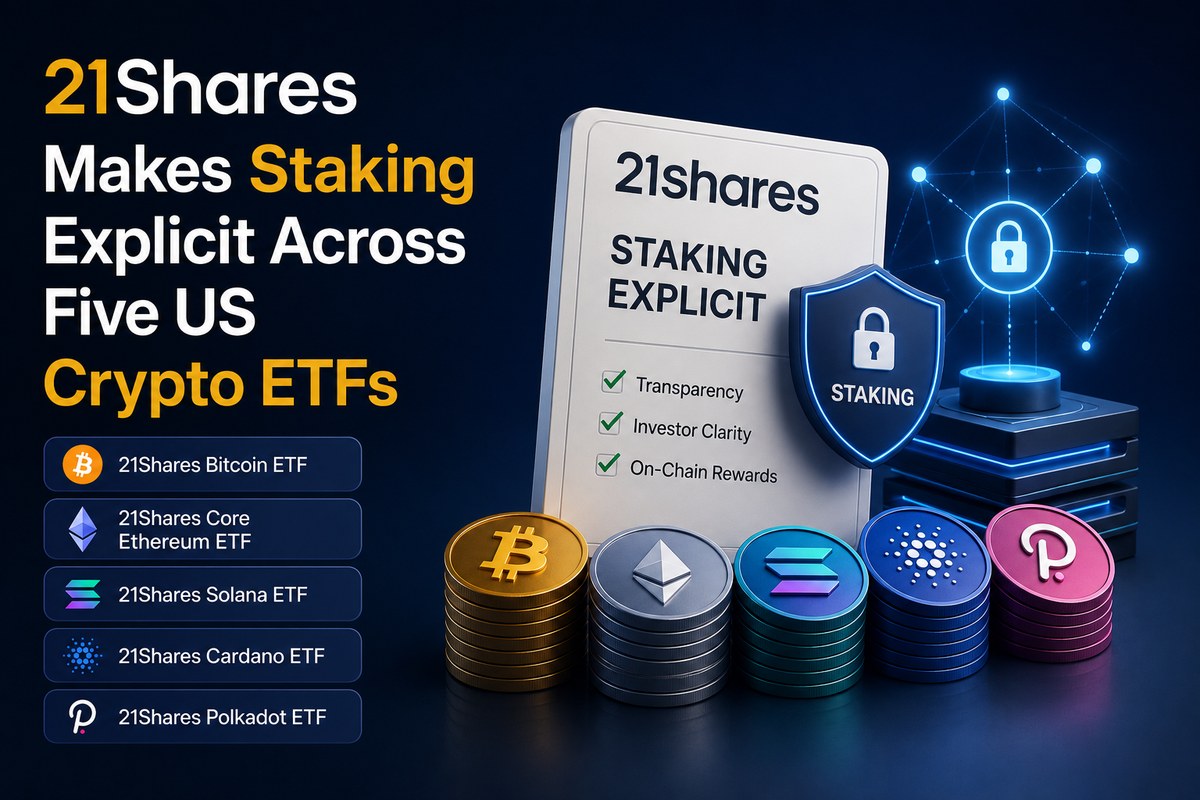
21Shares has made staking a much more visible part of its US exchange-traded product strategy. On August 27, the issuer renamed five single-asset ETFs so that “Staking” now appears directly in each product name: Ethereum, Solana, Polkadot, Sui and Hyperliquid.
The change is easy to dismiss as branding. It should not be confused, however, with the sudden addition of staking to funds that previously held only passive spot exposure. Regulatory filings show that some of these products were already structured to reflect rewards from staking part of their underlying assets. What changed on August 27 is how explicitly that feature is presented to investors.
That distinction makes this a useful Market Pulse event. The relevant question is not whether ETH, SOL or DOT suddenly became yield-bearing. They already are proof-of-stake assets. The question is whether staking becomes a more standard component of US-listed crypto exposure — and what investors should measure when an ETF tries to combine price tracking, liquidity and protocol rewards.
What happened
21Shares announced that five US-listed products received new names effective at the market open on August 27:
- TETH became the 21Shares Ethereum Staking ETF.
- TSOL became the 21Shares Solana Staking ETF.
- TDOT became the 21Shares Polkadot Staking ETF.
- TSUI became the 21Shares Sui Staking ETF.
- THYP became the 21Shares Hyperliquid Staking ETF.
21Shares listed current staking-yield figures of 0.80% for TETH, 4.45% for TSOL, 2.04% for TDOT, 1.13% for TSUI and 1.33% for THYP. These are disclosed product figures, not guaranteed future returns. Network rewards, the amount of assets staked, validator performance and fund-level costs can all change the outcome over time.
Existing shareholders were not required to take action. According to 21Shares, tickers, CUSIPs, underlying asset exposures, management-fee structures and primary exchange listings remained unchanged.
The SEC filing for TETH independently confirms the change from “21Shares Ethereum ETF” to “21Shares Ethereum Staking ETF.” It also shows another infrastructure change effective August 27: the fund moved from the CME CF Ether-Dollar Reference Rate – New York Variant to the FTSE Ethereum Index for share valuation and NAV calculations.
That benchmark transition is part of a wider 21Shares agreement with FTSE Russell covering several US crypto ETFs. The companies said ARKB, TETH, TSOL, TOXR, TSUI, TDOG and TDOT were moving to corresponding FTSE digital-asset indices, while their underlying exposures, legal structures, custodians, listings and fee schedules remained unchanged.
Why this matters
A conventional spot crypto ETF has a relatively simple objective: provide exposure that closely follows the underlying asset after fees and operational costs.
Staking introduces another layer.
Proof-of-stake tokens can generate protocol rewards when assets participate in network validation. If an ETF stakes part of its holdings and retains rewards for the benefit of the fund, its economic profile is no longer explained solely by the spot price of the token.
That creates a new metric for investors: staking capture efficiency.
For example, the Solana network may offer one level of gross staking rewards while an ETF delivers a different effective contribution to NAV. The difference can reflect how much of the portfolio is actually staked, validator commissions, liquidity buffers, fund expenses, timing and operational constraints.
The headline “staking yield” is therefore only the starting point.
SEC filings for TSOL describe an objective of tracking SOL while reflecting rewards from staking a portion of the fund’s SOL, subject to the sponsor determining that staking can be performed without undue legal or regulatory risk. Polkadot filings use a similar structure and explicitly note network bonding and unbonding periods.
Market reaction: look beyond the token price
There is no sound basis for attributing a short-term move in ETH, SOL, DOT, SUI or HYPE specifically to the ETF name changes. The announcement did not alter the tokens’ protocols, supply schedules or underlying ETF exposures.
The more useful market reaction will emerge in ETF-level data.
One metric is fund flows. If staking becomes a meaningful differentiator, flows into staking-enabled products versus competing spot products can show whether investors value the additional yield component.
Another is the ETF premium or discount to NAV and bid-ask spread. Staking creates a liquidity-management challenge because some underlying tokens may be committed to validators while ETF shares must continue trading normally. Efficient creations and redemptions require the fund to balance reward generation against available liquidity.
This is particularly relevant for networks with bonding or unstaking delays. A fund cannot treat 100% of its assets as permanently locked if it needs operational flexibility.
There is also validator and slashing risk. Staking rewards are not interest paid by a risk-free borrower. They depend on protocol mechanics and validator operations. Depending on the network, validator failures or rule violations can expose staked assets to penalties.
Finally, investors should distinguish gross protocol yield from shareholder outcome. A high staking rate does not automatically mean an ETF will outperform direct token ownership by the same percentage.
Why the FTSE benchmark change also matters
The simultaneous benchmark migration deserves attention because ETF tracking is measured against a reference price.
21Shares and FTSE Russell said seven US products would move to FTSE digital-asset indices on August 27. For TETH, the SEC filing explicitly confirms that NAV calculations switch to the FTSE Ethereum Index.
A benchmark change does not change the underlying token, but it can affect the reference against which tracking quality is evaluated. Market participants should therefore avoid interpreting small changes in reported tracking error around the transition without checking the benchmark methodology.
For MyCoinWay users, this creates a useful comparison between regulated ETF pricing, underlying spot markets and derivatives. Large or persistent differences between ETF pricing, spot prices and funding conditions would be more meaningful than a one-session move following the announcement.
What to watch next
- ETF inflows and outflows: compare staking-branded products with competing spot-only exposure where comparable products exist.
- Effective staking contribution: track disclosed staking yield versus protocol-level rewards and changes in the share of assets actually staked.
- Premiums, discounts and bid-ask spreads: deterioration could indicate that liquidity management becomes more difficult during volatile periods.
- Spot and derivatives conditions: watch unusual volume spikes, inter-exchange spreads and funding rates in ETH, SOL and other affected assets.
- Validator and unstaking risks: protocol disruptions, validator incidents or longer withdrawal queues could matter even when the token price itself is stable.
The core signal is not simply whether “staking ETFs” attract attention. It is whether they can consistently combine protocol rewards with tight tracking and liquid ETF trading.
Disclaimer
This article is for informational and analytical purposes only. It is not investment, legal or tax advice, a recommendation to buy or sell any cryptoasset or ETF, or a promise of future returns. Staking and crypto ETFs involve market, liquidity, custody, validator, smart-contract, protocol and regulatory risks. Staking yields are variable and should not be treated as guaranteed income.
Sources
21Shares — product-name update and disclosed staking yields. Official announcement
SEC — 21Shares Ethereum Staking ETF Form 8-K. SEC filing
SEC — 21Shares Solana ETF prospectus supplement. SEC filing
LSEG / FTSE Russell — global benchmark partnership with 21Shares. FTSE Russell announcement
Yahoo Finance — independent coverage of the ETF changes. Yahoo Finance coverage