Binance Enforces EU Sanctions: How the 14-Platform Ban Warps P2P Liquidity
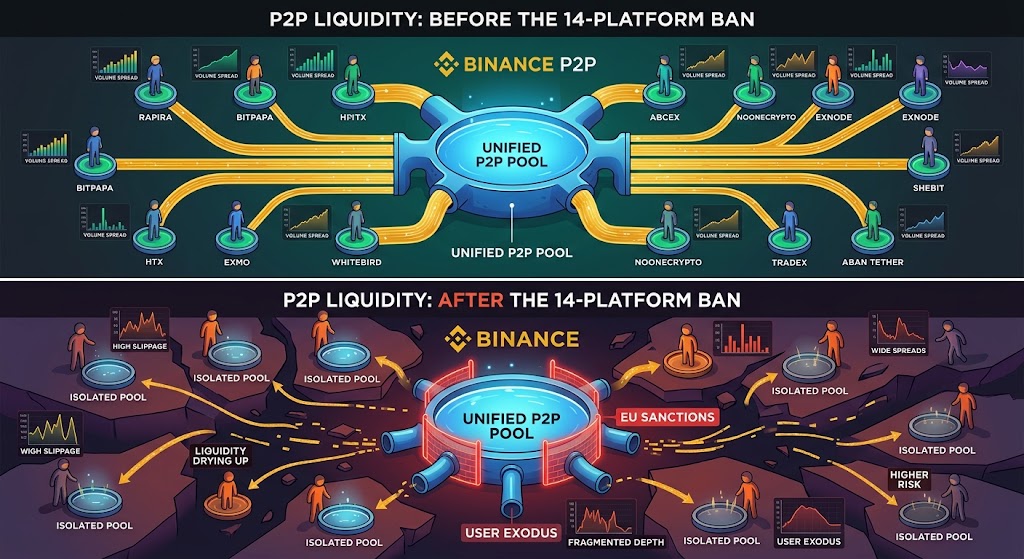
The geopolitical landscape continues to cast a long, definitive shadow over the digital asset ecosystem. On August 14, 2026, the world’s largest cryptocurrency exchange by volume, Binance, executed a sweeping regulatory enforcement action. Following the enactment of the European Union’s 21st sanctions package, which took effect on August 13, Binance officially blocked all transactions and severed API integrations with 14 distinct cryptocurrency platforms.
These 14 entities were explicitly identified by the EU Council as facilitators of sanctions evasion for Russian structures. While the geopolitical implications of this move are vast, as a Senior Editor and Analyst at MyCoinWay, my focus is strictly on the mechanical market fallout. This is not merely a compliance headline; it is a forced "liquidity quarantine" that immediately severs established cross-border arbitrage routes. For active traders, over-the-counter (OTC) desk operators, and peer-to-peer (P2P) merchants, the sudden removal of these 14 platforms from the Binance network fundamentally alters regional liquidity depth and fiat-to-crypto pricing models.
The Mechanics of a Liquidity Quarantine
To understand the severity of this market impact, we must examine how regional liquidity actually flows behind the scenes. P2P merchants and OTC desks rely on a complex, highly efficient web of secondary and tertiary exchanges to maintain tight bid-ask spreads. If fiat is deposited on a regional, lower-tier platform, merchants often instantly hedge or route that capital through a tier-1 mega-exchange like Binance to access deep global liquidity and rebalance their portfolios.
By blocking these 14 platforms, Binance has abruptly severed these critical routing bridges. Market makers and P2P operators can no longer seamlessly transfer assets from these sanctioned entities to the world’s most liquid order books. This creates a severe, mechanical supply-and-demand bottleneck. Capital trapped on the sanctioned platforms becomes highly illiquid, while the broader global market loses a notable chunk of daily arbitrage volume that previously kept regional prices in check.
When cross-exchange routing is restricted, the risk profile for P2P merchants increases significantly. To compensate for the inability to quickly offload or acquire inventory via Binance, these merchants are forced to aggressively adjust their pricing models.
Market Pulse: P2P Spreads and Stablecoin Friction
The immediate, actionable consequence of this regulatory ban is already being felt across the P2P markets, particularly in Eastern Europe and adjacent emerging markets that relied heavily on these specific fiat gateways.
First, we are observing a rapid widening of P2P bid-ask spreads. Merchants who previously offered tight 0.5% to 1% spreads on USDT or USDC are now quoting spreads of 3% or higher in affected fiat corridors. This spread widening acts as a direct "risk premium" for operating in a suddenly fragmented liquidity environment. For retail users attempting to enter or exit the crypto market using local fiat currencies, the cost of doing business has mechanically increased overnight.
Second, this enforcement accelerates a structural flight to safety within the stablecoin sector. Capital is ruthlessly pragmatic. As regulatory nets tighten globally, institutional and high-net-worth liquidity providers are aggressively migrating away from offshore, unregulated stablecoin issuers and rotating capital into fully compliant, heavily audited assets like USDC. Furthermore, they are restricting their custody exclusively to tier-1 platforms. This rapid rotation can cause temporary inter-exchange price deviations as liquidity pools on secondary exchanges dry up, creating fleeting but highly profitable arbitrage windows for traders who have access to compliant, deep-liquidity venues.
Finally, the derivatives market may experience localized volatility. Whenever a major exchange blocks fiat or crypto gateways, it triggers sudden, forced deleveraging for users who relied on those specific pipelines for margin top-ups. If traders are unable to move funds quickly to defend their positions due to the blocked platforms, we could see localized liquidation wicks on specific trading pairs, momentarily distorting perpetual futures funding rates.
What to Track Next
Navigating a market disrupted by geopolitical regulation requires a strict focus on hard data rather than speculative sentiment. Relying on outdated liquidity assumptions will inevitably lead to poor execution.
Here are the critical metrics you must track in the coming days:
- Localized P2P Spreads: Monitor the bid-ask spreads on P2P desks for Eastern European and Central Asian fiat corridors. Persistent wide spreads indicate ongoing liquidity shortages and high friction in fiat-to-crypto onboarding.
- Inter-Exchange Arbitrage Windows: Track price deviations between Binance and secondary exchanges that may still interact with the sanctioned entities. As liquidity fractures, these spreads will widen, offering delta-neutral arbitrage opportunities for compliant traders.
- Stablecoin Dominance Shifts: Watch the circulating supply and exchange balances of major stablecoins like USDT and USDC. A sudden spike in USDC inflows to tier-1 exchanges confirms the institutional flight to regulatory safety.
- Funding Rate Volatility: Keep a close eye on perpetual funding rates. Sudden blockages in capital flows can trap traders, leading to forced liquidations that temporarily skew funding rates into deeply negative or positive territory.
The enforcement of the EU’s 21st sanctions package by Binance proves that regulatory compliance is no longer an isolated legal issue—it directly dictates global market mechanics. To successfully navigate this fragmented liquidity landscape, we highly recommend utilizing the MyCoinWay Market Pulse dashboard. By tracking live P2P spreads, monitoring funding rate divergences, and analyzing real-time order book depth, you can adapt your execution strategies to the new realities of a heavily regulated crypto ecosystem.
Disclaimer: This article is for informational and analytical purposes only. It does not constitute financial, investment, or legal advice. Cryptocurrency markets are highly volatile, and regulatory enforcement actions can lead to unpredictable market behavior. Always conduct your own research before executing trades.
Sources:
- Binance Official Announcements: Update on Platform Restrictions (August 14, 2026).
- United24 Media / The Moscow Times: "Binance Blocks Transactions With 14 Crypto Platforms After New EU Sanctions" (August 14, 2026).