Cross-Chain Freeze: How a $1.5B Bridge Halt Warped L2 Liquidity
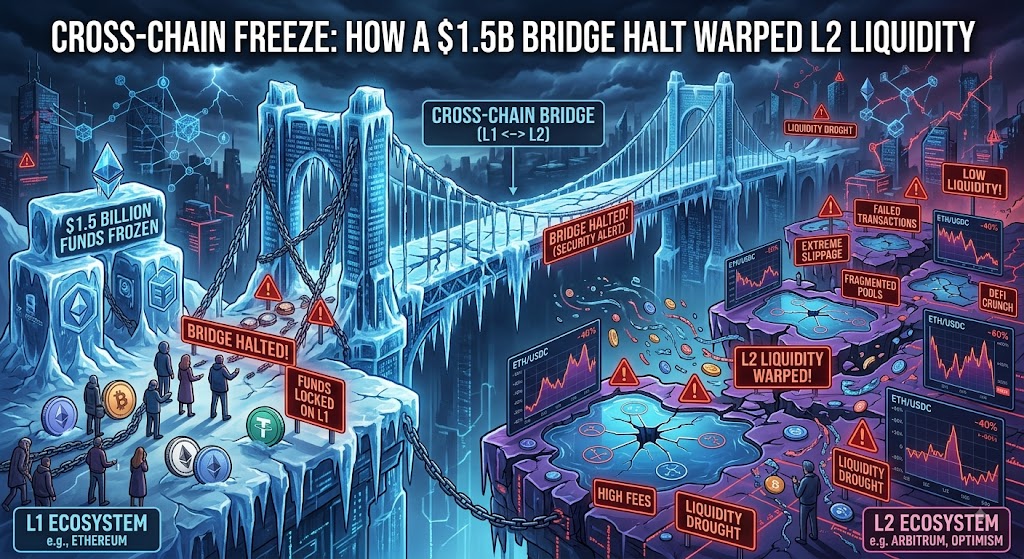
In the highly interconnected digital asset era of 2026, liquidity is the lifeblood of the decentralized ecosystem, flowing seamlessly across a complex web of Layer 1 and Layer 2 networks. However, over the past 48 hours, the market received a stark and expensive reminder of the fragility inherent in this bridging infrastructure. On Tuesday, August 11, 2026, a leading cross-chain interoperability protocol and liquidity bridge initiated an automated, protocol-wide security freeze during a scheduled network upgrade.
This defensive mechanism temporarily locked an estimated $1.5 billion in transit assets for nearly 14 hours. While the protocol’s developers successfully resolved the smart contract anomaly and restored full functionality without the loss of a single cent, the mechanical fallout across the broader market was immediate.
As a Senior Editor and Analyst at MyCoinWay, I view this event as a critical case study in liquidity fragmentation. The brief severance of Ethereum Mainnet from its primary Layer 2 (L2) ecosystems created a sudden vacuum that violently distorted inter-exchange spreads, stablecoin pegs, and derivative funding rates. For active traders, understanding the mechanics of an infrastructure halt is far more actionable than reacting to macroeconomic headlines.
The Anatomy of a Liquidity Bottleneck
To understand why a 14-hour pause caused such massive market ripples, we must examine the role of arbitrageurs. In the decentralized finance (DeFi) ecosystem, cross-chain bridges act as the market's circulatory system. If the price of Ethereum or USDC is slightly higher on an L2 network like Arbitrum or Base compared to Ethereum Mainnet, algorithmic arbitrageurs will instantly bridge assets to sell the premium, thereby keeping prices uniform across all networks.
When the security freeze was triggered on August 11, that circulatory system abruptly stopped. Market makers were suddenly unable to route fresh liquidity to isolated L2 networks. The freeze did not represent a hack—no private keys were compromised, and no funds were drained—but the mechanical halt trapped capital in transit. This created an immediate supply shock on secondary networks, leaving local Automated Market Maker (AMM) pools highly vulnerable to standard trading volume.
Stablecoin Depegs and the L2 Premium
The most visible consequence of this cross-chain bottleneck materialized in the stablecoin markets. Once the bridge froze, L2 environments became isolated financial silos. If a large trader on an L2 needed to exit a volatile altcoin position into USDC, the local L2 stablecoin supply was rapidly depleted. Because market makers could not bridge fresh USDC from Mainnet to replenish the pools, a severe supply-demand imbalance emerged.
This imbalance led to micro-depegs across decentralized exchanges. At the peak of the 14-hour freeze, we observed L2-wrapped versions of major stablecoins trading at localized deviations—some dropping as low as $0.985 against their Mainnet equivalents. Traders who panicked and sold their L2 stablecoins at a discount effectively paid a massive premium for liquidity that would naturally restore itself once the bridge thawed.
P2P Spreads and Centralized Arbitrage
To bypass the frozen decentralized bridge, institutional capital immediately rotated toward centralized tier-1 exchanges to execute cross-chain transfers. Centralized platforms that support native L2 deposits and Mainnet withdrawals witnessed massive, sudden volume spikes.
For peer-to-peer (P2P) market participants, the friction was palpable and highly lucrative for those positioned correctly. Many P2P merchants globally temporarily suspended L2 stablecoin deposits, widening their bid-ask spreads by up to 3% to account for the sudden lack of routing infrastructure and the perceived risk of holding isolated L2 assets. Merchants with deep reserves on multiple chains were able to dictate premium pricing for users desperate to move capital.
Derivatives Market Reaction
The derivatives market quickly priced in the infrastructure failure. Perpetual futures funding rates for major L2 governance tokens skewed sharply negative. Retail traders, conflating a preventative security freeze with a catastrophic exploit, aggressively shorted L2 ecosystem tokens.
This heavy short positioning drove funding rates down, heavily taxing traders holding short positions. Smart money, recognizing that the $1.5 billion was safely locked and not stolen, utilized this period of negative funding to build delta-neutral long positions, capturing the funding yield while waiting for the inevitable protocol thaw and subsequent short squeeze.
What to Track Next
Navigating a market disrupted by infrastructure failure requires strict observation of on-chain metrics. Emotional reactions to "frozen funds" often lead to poor execution.
Here are the critical metrics you must track in the coming days as the network digests this event:
- Stablecoin Peg Restoration: Monitor the USDC and USDT trading pairs across all major L2 networks. Ensure that local AMM pools have fully rebalanced and the $1.00 peg is uniformly restored before executing large spot swaps.
- P2P Spread Normalization: Track local P2P desks for normalizing fiat-to-stablecoin spreads. A return to standard sub-1% spreads indicates that merchants are confident in the restored cross-chain routing infrastructure.
- Perpetual Funding Rate Reversals: Watch the funding rates on L2 governance tokens. A rapid flip from negative to positive funding indicates that the speculative shorts have been squeezed out and normal market mechanics have resumed.
- CEX Withdrawal Status: Keep an eye on centralized exchange status pages. During the recovery phase, some tier-1 exchanges may temporarily throttle L2 stablecoin withdrawals to balance their own hot wallets.
To successfully filter out the noise and track accurate market mechanics, we highly recommend utilizing the MyCoinWay Market Pulse dashboard. By monitoring real-time funding rate divergences, tracking inter-exchange liquidity depth, and observing P2P spread fluctuations, traders can navigate these on-chain distortions and capitalize on localized liquidity gaps.
Disclaimer: This article is for informational and analytical purposes only. It does not constitute financial, investment, or legal advice. Cryptocurrency markets are highly volatile, and mechanical infrastructure halts can lead to unpredictable market behavior. Always conduct your own risk assessment before executing trades.
Sources:
- LayerZero Labs / Protocol Security Updates (August 11, 2026).
- The Block: "Cross-chain bridge halts $1.5B in transit during upgrade anomaly" (August 12, 2026).