SEC Advances 'Regulation Crypto': The Impact on Altcoin Funding Rates
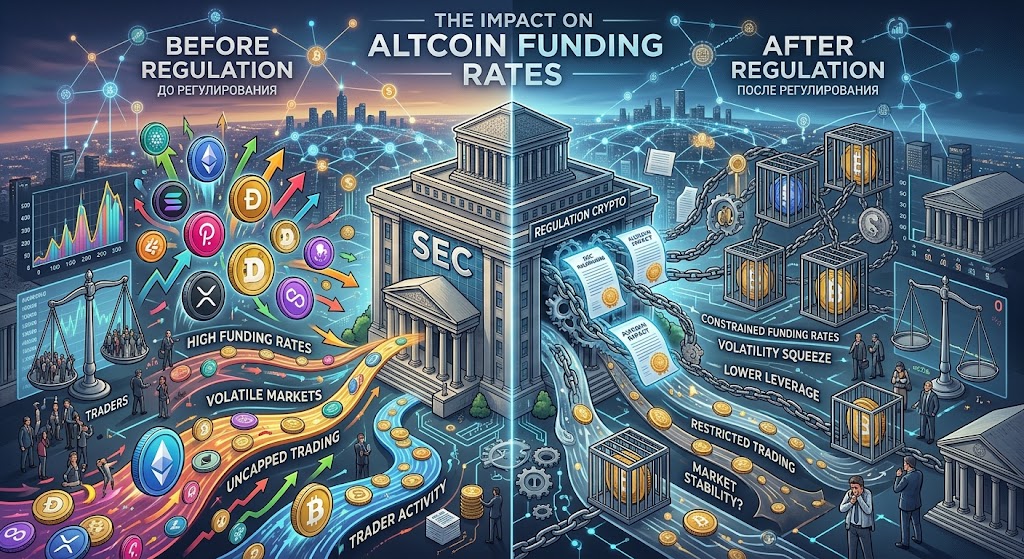
The United States regulatory landscape for digital assets experienced a monumental pivot this week. On Friday, August 14, 2026, the Securities and Exchange Commission (SEC), under the leadership of Chairman Paul Atkins, convened an open meeting to vote on the publication of a groundbreaking proposal known as "Regulation Crypto." Arriving just days after the U.S. Senate adjourned for its August recess without voting on the highly anticipated Digital Asset Market CLARITY Act, the SEC's proactive move signals a decisive end to the era of "regulation by enforcement."
As a Senior Editor and Analyst at MyCoinWay, I observe that this is not merely a bureaucratic milestone. It is a fundamental shift in market structure that immediately re-prices the risk premium on alternative cryptocurrencies (altcoins). The transition toward formal, notice-and-comment rulemaking creates a predictable environment for capital allocators. In the immediate term, it is sparking a rapid unwinding of defensive short positions and mechanically altering perpetual funding rates across the derivatives ecosystem.
The Mechanics of Regulation Crypto
To comprehend the market's aggressive repricing, we must dissect what Regulation Crypto actually proposes. While the final implementation is still subject to a months-long public comment period, the draft framework introduces a bespoke offering regime specifically tailored for digital assets. Crucially, it outlines a formal exemption pathway that allows qualifying crypto projects to raise capital without automatically triggering the full, prohibitive registration requirements of the Securities Act of 1933.
Perhaps most impactful for secondary market liquidity is the proposal's attempt to clarify the lifecycle of a token. It addresses a long-standing legal ambiguity by describing scenarios where an asset, initially sold as an investment contract, may no longer fall under securities jurisdiction once the managerial efforts of the founding team are exhausted and the network achieves sufficient decentralization.
For institutional market makers, regulatory ambiguity is a tax on liquidity. The lack of clear guidelines previously forced tier-1 U.S. exchanges to delist numerous altcoins, fracturing global liquidity and driving volume offshore. By proposing a clear, legal off-ramp for tokens to shed their "security" status, the SEC is effectively issuing a green light for institutional capital to begin accumulating these assets on regulated U.S. platforms.
Market Pulse: The Altcoin Short Squeeze and Funding Rates
The immediate mechanical reaction to the August 14 vote is playing out violently in the derivatives market. For years, hedge funds and algorithmic traders have maintained structural short positions on major Layer 1 and Layer 2 governance tokens, utilizing them as a hedge against sudden SEC enforcement actions.
With Regulation Crypto moving forward, that specific regulatory risk is evaporating. Traders are rushing to cover their shorts, triggering a broad short squeeze across the altcoin sector. This is highly visible in the perpetual futures market. Funding rates for historically suppressed assets are rapidly flipping from negative to deeply positive. When funding rates skew heavily positive, it indicates that long speculators are paying a premium to maintain their positions, reflecting a sudden surge in bullish, compliance-driven conviction.
However, traders must approach this shift mechanically. A deeply positive funding rate, if sustained without corresponding spot market buying, creates the risk of a long liquidation cascade. Arbitrageurs who hold spot assets and short the perpetual contracts to collect the funding fee (a strategy known as cash-and-carry arbitrage) are currently locking in outsized, risk-neutral yields.
Inter-Exchange Spreads and U.S. Liquidity Return
Beyond derivatives, the spot market is showing early signs of a U.S.-centric liquidity revival. Anticipating that top-tier U.S. exchanges will soon be able to relist previously contentious assets without fear of immediate SEC litigation, we are tracking localized volume spikes.
This anticipation is compressing inter-exchange spreads. Historically, the price of certain altcoins on offshore, lightly regulated exchanges would trade at a slight premium or discount compared to U.S.-compliant platforms due to fractured liquidity and compliance barriers. As market makers prepare for the implementation of Regulation Crypto, they are actively bridging capital back to U.S. entities. This capital rotation tightens bid-ask spreads and unifies cross-border pricing, making the global market far more efficient.
What to Track Next
The transition from a proposed rule to an enacted framework will take months, but the market is forward-looking. To navigate this structural shift, traders must abandon emotion and rely on hard data.
Here are the critical metrics to monitor in the coming weeks:
- Perpetual Funding Rate Deltas: Watch the funding rates of major altcoins that were previously labeled as securities in past SEC lawsuits. A sustained positive funding rate confirms institutional repricing.
- Offshore vs. U.S. Volume Share: Track the percentage of altcoin trading volume occurring on U.S.-regulated exchanges versus offshore platforms. A shift toward the U.S. indicates returning institutional spot demand.
- Inter-Exchange Arbitrage Spreads: Monitor price deviations between offshore and U.S. platforms. As liquidity returns to the U.S., these spreads should mechanically compress.
- Open Interest Growth: Observe the open interest in altcoin derivatives. A steady increase in open interest alongside rising spot prices suggests healthy, sustained capital inflows rather than a momentary short squeeze.
To successfully navigate this evolving regulatory landscape, we highly recommend utilizing the MyCoinWay Market Pulse dashboard to track real-time funding rate divergences, spot volume spikes, and inter-exchange liquidity depth.
Disclaimer: This article is for informational and analytical purposes only. It does not constitute financial, investment, or legal advice. Cryptocurrency markets are highly volatile, and regulatory proposals are subject to revision. Always conduct your own research before executing trades.
Sources:
- U.S. Securities and Exchange Commission: Open Meeting Agenda (August 14, 2026).
- Cogent Law / Bitcoin Foundation: "SEC Moves Toward Landmark 'Regulation Crypto' Framework" (August 2026).