Bitcoin's $2.7B Short Squeeze: How Treasury Buybacks Ignited It
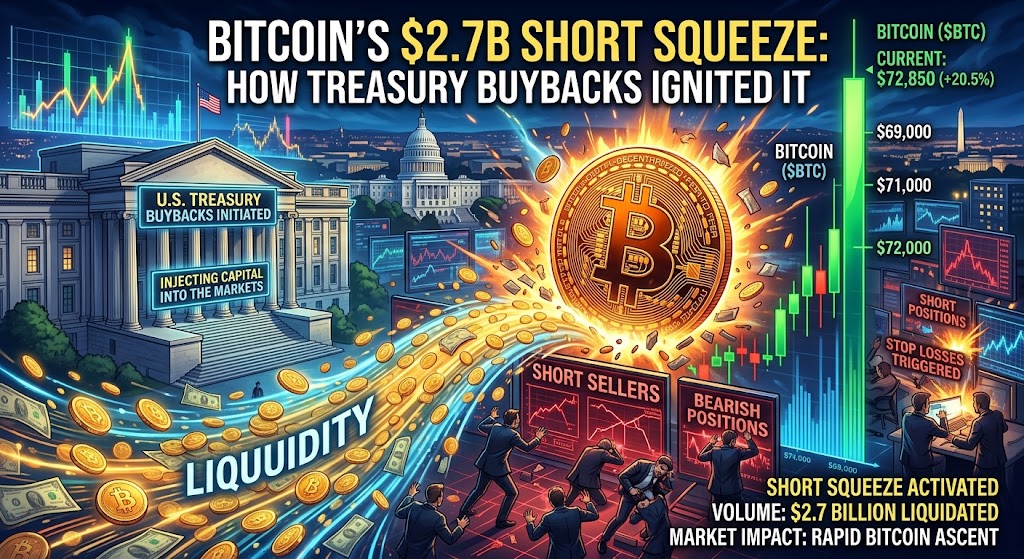
The cryptocurrency market thrives on the complex interplay between macroeconomic policy and algorithmic trading mechanics. Over the past 72 hours, we witnessed a masterclass in how traditional financial liquidity injections can trigger violent, compounding reactions on-chain. Following a pivotal structural announcement from the United States Treasury Department, Bitcoin (BTC) staged an aggressive 20% rally. The world's leading digital asset surged from weekly lows of approximately $62,800 to confidently breach the $75,300 mark.
As a Senior Editor and Analyst at MyCoinWay, I must emphasize that this was not a gradual, organic accumulation phase. This was a mechanical market explosion. While the initial spark came from traditional bond markets, the subsequent inferno was driven by a historic $2.7 billion short squeeze in the crypto derivatives ecosystem. Understanding how dropping bond yields trigger forced liquidations is essential for active traders looking to navigate the current volatility and manage their risk effectively.
The Macro Catalyst: The U.S. Treasury's Liquidity Injection
To comprehend the sheer velocity of this week's price action, we must look at the foundational plumbing of the global financial system. On August 19, 2026, the U.S. Treasury Department revealed plans to more than double the size of its government debt repurchases. The Treasury stated that this increase in buyback operations is designed to provide greater liquidity support in longer-dated nominal sectors, which have been under significant pressure.
The mechanical result of the government buying its own debt is an immediate suppression of bond yields. When long-term Treasury yields fall, the traditional financial market undergoes a rapid psychological and mechanical shift. Lower yields fundamentally reduce the opportunity cost of holding non-yielding, speculative assets like gold and Bitcoin. Institutional algorithms, sensing the deterioration of "risk-free" returns, immediately rotated capital out of the bond market and shifted toward a "risk-on" posture.
This macroeconomic tailwind provided the initial spot buying pressure. Institutional platforms and corporate proxies—evidenced by Coinbase shares rising 7.5% and MicroStrategy climbing nearly 8%—absorbed the early inflows. However, spot buying alone rarely accounts for a 20% surge in a multi-trillion-dollar asset within a matter of days.
The Anatomy of a $2.7 Billion Short Squeeze
While the Treasury's move provided the fundamental catalyst, the vertical ascent past $75,000 was purely mechanical. As Bitcoin's spot price breached critical technical resistance levels around the $68,000 mark, it triggered a massive cascade of forced liquidations in the perpetual futures market.
Over-leveraged traders who had bet heavily against the market—anticipating a prolonged summer lull—were caught completely off guard. When a trader's short position is liquidated, the exchange's risk engine is forcefully mandated to buy the underlying asset at market price to cover the outstanding debt. This creates a ruthless, self-fulfilling feedback loop: automated buying pushes the price higher, which in turn triggers higher stop-losses and liquidations, forcing even more automated buying.
Over a condensed window, this phenomenon resulted in a staggering $2.7 billion short squeeze. This mechanical buying completely overwhelmed the resting sell orders in the spot order books. The lack of overhead supply led to severe slippage, printing massive upward price wicks that temporarily disconnected the derivatives market from fundamental spot valuations.
Market Pulse: Funding Rates and P2P Friction
For active participants utilizing platforms like MyCoinWay, a short squeeze of this magnitude radically alters the trading environment. Relying on standard support and resistance metrics is dangerous when the market is driven by liquidations.
First, the perpetual futures funding rates experienced a violent paradigm shift. Prior to the rally, funding rates were muted or slightly negative, reflecting a cautious market. As the short sellers were wiped out and momentum traders FOMO’d (Fear Of Missing Out) into leveraged long positions to chase the green candles, funding rates skewed deeply positive. An excessively high positive funding rate indicates an overcrowded long market, where traders are paying exorbitant premiums to maintain their bullish bets. This creates a fragile setup; if spot buying exhausts itself, these late longs become prime targets for a reciprocal long-squeeze flush.
Second, the velocity of the rally caused brief but significant inter-exchange spreads. Spot liquidity on tier-1 centralized exchanges struggled to keep pace with the derivative-driven price action, creating fleeting but highly profitable arbitrage windows for high-frequency traders who could bridge assets between platforms.
Finally, in the peer-to-peer (P2P) markets, the sudden price appreciation created localized stablecoin friction. As retail enthusiasm was reignited by mainstream headlines of Bitcoin breaking $75,000, users rushed to onboard local fiat currencies. This sudden, aggressive demand for USDT and USDC caused P2P merchants to widen their bid-ask spreads. Merchants capitalized on the urgency, allowing them to capture a significant premium on fiat-to-crypto conversions during the volatility spike.
What to Track Next
Navigating the aftermath of a multi-billion-dollar liquidation event requires extreme discipline. Traders must pivot from chasing momentum to observing structural data.
Here are the critical metrics you must track in the coming days:
- Perpetual Funding Rate Normalization: Closely monitor funding rates across major exchanges. If rates remain deeply positive while the spot price consolidates or drops, it signals that the market is over-leveraged on the long side and vulnerable to a sharp downward correction.
- Spot Volume Confirmation: A $2.7 billion squeeze creates artificial buying volume. Track the cumulative volume delta (CVD) to ensure that genuine institutional spot buying is stepping in to support the new $75,000 price floor.
- 10-Year Treasury Yields: Keep a watchful eye on U.S. macroeconomic indicators. If inflation data or Fed commentary causes bond yields to spike again, the "risk-on" narrative will evaporate, acting as an immediate headwind for Bitcoin.
- Inter-Exchange Liquidity Depth: Utilize the MyCoinWay Market Pulse tools to check the +/- 2% order book depth on tier-1 exchanges. Ensure that sufficient resting liquidity has returned to the market before executing large block trades to avoid slippage.
By understanding the mechanics of forced liquidations and macroeconomic liquidity injections, traders can separate fundamental growth from derivative-driven noise, positioning themselves safely for the next market cycle.
Disclaimer: This article is for informational and analytical purposes only. It does not constitute financial, investment, or legal advice. Cryptocurrency markets are highly volatile, and structural liquidations can lead to unpredictable price action. Always conduct your own research before executing trades.
Sources:
- U.S. Treasury Department debt repurchase notices.
- Hindustan Times: "Why is crypto suddenly rallying? Bitcoin jumps 20% as $2.7 billion short squeeze hits" (August 21, 2026).