Fed Holds Rates at 3.5%-3.75%: The Hawkish Pause Draining Crypto Liquidity
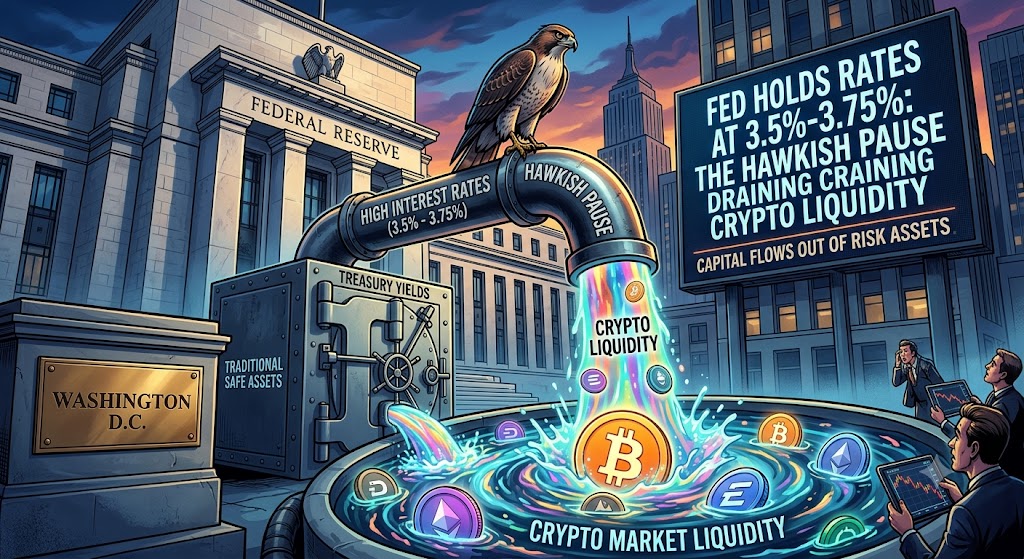
The macroeconomic gravity weighing on the digital asset market was forcefully reasserted this week. On Wednesday, July 29, 2026, the United States Federal Reserve concluded its Federal Open Market Committee (FOMC) meeting, keeping the federal funds rate unchanged at 3.5%-3.75% for the fifth consecutive time. While a rate hold was widely expected, the internal mechanics of the decision delivered a hawkish shock to the market.
Three of the twelve policymakers formally dissented, favoring an immediate 25-basis-point rate hike. Furthermore, Fed Chairman Kevin Warsh forcefully reiterated the central bank's commitment to achieving its 2% inflation target, effectively crushing hopes for near-term monetary easing.
As a Senior Editor and Analyst at MyCoinWay, I constantly monitor the intersection of traditional monetary policy and crypto market mechanics. The immediate reaction was swift: the US dollar and 10-year Treasury yields strengthened, while Bitcoin initially slid to approximately $63,890 before stabilizing in the mid-$64,000 range. However, the true story lies beneath the surface price action. This "higher for longer" rate environment is actively reshaping institutional risk models, draining spot liquidity, and creating a fragile setup for derivatives traders.
The Macro Headwind: Why "Higher for Longer" Hurts Crypto
To understand the market's muted reaction and underlying fragility, we must look at the fundamental relationship between interest rates and non-yielding assets. When the Federal Reserve signals a tighter policy path, the cost of capital remains high, and risk-free yields (like US Treasuries) remain attractive. This increases the opportunity cost of holding speculative, non-yielding assets such as Bitcoin.
The hawkish dissent from three FOMC members signals that the Fed is more concerned with sticky inflation than with stimulating economic growth. For institutional capital allocators, this means the risk-on environment they anticipated in late 2026 is delayed. Consequently, we are seeing a reduction in the aggressive spot buying that characterized earlier rallies. This macroeconomic pressure is further compounded by recent weakness in global equities, particularly in the tech and AI sectors, which share a strong correlation with digital assets.
Liquidity Withdrawal and Spot Market Thinning
The immediate mechanical fallout from this hawkish pause is highly visible in the spot order books. Institutional market makers operate on probability and risk-adjusted returns. When the probability of a rate cut diminishes and the threat of a hike emerges, the immediate reaction is to widen bid-ask spreads and pull resting liquidity from the order books.
For active traders, this means that executing large market orders will incur significantly higher slippage. The market's shock absorbers have been temporarily removed. When liquidity is thin, the market becomes highly susceptible to sudden, news-driven price wicks.
Derivatives Market: A Fragile Balance
While the spot market thins out, the derivatives market is grappling with the reality of prolonged tight monetary conditions. We are observing a critical test in perpetual futures funding rates.
Following the Fed's announcement, as Bitcoin tested the lower bounds of its current range, funding rates experienced compression. Traders hedging against potential downside risks are keeping funding rates muted. However, the market remains heavily leveraged. If the broader macroeconomic sentiment sours further—perhaps due to escalating geopolitical tensions or continued weakness in traditional equities—a sudden drop through key support levels could trigger a cascade of long liquidations, exacerbating the downward pressure.
What to Track Next
Navigating a market gripped by a hawkish central bank requires strict mechanical observation rather than directional guessing.
Here are the critical metrics you must track in the coming days:
- Key Support Levels: Monitor the $62,700-$63,000 zone closely. A sustained break below this area could expose Bitcoin to further declines toward the $61,300-$61,900 region.
- Perpetual Funding Rates: Track the funding rates across major exchanges. Deeply negative rates combined with flat price action often signal an exhausted seller base, while sustained positive rates in a downtrend indicate unhealthy leverage buildup.
- Spot Order Book Depth: Before executing any significant trades, meticulously check the liquidity depth on your exchange. Thin books mean that executing large orders requires patience and the use of limit orders to avoid slippage.
- US Dollar Strength: Keep an eye on the US Dollar Index (DXY). Sustained strength in the dollar following the Fed's hawkish signals will continue to act as a headwind for Bitcoin prices.
The Federal Reserve's July 29 decision is a stark reminder that the cryptocurrency market does not operate in isolation. To survive and thrive in this environment, traders must rely on institutional-grade data. We highly recommend utilizing the MyCoinWay Market Pulse dashboard to monitor live funding rate divergences, track order book depth in real-time, and adapt to the shifting macroeconomic tides.
Disclaimer: This article is for informational and analytical purposes only. It does not constitute financial, investment, or legal advice. Cryptocurrency markets are highly volatile, and macroeconomic shifts can lead to unpredictable price action. Always conduct your own research before making trading decisions.
Sources:
- Livemint: "Bitcoin price today rises after US Fed holds rate - What does it mean for the cryptocurrency? Key levels to watch" (July 30, 2026).
- Roic News: "Bitcoin Eyes the Fed as Dollar Weakens Ahead of Rate Decision" (July 29, 2026).