CLARITY Act Stalls in Senate: What Changes for Crypto?
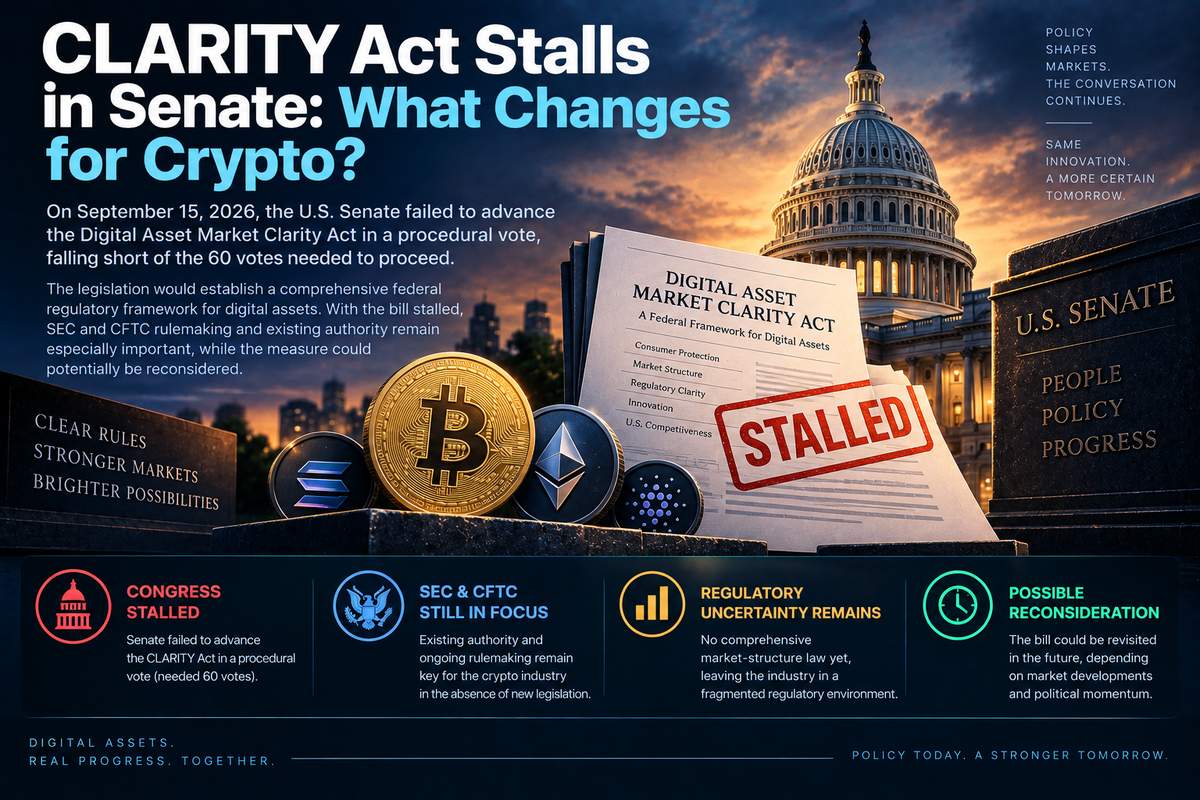
The CLARITY Act did not pass its Senate procedural hurdle
On September 15, 2026, the U.S. Senate voted 49–50 on a motion to invoke cloture on the motion to proceed to H.R. 3633, the Digital Asset Market Clarity Act.
The motion required three-fifths support and therefore failed. The official Senate record lists the result as “Cloture on the Motion to Proceed Rejected.”
That distinction matters.
The Senate did not hold a final vote rejecting the CLARITY Act itself. Instead, senators failed to clear the procedural threshold required to advance consideration of the bill.
The immediate result is nevertheless significant: the legislation has stalled.
What was the CLARITY Act supposed to change?
H.R. 3633 is designed to create a federal framework for digital commodity markets and clarify responsibilities between the Securities and Exchange Commission and the Commodity Futures Trading Commission.
The Senate's official description says the legislation would establish a system regulating the offer and sale of digital commodities through the SEC and CFTC, while addressing several other digital-asset policy issues.
This matters because one of the longest-running questions in U.S. crypto regulation has been where securities regulation ends and commodities regulation begins.
A statutory framework could provide rules that are more durable than interpretations or regulations issued solely by agencies.
SEC Chairman Paul Atkins made essentially this distinction in August, describing legislation as important for creating rules that are durable across future administrations, while the SEC continued developing its own crypto framework.
What actually changed after the vote?
The clearest change is legislative.
Congress did not advance H.R. 3633 through this procedural step.
What did not happen is equally important.
Existing securities and commodities laws were not automatically rewritten. Existing SEC and CFTC authority did not disappear. Nor were the agencies' ongoing crypto initiatives cancelled by the vote.
The SEC, for example, proposed Regulation Crypto Assets on August 18. The proposal would create tailored exemptions for certain investment contracts involving crypto assets and a conditional safe harbor under federal securities law.
Earlier, in March, the SEC issued an interpretation explaining how it views the application of federal securities laws to several categories of crypto assets and activities, with the CFTC providing related guidance.
The failed Senate vote therefore leaves the U.S. with an important distinction:
Congressional market-structure legislation has stalled, while agency-level rulemaking can continue.
Why the 49–50 result should not be read as the final status of the bill
A common mistake is to interpret the vote as if senators voted 49–50 on final passage.
They did not.
The question before the Senate was whether to invoke cloture on the motion to proceed. The threshold was 60 votes.
That means the vote tells us that supporters lacked enough votes to overcome this procedural barrier at that moment.
It does not, by itself, permanently terminate H.R. 3633 or prevent lawmakers from revisiting crypto market-structure legislation.
Reuters also reported that a procedural vote by Senator Thom Tillis preserved the possibility of reconsideration.
The more precise conclusion is therefore that the bill is stalled, not that comprehensive U.S. crypto legislation has been permanently defeated.
What does this mean for exchanges, issuers and investors?
In the short term, less changes than the headline may suggest.
Companies still have to operate under the regulatory framework that existed before September 15.
The larger consequence concerns regulatory certainty.
A congressional statute can establish legal responsibilities between regulators and market participants in a way that is harder for future agency leadership to reverse.
Agency interpretations and rulemaking can still provide substantial guidance, but they are a different mechanism.
This is why the next phase of U.S. crypto regulation should not be watched only through Congress.
SEC and CFTC actions now matter at least as much.
Market reaction needs a causality warning
Bitcoin and several crypto-linked equities declined around the vote. Reuters reported Bitcoin down roughly 4%, while Coinbase and Circle shares fell around 9%.
But it would be too strong to say the Senate vote alone caused the entire move.
Crypto markets were simultaneously dealing with broader macro conditions, including rising bond yields and expectations around Federal Reserve policy. Reuters had already identified those factors as important risks for Bitcoin before the Senate vote.
The correct interpretation is therefore that the crypto decline coincided with and followed the failed vote, while other macro and market factors were also active.
What to watch next
1. Any renewed Senate procedure on H.R. 3633.
A new procedural move would indicate that negotiations have resumed rather than the bill simply remaining stalled.
2. Changes to the legislative text.
Material amendments would show what lawmakers believe is necessary to assemble a broader coalition.
3. SEC Regulation Crypto Assets.
The SEC's August proposal remains an important parallel regulatory track. Progress there would demonstrate that agency-level crypto regulation is moving forward even without immediate congressional legislation.
4. SEC and CFTC implementation guidance.
New interpretations, exemptions or market-structure rules could reduce some uncertainty that Congress has not yet resolved.
5. Market structure rather than price alone.
Trading volume, open interest, funding rates and liquidity are more useful for assessing whether the vote produced a persistent change in positioning than a single Bitcoin price move.
Conclusion
The September 15 vote did not abolish the CLARITY Act and did not rewrite U.S. crypto regulation overnight.
It prevented H.R. 3633 from advancing through a crucial Senate procedural step.
The bigger question now is where regulatory clarity comes from next: another congressional attempt, SEC and CFTC rulemaking, or some combination of the two.
That distinction matters more than treating a 49–50 procedural vote as the end of U.S. crypto market-structure reform.
Sources
U.S. Senate — Roll Call Vote 234
Reuters — U.S. Senate fails to advance cryptocurrency bill
SEC — Regulation Crypto Assets proposal
SEC — Application of Federal Securities Laws to Crypto Assets
This material is for informational and analytical purposes only and does not constitute financial, investment, legal or tax advice.