SEC Opens a Limited Path for Tokenized U.S. Stock Trading
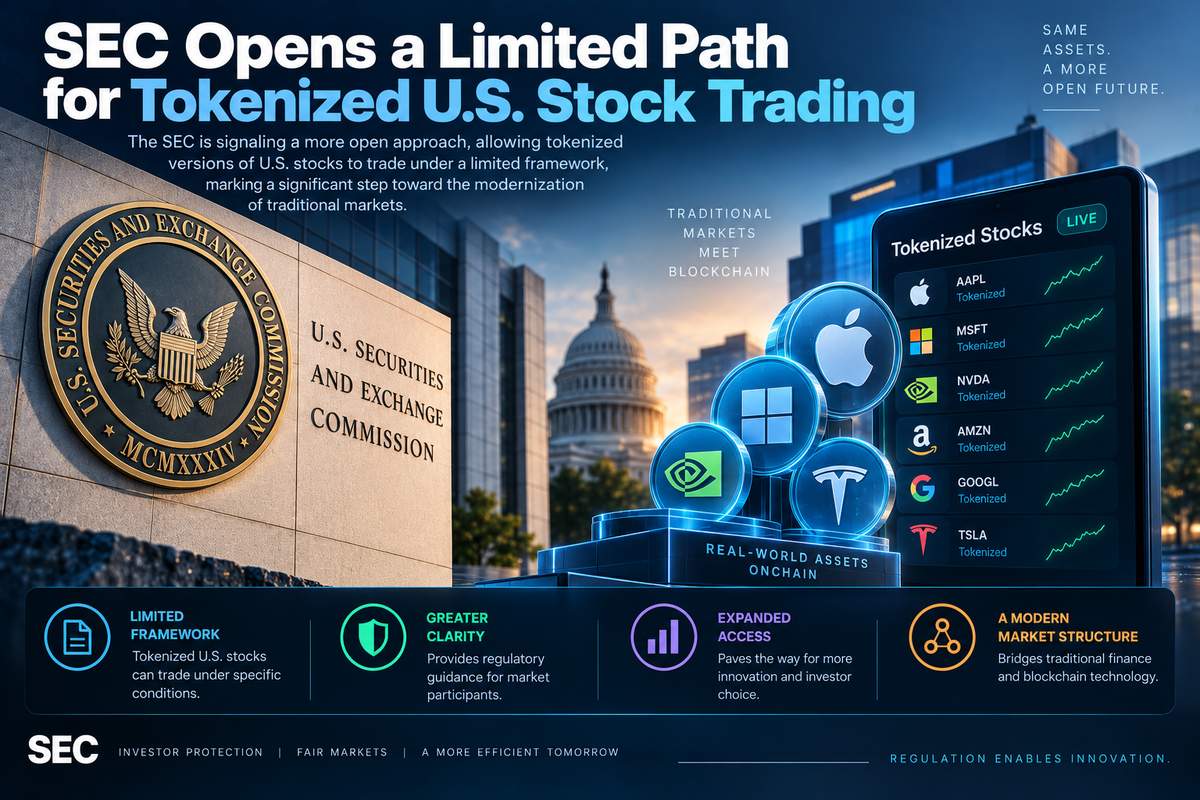
The U.S. Securities and Exchange Commission has opened a regulated path for tokenized U.S. stocks to trade onchain.
But it has not simply moved the stock market onto blockchain.
On September 17, the SEC issued its Innovation Exemption, a temporary and conditional framework allowing a new category of platform — a Tokenized Securities Venue, or TSV — to facilitate trading in tokenized National Market System stocks through permissioned automated market maker liquidity pools.
The exemption is scheduled to last five years.
That sounds like a major step toward 24/7 onchain capital markets. It is. But the details make the experiment considerably narrower than the headline.
What the SEC actually approved
A TSV can bring together buyers and sellers of tokenized NMS stocks through one or more AMM liquidity pools.
The model borrows a familiar mechanism from decentralized finance: instead of relying exclusively on a traditional order book, participants can interact with pools containing liquidity supplied by market participants.
However, these are not unrestricted DeFi pools.
Access must be permissioned, and the venues operate under specific SEC conditions.
The SEC temporarily exempts qualifying TSVs from being treated as exchanges under the Exchange Act. Certain liquidity providers using proprietary capital can also receive conditional relief from the definition of a dealer.
The relief is temporary rather than a permanent rewrite of securities law.
The SEC says it wants to observe how these markets function before determining what longer-term regulation should look like.
Not every “tokenized stock” qualifies
One of the most important distinctions concerns what the token represents.
Under the exemption, a tokenized NMS stock must provide its holder with the same rights and privileges as the equivalent traditional share.
That includes economic and governance rights such as dividends and voting rights where those rights exist for the underlying class.
This makes the framework materially different from a synthetic token whose price merely follows Apple, Nvidia or another listed company.
A synthetic instrument can give a trader economic exposure to a stock price without making that trader a shareholder.
The SEC framework is designed around tokenized securities that retain the rights of the underlying security.
That distinction is important because the term “tokenized stock” has been used for products with very different legal structures.
Companies can object
The SEC has also created a safeguard for issuers.
If an unaffiliated third party tokenizes a company's stock, the TSV must give the underlying issuer written notice and an opportunity to object before making the tokenized security available for trading.
An issuer can therefore prevent its stock from being traded on that TSV.
This means the exemption does not create a universal right for crypto platforms to tokenize every company listed in the United States.
Issuer participation — or at least lack of objection — becomes one of the practical constraints on how broad the market can become.
24/7 does not mean detached from the stock market
Blockchain infrastructure is often associated with continuous trading.
But the SEC framework keeps an important connection to the traditional market.
If trading in the underlying stock is halted on its primary listing exchange, the TSV must halt trading in the tokenized version at the same time.
That condition matters.
A tokenized stock may use blockchain infrastructure, but it does not become an independent asset with its own completely separate market rules.
Corporate events, regulatory halts and market-integrity mechanisms surrounding the underlying security still matter.
The exemption therefore looks less like replacing the existing stock market and more like attaching a new trading rail to it.
The smart contracts must be visible
The technology layer is also subject to conditions.
Smart contracts used by a TSV must be auditable, public and deployed on a public, permissionless distributed ledger.
The venue itself, however, remains permissioned in terms of participant access.
This creates an interesting hybrid structure:
the blockchain infrastructure can be publicly inspectable, while participation in the regulated market is controlled.
That is very different from assuming that “onchain” automatically means anonymous or unrestricted access.
Tokenization does not automatically create liquidity
Moving a stock onto blockchain does not guarantee that anyone will trade it.
This is probably the biggest market-structure question behind the experiment.
Traditional U.S. equities already have highly developed exchanges, market makers, clearing systems and deep liquidity in major stocks.
A tokenized venue has to offer something sufficiently useful to attract buyers, sellers and liquidity providers.
Potential benefits include longer trading availability, programmable settlement and new forms of market infrastructure.
But those advantages need to survive contact with real trading.
A market with a technically available token but wide bid-ask spreads and shallow liquidity would not necessarily be an improvement for investors.
The SEC itself is imposing limits on both the number of symbols and the volume that can trade under the exemption.
This makes the initial phase an experiment rather than a wholesale migration.
Why the AMM model is worth watching
The use of AMM liquidity pools is particularly notable.
AMMs are familiar in DeFi, where liquidity providers contribute assets to pools and algorithms determine trading prices according to predefined mechanisms.
Applying that model to regulated U.S. stocks creates new questions.
How deep will the pools be?
How closely will tokenized prices track the primary exchange?
What happens to spreads outside normal U.S. trading hours?
How efficiently can liquidity providers respond when the underlying market is closed?
And will institutional market makers consider the economics attractive enough to commit meaningful capital?
The exemption creates a regulatory environment in which those questions can finally generate observable data.
This is an experiment, not the final U.S. tokenization regime
The five-year duration is another important limitation.
SEC Chair Paul Atkins described the exemption as a bridge toward longer-term rulemaking.
The agency is also requesting public comment and can use information from operating TSVs to determine what future rules should look like.
Anti-fraud and anti-manipulation provisions continue to apply.
The SEC has therefore not declared that the experimental structure should become the permanent architecture of U.S. securities markets.
It has created a controlled environment in which that architecture can be tested.
What to watch next
- Number of approved TSVs: multiple operating venues would indicate that the exemption is attracting real market infrastructure rather than remaining a regulatory option on paper.
- Number of tokenized symbols: growth toward the permitted limits would show whether issuers and venues actually want to use the framework.
- Trading volume and liquidity: sustained volume, tighter spreads and meaningful pool depth would provide stronger evidence of adoption than token launches alone.
- Price dispersion: the gap between tokenized shares and the same stocks on primary exchanges will show how efficiently the two market structures remain connected.
- Issuer objections: frequent objections would materially limit the universe of tokenized stocks even if technology and investor demand are available.
Conclusion
The SEC's Innovation Exemption is a meaningful step toward onchain U.S. capital markets, but it should not be interpreted as the stock market suddenly becoming an unrestricted crypto market.
The framework is deliberately narrow.
Tokenized stocks must preserve the rights of traditional shares. Issuers can object. Trading halts remain linked to primary exchanges. Access is permissioned. Symbol and volume limits apply. And the entire experiment is temporary.
What changes is the infrastructure.
For the first time under this framework, regulated market participants can test whether public blockchains and AMM-style liquidity can coexist with U.S. shareholder rights and securities-market controls.
Whether that becomes a new market structure will depend not on the word “tokenized,” but on the evidence that follows: venues, liquidity, spreads, volumes and actual issuer participation.
Sources
SEC — Innovation Exemption press release:
SEC Chairman Paul S. Atkins — statement:
SEC Commissioner Hester M. Peirce — statement:
Reuters — independent confirmation: