South Korea Maps a Three-Step Shift to Tokenized Securities
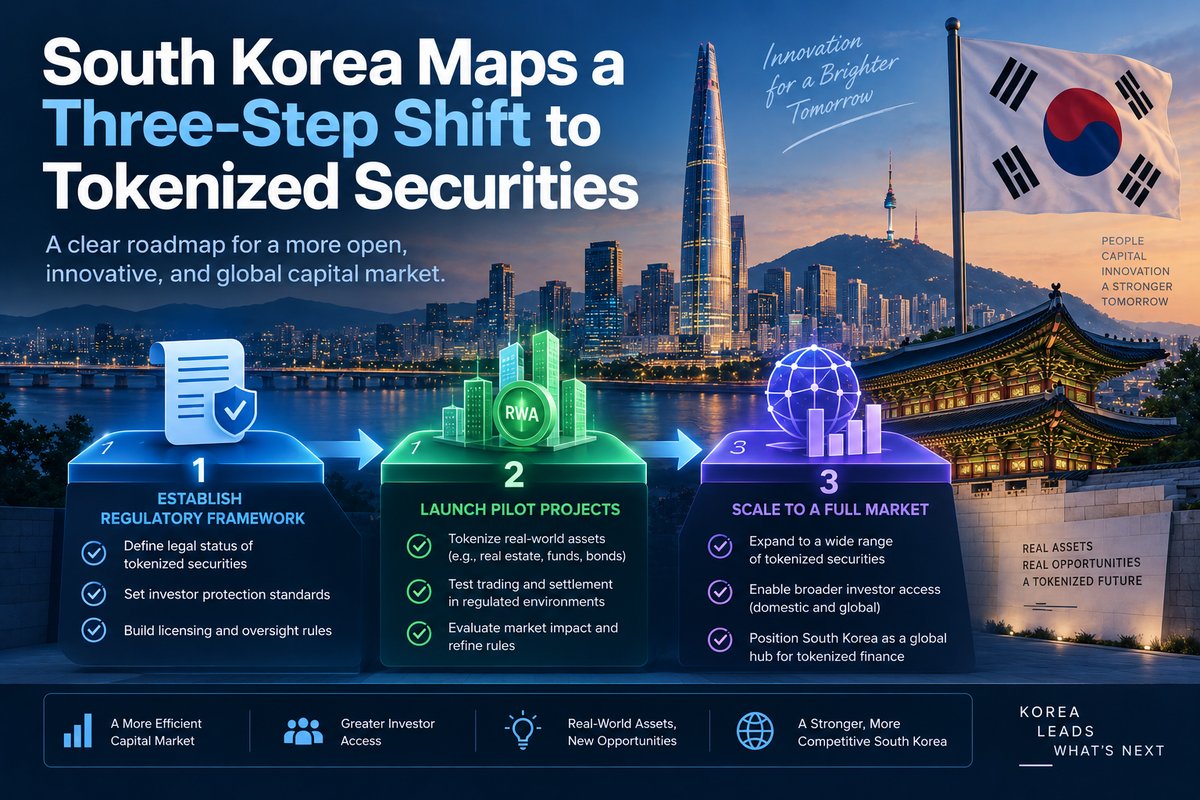
South Korea has laid out one of the clearest government roadmaps yet for moving conventional capital-market assets toward blockchain infrastructure. On September 4, the Financial Services Commission (FSC) announced a three-phase plan covering not only fractional-investment products but eventually traditional stocks, bonds and funds.
The important word is eventually.
The first phase starts when amendments to the Electronic Registration Act take effect on February 4, 2027. It does not move the entire Korean stock market on-chain. Instead, authorities will begin with selected institutional products, unlisted shares and fractional investments. Broader public securities come in a later phase, while stablecoin-linked on-chain settlement is the final objective and has no fixed implementation date.
That distinction matters because “tokenized securities” can describe very different market structures. Putting a security record on distributed infrastructure is not the same as moving issuance, trading, cash settlement and investor rights onto the same blockchain.
What South Korea actually announced
The FSC’s roadmap has three stages.
From February 2027, phase one will cover privately pooled money-market funds and bonds reserved for institutional investors, unlisted equities through trust structures, and publicly offered fractional-investment securities. The legal change taking effect that month formally recognizes tokenized securities as a digital form of securities under Korea’s electronic-registration framework.
The treatment of unlisted shares illustrates why the details matter. The initial model does not necessarily place the actual company share itself directly on a blockchain. The existing share can remain within the conventional system while investors receive a tokenized trust-beneficiary security representing an interest in it.
Phase two would broaden tokenization to all categories of publicly offered securities.
Only phase three targets a more fundamental infrastructure change: an on-chain payment system linked to stablecoins for settling tokenized securities. The FSC explicitly says the timing of phases two and three will depend on how the first stage performs, how quickly financial firms adopt the technology and how pending stablecoin legislation develops.
So February 2027 is a starting point, not the date when Korea’s entire capital market becomes blockchain-based.
Tokenization does not automatically mean instant settlement
This is the most important practical distinction.
A security has several layers: issuance, ownership records, trading, clearing, cash settlement and the exercise of investor rights. Tokenizing one layer does not automatically transform the others.
South Korea’s roadmap appears designed to migrate those components gradually rather than replacing the existing market in one step.
That helps explain why the Korea Securities Depository remains central to the plan. The KSD will screen distributed-ledger systems and conduct operating tests before securities firms connect their infrastructure. The requirements include not only blockchain functionality but contingency and business-continuity plans for system failures.
The objective is therefore not simply to put financial assets “on blockchain.” Regulators want distributed infrastructure to preserve a stability standard comparable with the current securities system.
That creates a useful metric for judging the project: does tokenization actually shorten or simplify settlement without introducing a new operational bottleneck?
Stablecoin settlement is potentially the bigger change
The final phase may ultimately matter more to crypto markets than tokenized share certificates themselves.
A blockchain security still needs a payment leg. If the asset moves on-chain but payment moves through conventional bank rails, part of the potential efficiency gain disappears.
The FSC’s end-state specifically envisages an on-chain payments infrastructure linked to stablecoins.
That could support delivery-versus-payment structures in which the security and settlement asset move within interoperable digital infrastructure. But the roadmap does not identify a specific stablecoin, guarantee that public crypto stablecoins will qualify, or provide a date for this stage.
Those questions depend partly on legislation that has not yet been completed.
Therefore it would be premature to interpret the announcement as imminent Korean demand for USDT, USDC or any other existing token.
The significant development is narrower: a major capital-market regulator is explicitly designing stablecoin settlement into its long-term securities architecture.
Existing brokers are not being replaced
Another misconception would be that blockchain infrastructure removes regulated intermediaries.
Under the FSC proposal, financial firms already authorized to conduct investment business can handle tokenized securities within their existing licensed activities without obtaining a separate token-specific authorization. OTC intermediaries, however, will need prior consultation with the Financial Supervisory Service.
Retail participation will also remain constrained. The FSC set an annual net-purchase limit of KRW100 million per OTC exchange for retail investors. Issuers that want to manage tokenized-securities accounts themselves face minimum capital, staffing, IT and cybersecurity requirements; the equity-capital threshold is KRW4 billion.
In other words, Korea is using blockchain to modify regulated market plumbing, not to remove regulation from securities trading.
What could actually improve — and what could fail
Tokenization could reduce reconciliation work, make ownership records more programmable and eventually shorten settlement chains. It could also make certain currently illiquid assets easier to divide and distribute.
But those are potential benefits, not confirmed results.
A tokenized market can still have poor liquidity. Putting an asset on a distributed ledger does not create buyers and sellers.
Likewise, faster technical settlement is useful only when custodians, brokers, payment assets and blockchains interoperate reliably. Fragmented networks could simply replace one set of intermediaries with several new bridges and reconciliation layers.
The first phase will therefore function as an infrastructure test as much as a product launch.
There is also no meaningful token-price reaction to analyze yet. The announcement establishes a future regulatory architecture rather than launching a new cryptoasset or injecting capital into an existing market. Any attempt to tie current BTC, ETH or stablecoin price movements directly to the roadmap would overstate causality.
What to watch next
- February 2027 phase-one launches: the number and size of MMFs, bonds, unlisted-share structures and fractional products actually tokenized will show whether the roadmap progresses beyond policy.
- Settlement time and operational failures: shorter settlement with no increase in outages or reconciliation problems would support the infrastructure thesis.
- Phase-two timing: a firm timetable for publicly offered stocks, bonds or funds would mark a much larger expansion than phase one.
- Stablecoin legislation and settlement design: the crucial questions are what type of stablecoin may qualify, who can issue it and how redemption and final settlement will work.
- OTC liquidity: trading volume, spreads and the number of active participants will indicate whether tokenization improves actual market accessibility rather than only changing the record-keeping technology.
Conclusion
South Korea is not putting its entire stock market on-chain in February 2027. It is building a staged migration path.
The first stage deliberately limits the scope. The second would broaden tokenized issuance. The third could change settlement more fundamentally by linking securities transfers with stablecoin payments.
For crypto markets, that last step is potentially the most consequential — and also the least finalized. Until the legal and operational details emerge, the useful signal is progress in infrastructure and settlement, not speculation about which token might benefit.
Sources
Financial Services Commission — Policy Roadmap on Digital Transformation and Tokenization of Securities Issuance and Circulation
CoinDesk — South Korea targets February 2027 rollout for tokenized securities
The Block — South Korea to tokenize securities in three stages
Disclaimer
This material is for informational and analytical purposes only and does not constitute financial, investment, legal or tax advice.