Why Dollar Stablecoin Demand Can Spill Into FX Markets
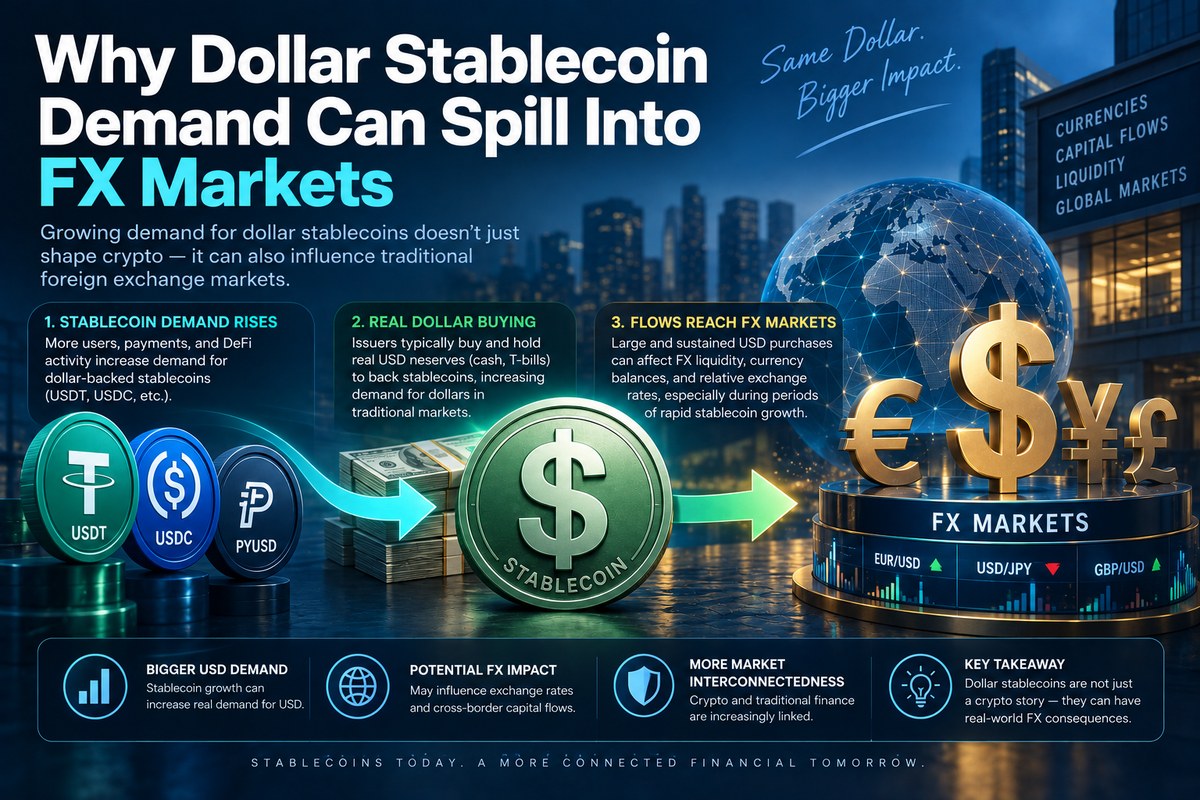
A new Bank of Korea study offers a useful answer to a question that is becoming more important as dollar stablecoins expand: when people buy dollar stablecoins with local currency, can that demand reach the conventional foreign-exchange market?
The answer is not simply “yes” or “no.”
According to research published by the Bank of Korea on September 3, the connection depends heavily on market structure — particularly on whether global intermediaries can trade both stablecoins and conventional currencies.
The study uses the introduction of fiat-to-dollar-stablecoin pairs on Binance as a way to examine what happens when that connection becomes easier. Its results indicate two effects: local stablecoin prices become more closely aligned with ordinary FX rates, while stablecoin buying pressure can also transmit more strongly into the corresponding currency market.
That combination is important for MyCoinWay users because a falling local stablecoin premium does not necessarily mean stablecoin demand has become economically less important. It can mean that the demand is being absorbed through a more integrated market.
What the Bank of Korea studied
Dollar stablecoins such as USDT and USDC effectively provide a digital asset whose reference value is the US dollar.
When someone buys a dollar stablecoin with euros, lira, won or another currency, the economic transaction resembles purchasing a dollar-denominated asset with that local currency.
But this does not automatically mean a matching transaction immediately appears in the traditional FX market.
The transmission depends on who stands on the other side.
The Bank of Korea focuses on a structure in which global intermediaries — including liquidity providers able to operate in both crypto and FX markets — directly participate in fiat–stablecoin markets.
When a user buys stablecoins with local currency, such an intermediary can sell stablecoins to the user and then manage the resulting local-currency exposure through the conventional FX market.
That creates a bridge between two previously more segmented markets.
Why a fiat pair can reduce a stablecoin premium
Before strong global arbitrage exists, local stablecoin markets can develop premiums.
Suppose dollar stablecoins are in unusually high demand in one country. If moving stablecoins or fiat capital into that market is costly or restricted, the token may trade above the value implied by the normal USD exchange rate.
That premium reflects market segmentation.
The Bank of Korea finds that after relevant fiat–stablecoin pairs became available on Binance, stablecoin premiums declined significantly and stablecoins flowed from Binance toward local markets when local premiums were higher.
The mechanism is intuitive.
If a stablecoin is expensive locally but cheaper on a globally connected venue, intermediaries have an incentive to supply the expensive market. More arbitrage should pull the two prices closer together.
But this produces a result that can look paradoxical.
A smaller stablecoin premium can coexist with a stronger link to the FX market.
The premium disappears partly because the imbalance is no longer trapped entirely inside the local crypto market.
Where the FX effect comes from
Consider what happens after a globally active market maker sells dollar stablecoins to buyers holding a local currency.
The intermediary now has more of that local currency.
If it does not want to maintain the exposure, it can sell the local currency against dollars in the conventional FX market.
Stablecoin buying pressure has therefore created an FX transaction indirectly.
The Bank of Korea reports that before the introduction of relevant trading pairs, stablecoin premiums had only a limited relationship with the corresponding dollar exchange rates. After pairing, higher premiums were associated with significant local-currency depreciation.
The researchers also found that net buyer-initiated order flow — a measure of buying pressure — was significantly associated with depreciation in the currencies linked through those markets.
This does not mean every USDT purchase mechanically weakens a national currency.
The study identifies a transmission channel and empirical relationship under particular market structures. Exchange rates remain influenced by monetary policy, interest rates, trade flows, portfolio flows, macroeconomic expectations and many other factors.
Korea provides the useful comparison
One of the strongest parts of the research is its comparison with South Korea.
According to the paper, Korea did not have the same direct Binance fiat pairing considered in the study.
There, stablecoin buying pressure was primarily reflected in a higher local stablecoin premium rather than a statistically significant effect on the exchange rate.
That contrast helps explain the mechanism.
When markets are more segmented, demand pressure can remain inside the crypto market and show up as a premium.
When global intermediaries can connect crypto and FX liquidity more directly, arbitrage can reduce that premium — but some of the pressure can instead reach the foreign-exchange market.
So a large premium and strong FX transmission are not necessarily two versions of the same signal.
In some structures, one can decrease while the other increases.
What this means for P2P prices
This is where the research is particularly relevant to MyCoinWay.
A P2P stablecoin reference price can contain information about local supply and demand, access to banking rails, liquidity conditions and the cost of moving between fiat and crypto markets.
But it should not be read as a direct exchange-rate forecast.
A rising USDT/local-currency reference premium might indicate stronger demand for dollar-linked digital value or greater local market friction. It does not by itself reveal which mechanism is responsible.
Likewise, a falling premium does not necessarily indicate weakening dollar demand. Better arbitrage or stronger links with global exchanges can compress the premium even when underlying demand remains substantial.
MyCoinWay’s P2P Price Index should therefore be treated as reference data for local stablecoin pricing, not as executable advertisements and not as proof of future FX movements.
The most useful analysis combines local reference prices with conventional FX rates, exchange liquidity and market structure.
Why this matters as stablecoins scale
The Bank of Korea’s policy conclusion extends beyond crypto trading.
As corporations, foreign investors and other large participants gain more access to stablecoins, the boundary between crypto-dollar demand and ordinary dollar demand may become less distinct.
That is particularly relevant for economies where the domestic currency has less global liquidity than the US dollar.
The researchers argue that digital-asset regulation should therefore be considered alongside FX-market depth and the international role of domestic currencies.
This does not imply stablecoins inevitably destabilize currencies.
Deeper markets can absorb flows more efficiently. More direct arbitrage can also eliminate large pricing distortions.
The important point is that stablecoins increasingly form part of the broader capital-flow infrastructure rather than an isolated crypto market.
What to watch next
- Local stablecoin premium versus the spot FX rate: a widening premium can indicate local demand or market friction; compression may indicate stronger arbitrage rather than weaker demand.
- Fiat–stablecoin trading volume: sustained increases show that more local-currency demand is passing directly through stablecoin markets, increasing the potential importance of the transmission channel.
- Buyer-initiated order flow: persistent net buying provides a more direct measure of stablecoin demand pressure than price alone.
- Cross-venue price dispersion: smaller differences between global and local markets can signal improved integration and arbitrage efficiency.
- Changes in fiat on/off-ramp access: new exchange pairs, banking connections or institutional participants can materially change how stablecoin demand is transmitted.
For MyCoinWay users, the P2P Price Index can serve as one reference point for observing local stablecoin pricing. It should be interpreted alongside spot FX and broader liquidity conditions rather than as a standalone trading or currency signal.
Conclusion
The Bank of Korea study highlights an important transition in stablecoin markets.
As fiat and stablecoin liquidity become more connected, local premiums may become smaller — yet the macroeconomic relevance of stablecoin demand may become larger.
That is because efficient intermediaries do more than equalize crypto prices. They can transmit positions between the crypto market and the conventional foreign-exchange market.
For users, the practical lesson is not that stablecoin demand predicts a currency’s next move. It is that stablecoin premiums, liquidity and FX rates increasingly need to be interpreted as parts of the same market structure.
Sources
CoinDesk — Dollar-backed stablecoins can push local currencies lower, Bank of Korea study finds
Seoul Economic Daily — Dollar Stablecoin Trading Weakens Local Currencies, BOK Says
Disclaimer
This material is for informational and analytical purposes only and does not constitute financial, investment, legal or tax advice.