Tether Freezes $320M in DeFi Protocol: The Liquidity Impact
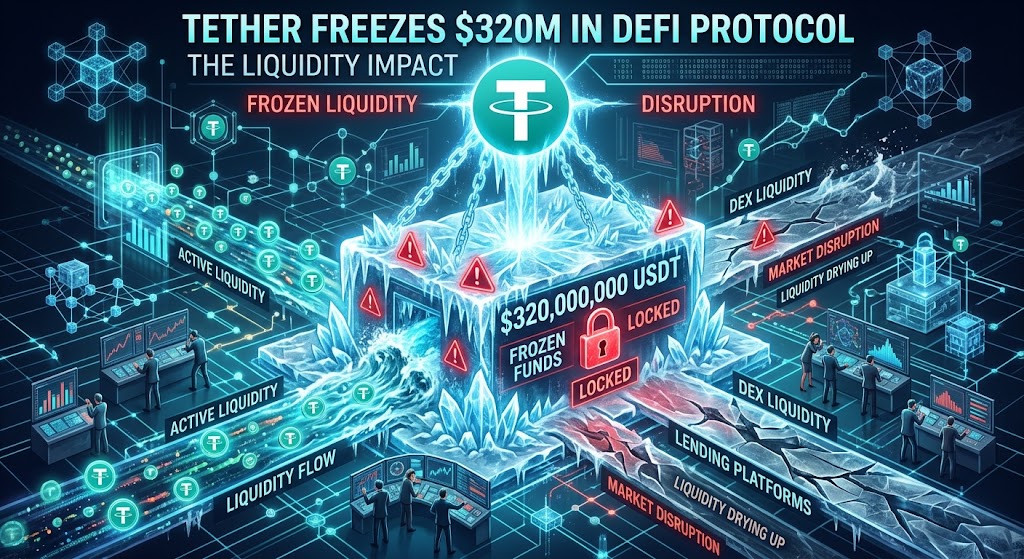
The intersection of centralized stablecoins and decentralized finance (DeFi) has always harbored a fundamental contradiction. Over the past 48 hours, the cryptocurrency ecosystem witnessed a brutal demonstration of this reality. On Sunday, August 23, 2026, the United States Office of Foreign Assets Control (OFAC) announced severe sanctions against a prominent decentralized cross-chain liquidity aggregator, citing its role in facilitating high-volume money laundering for cybercriminal syndicates.
The regulatory hammer was swift, but the mechanical market impact was driven by the immediate compliance of the world's largest stablecoin issuer. Within hours of the OFAC announcement, Tether proactively blacklisted the specific smart contract addresses associated with the targeted aggregator. This action effectively froze approximately $320 million in USDT.
As a Senior Editor and Analyst at MyCoinWay, I observe this not merely as a regulatory headline, but as a catastrophic mechanical shock to on-chain liquidity. The sudden immobilization of a third of a billion dollars inside active trading pools is violently reshaping peer-to-peer (P2P) pricing models, distorting inter-exchange spreads, and testing the resilience of stablecoin pegs across secondary markets.
The Illusion of Decentralized Liquidity
To understand the severity of this market distortion, we must examine the plumbing of decentralized liquidity pools. The sanctioned aggregator relied on deep reserves of USDT and USDC to facilitate seamless cross-chain swaps for users. When Tether executed the blacklist command at the smart contract level, those specific USDT tokens were cryptographically frozen. They cannot be transferred, swapped, or redeemed.
For the decentralized protocol, this is a fatal mechanical failure. Automated Market Makers (AMMs) price assets based on the mathematical ratio of tokens within a pool. With $320 million in USDT suddenly rendered "dead," the mathematical balance of these pools collapsed. Users attempting to route trades through the aggregator were met with catastrophic slippage or entirely failed transactions.
More importantly, this event shatters the illusion of absolute decentralization. While the smart contracts dictating the trades are immutable and decentralized, the primary asset fueling them (USDT) remains entirely subject to centralized, fiat-backed control. This realization is triggering a massive reassessment of risk among institutional liquidity providers who previously viewed top-tier DeFi protocols as safe, non-custodial yield generators.
Market Pulse: Localized Depegs and P2P Friction
The immediate financial fallout of the Tether freeze is actively rippling through the spot and P2P markets.
First, we are witnessing severe, localized stablecoin depegs. Traders who held liquidity provider (LP) tokens representing the frozen USDT or held wrapped versions of the asset on adjacent Layer 2 networks panicked. Desperate to exit their positions before further secondary sanctions could be applied, these traders aggressively dumped their associated tokens into unaffected secondary pools. This localized panic-selling pushed the price of these specific wrapped-USDT derivatives down to as low as $0.91 against USDC on decentralized exchanges. Arbitrageurs, who typically step in to buy discounted stablecoins and restore the $1.00 peg, are sidelined; the underlying assets are frozen, meaning the arbitrage loop cannot be closed.
Second, the peer-to-peer (P2P) market is experiencing a profound shock in liquidity routing. P2P merchants rely on velocity and the fungibility of stablecoins to maintain tight bid-ask spreads. The sudden blacklisting of $320 million has introduced a heavy "taint" premium to the market. Merchants are terrified of inadvertently receiving USDT that has interacted with the sanctioned aggregator, which could lead to their own exchange accounts being frozen.
Consequently, P2P desks across emerging markets have drastically widened their spreads on USDT transactions, increasing the cost of fiat-to-crypto onboarding. Simultaneously, we are tracking a massive capital rotation into USDC. P2P merchants are currently charging a premium for USDC liquidity, viewing it as the "cleaner" and structurally safer alternative in the immediate aftermath of the OFAC action.
Derivatives Market: Funding Rates and Short Bets
The derivatives market moved with ruthless efficiency to price in the protocol's demise. Upon the announcement, the governance token of the sanctioned aggregator plummeted. Speculators and algorithmic trading firms aggressively piled into short positions, driving perpetual futures funding rates deeply into negative territory.
When funding rates become this severely negative, short sellers are forced to pay exorbitant fees to long position holders. While the fundamental outlook for the sanctioned protocol is bleak, this overcrowded short positioning creates a highly fragile market structure. If the spot selling exhausts itself, the negative funding will force weaker shorts to close their positions, potentially triggering a brief but violent short squeeze.
What to Track Next
Navigating a market disrupted by severe regulatory enforcement requires strict adherence to on-chain data and an understanding of liquidity flows.
Here are the critical metrics you must track in the coming days:
- P2P Stablecoin Spreads: Closely monitor the bid-ask spreads for USDT and USDC on local P2P desks. A persistent widening of USDT spreads indicates ongoing fear of tainted assets, making USDC the preferred settlement layer.
- Tier-1 Exchange Inflows: Watch for major centralized exchanges pausing USDT deposits from specific Layer 2 networks or DeFi protocols as they update their own compliance algorithms to isolate tainted funds.
- Perpetual Funding Rate Reversals: Track the funding rates of DeFi governance tokens. Deeply negative rates offer high yield for delta-neutral strategies, but traders must be wary of sudden short squeezes.
- TVL Migration: Observe the Total Value Locked (TVL) in competing, fully compliant decentralized exchanges (DEXs). Capital fleeing the sanctioned protocol will rapidly seek new homes, boosting the volume and fee revenues of compliant alternatives.
The freezing of $320 million in USDT is a stark reminder that regulatory compliance overrides decentralized code. To navigate this highly fragmented liquidity landscape, we highly recommend utilizing the MyCoinWay Market Pulse dashboard. By tracking real-time P2P spread adjustments, monitoring funding rate divergences, and observing cross-exchange liquidity depth, traders can protect their capital and capitalize on localized pricing inefficiencies.
Disclaimer: This article is for informational and analytical purposes only. It does not constitute financial, investment, or legal advice. Cryptocurrency markets are highly volatile, and regulatory enforcement actions can lead to unpredictable market behavior. Always conduct your own research before executing trades.
Sources:
- U.S. Office of Foreign Assets Control (OFAC): Press Release on DeFi Sanctions (August 23, 2026).
- CoinDesk: "Tether Freezes $320M Following OFAC Sanctions on Cross-Chain Aggregator" (August 23, 2026).