PayPal’s PYUSD Paradigm Shift: How Native Yields Threaten DeFi Liquidity
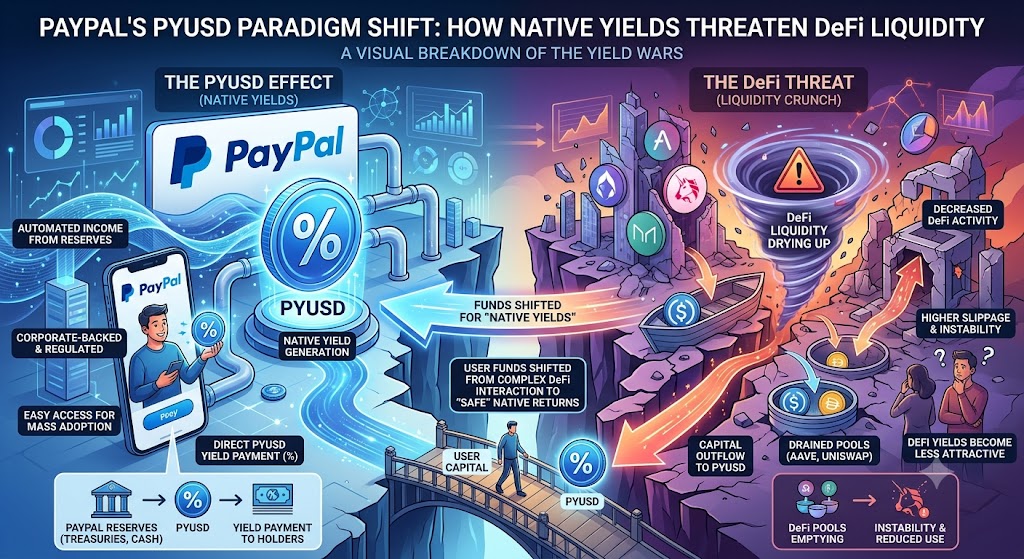
The digital asset ecosystem is undergoing a massive structural shift as the line between traditional financial infrastructure and decentralized finance (DeFi) continues to blur. Over the last 48 hours, a watershed moment occurred that directly challenges the current stablecoin hegemony. On August 2, 2026, payment giant PayPal, in collaboration with institutional crypto custodian Anchorage Digital, officially announced the launch of native, on-chain rewards for holders of PayPal USD (PYUSD).
While institutional stablecoin yields are not a new concept, the mechanics behind this specific partnership represent a true paradigm shift. Unlike traditional crypto yield generation, this new reward structure does not rely on rehypothecation, staking, or lending out the underlying assets. Instead, it passes a portion of the risk-free yield generated from the underlying US Treasury reserves directly to institutional PYUSD holders custodied at Anchorage.
As a Senior Editor and Analyst at MyCoinWay, I view this as a highly disruptive event that will actively drain liquidity from decentralized lending pools and aggressively reshape the peer-to-peer (P2P) stablecoin markets.
The Mechanics of "Risk-Free" On-Chain Yield
To understand the severity of this market shift, we must dissect how capital allocators currently generate yield on stablecoins. Historically, institutions holding USDT or USDC had to deploy their capital into DeFi lending protocols like Aave or Compound, or utilize centralized lending desks. This process inherently introduces smart contract risk and counterparty lending risk.
PayPal and Anchorage Digital are bypassing this entirely. Because PYUSD is fully backed by US dollar deposits, short-term US Treasuries, and similar cash equivalents, the reserves themselves generate a substantial yield in the current macroeconomic environment. By legally and mechanically passing this yield directly to the token holders without lending the tokens out, PayPal is offering what is effectively a "risk-free" native yield.
This removes the need for institutional capital to seek out yield in the DeFi ecosystem. Why would a hedge fund or treasury desk take on the smart contract risk of a decentralized lending pool for a 4.5% yield when they can simply hold PYUSD in a secure, institutional-grade custodian like Anchorage and receive a comparable, natively generated reward? This fundamental question is already beginning to trigger a massive capital rotation.
Market Pulse: DeFi Liquidity Drain and Funding Rates
The immediate mechanical fallout from this announcement will be felt most acutely within the DeFi lending sector. As institutional whales rotate their capital out of USDT and USDC liquidity pools and into PYUSD, decentralized lending protocols will face a severe liquidity drain.
In automated lending markets, borrowing rates are algorithmically determined by the utilization ratio of the capital pool. As capital leaves these platforms to capture PayPal's native yield, the supply of available stablecoins will shrink. This will mechanically force DeFi borrowing rates to spike. Traders who rely on borrowing stablecoins to leverage their long positions will face significantly higher capital costs. We expect perpetual futures funding rates to exhibit heightened volatility as traders adjust to the increased cost of stablecoin borrowing.
Furthermore, this capital flight impacts decentralized automated market makers (AMMs). Deep liquidity pools are required to facilitate large trades without slippage. If liquidity providers (LPs) pull their stablecoins to park them in Anchorage's PYUSD program, executing large block trades on decentralized exchanges will become more expensive, potentially widening inter-exchange spreads between DEXs and centralized tier-1 platforms.
P2P Spreads and Stablecoin Peg Deviations
The retail and P2P markets are also highly sensitive to this structural shift. While the Anchorage partnership is currently tailored for institutional clients, the broader market perception is that PYUSD is evolving into a superior, yield-bearing asset.
This shift in sentiment will likely cause a surge in retail demand for PYUSD. As demand spikes, we can expect to see micro-deviations in stablecoin pegs, with PYUSD potentially trading at a slight premium (e.g., $1.002) against USDT or USDC on major exchanges.
For P2P merchants, this creates a lucrative but volatile environment. Local P2P desks will see shifting volumes as users attempt to offload local fiat or USDT in exchange for PYUSD. We anticipate that P2P bid-ask spreads for PYUSD will widen in emerging markets as merchants price in the sudden supply-demand imbalance and the friction of sourcing sufficient PYUSD liquidity.
What to Track Next
Navigating this capital rotation requires strict observation of on-chain metrics rather than relying on market sentiment. Traders should monitor the following key indicators in the coming days:
- DeFi Utilization Rates: Monitor the supply of USDC and USDT on major lending protocols like Aave. A sharp decrease in total value locked (TVL) will confirm the institutional capital flight.
- PYUSD Peg Deviations: Track the PYUSD/USDT and PYUSD/USDC trading pairs. A sustained premium indicates aggressive market accumulation.
- P2P Stablecoin Spreads: Keep an eye on local P2P desks for widening fiat-to-PYUSD spreads, signaling a retail rush for the new asset.
- Perpetual Funding Rates: Watch for spikes in funding rates as the cost of borrowing stablecoins for leverage increases across the market.
The introduction of native, non-rehypothecated yield for stablecoins is not just a feature update; it is a direct challenge to the plumbing of decentralized finance. To successfully navigate this evolving liquidity landscape and track real-time P2P spreads and funding rate divergences, we highly recommend utilizing the MyCoinWay Market Pulse dashboard.
Disclaimer: This article is for informational and analytical purposes only. It does not constitute financial, investment, or legal advice. Cryptocurrency markets are highly volatile, and structural changes can lead to unpredictable price action. Always conduct your own research before making trading decisions.
Sources:
- PayPal and Anchorage Digital Joint Press Release on PYUSD Rewards (August 2, 2026).
- CoinDesk Market Analysis: Anchorage brings native yield to PYUSD.