Visa Turns Stablecoin Settlement Into an Onchain Credit Market
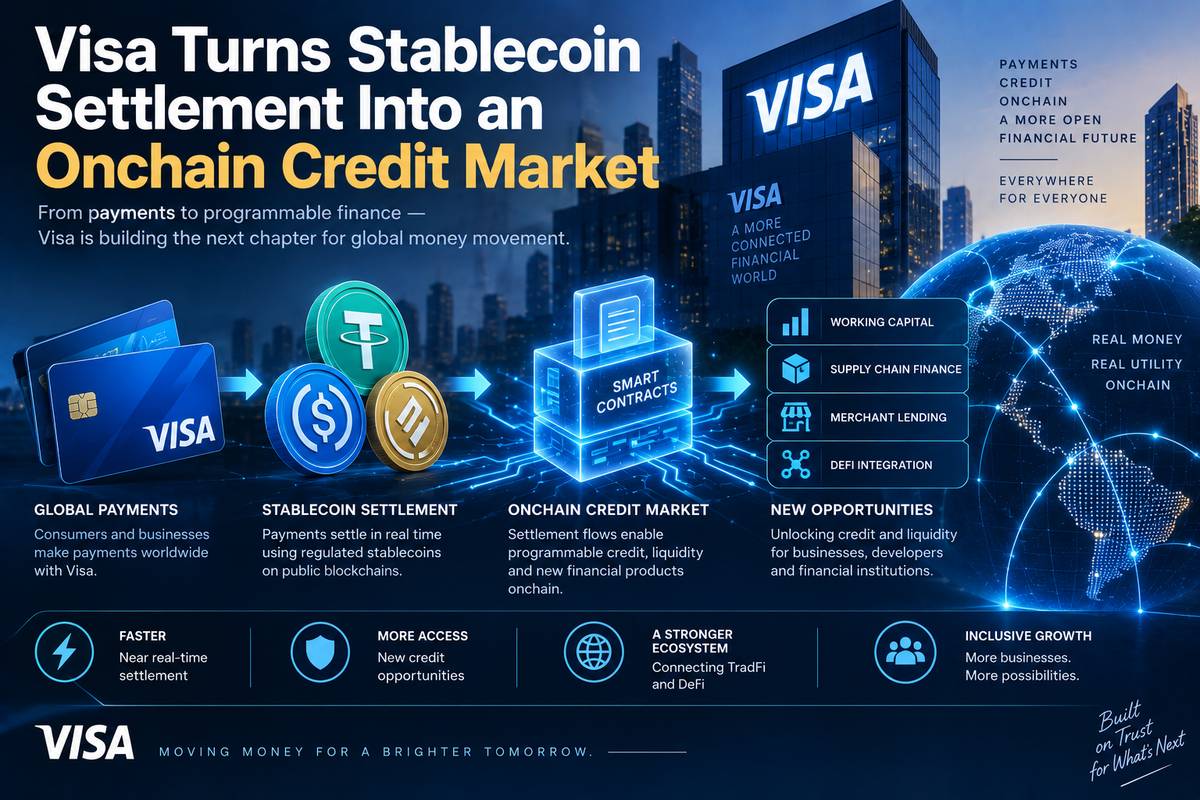
Visa's latest stablecoin milestone reveals something more interesting than another large crypto-related number.
On September 8, Visa said its stablecoin settlement volume had surpassed a $20 billion annualized run rate, more than 15 times its level a year earlier. More than 160 stablecoin-linked card programs were live globally in Visa's fiscal second quarter, while payment volume across those programs had increased nearly 200% year over year.
At the same time, Visa announced a new model that connects its settlement data with blockchain-based lending infrastructure to help some of those card programs finance their daily obligations.
The combination points to a counterintuitive problem: 24/7 money does not eliminate the need for credit. In some cases, it makes access to equally flexible credit more important.
What Visa's $20 billion figure actually means
The first distinction is essential.
Visa did not say consumers spent $20 billion through stablecoin cards during a quarter or a year.
The company said its stablecoin settlement volume recently surpassed a $20 billion annualized run rate.
An annualized run rate takes a recent level of activity and expresses what it would amount to over a year if that pace continued. It is therefore not the same thing as $20 billion of historical completed volume over the previous 12 months.
Settlement also represents a different layer of the payment process from consumer spending.
A customer might use a Visa-linked card at a merchant. Behind that payment, an issuer eventually has to settle what it owes through Visa's network. Stablecoins can be used in parts of this institutional settlement process.
Visa separately said that payment volume across its more than 160 stablecoin-linked card programs grew nearly 200% year over year.
These two statistics describe related but distinct activities.
Conflating them would exaggerate what the $20 billion figure tells us about consumer stablecoin spending.
Why card issuers need working capital
A card transaction does not necessarily move money from a cardholder to Visa at exactly the same moment.
Payment systems contain timing gaps.
An issuer may need to fund a settlement obligation before it has received the corresponding money from customers or associated wallets.
For mature card businesses, this type of funding is not new. Traditional lenders can provide warehouse lines or other credit facilities backed by receivables.
Visa argues that the economics can be different for younger stablecoin-linked card programs.
Some may need only a few million dollars of working capital during their early growth phase. They can also settle seven days a week, including weekends and holidays.
A traditional facility may take significant documentation, operating history and lender underwriting to establish. The fixed cost can be difficult to justify for a relatively small program that draws and repays capital on a daily cycle.
That creates a mismatch.
The payment infrastructure may operate continuously, but the financing supporting it may still be built around conventional banking processes.
How the onchain credit model works
Visa is working with Credit Coop on a stablecoin-denominated revolving credit facility designed around settlement obligations.
The structure has several components.
First, the participating card program has a settlement amount it needs to fund.
With the customer's authorization, Credit Coop receives relevant Visa settlement data through a secure data connection.
That data can then be used to determine how much financing is required for a settlement cycle.
Funds can be provided through an onchain revolving facility.
As cardholder proceeds arrive, they flow through a smart-contract mechanism that can automatically service interest and replenish the credit line.
Visa describes the underlying Credit Coop structure as being secured against settlement receivables rather than relying on a broad claim over all of the borrower's assets.
The important innovation is therefore not simply “a crypto loan.”
The system links a real payment-network obligation to a credit facility whose funding and repayment processes can operate programmatically.
Why 24/7 settlement creates a financing problem
This may appear paradoxical.
Stablecoins are often promoted precisely because they allow value to move outside banking hours. Why would faster settlement require more financing?
Because settlement speed and funding availability are separate variables.
Imagine a card program owes Visa money on a Sunday.
Its stablecoin infrastructure may be capable of settling immediately.
But if the company normally relies on a conventional credit line that cannot be drawn efficiently over the weekend, its financing schedule no longer matches its payment schedule.
A seven-day settlement system therefore works best with seven-day liquidity.
Onchain credit is one possible way to provide that liquidity.
It does not remove borrowing. It changes when the credit facility can operate and how draws and repayments can be executed.
What Visa has already disclosed
Visa says Credit Coop's model has supported more than $2.5 billion in cumulative financed settlement volume since 2023, with zero defaults across participating facilities.
The company also reported more than 3,000 borrow events and more than 9,000 repayment events executed onchain.
Rain, a Visa Principal Member involved in stablecoin-linked card programs, has used the facility since 2023. Visa says Rain alone has financed about $2 billion of settlement obligations through the structure.
Those figures are useful because they describe actual use rather than a future pilot.
But they also require context.
$2.5 billion of cumulative financed volume does not mean lenders currently have $2.5 billion outstanding.
A revolving facility can reuse capital repeatedly: money is borrowed, repaid and borrowed again.
Cumulative financed volume therefore measures activity through the system, not the amount of credit simultaneously at risk.
Does “zero defaults” prove the model is low risk?
No.
Zero defaults across the disclosed facilities is a meaningful operating record, but it does not establish that the structure is risk-free.
Credit risk still exists.
Settlement receivables need to materialize as expected.
Smart contracts and data integrations need to operate correctly.
Stablecoins used for funding need sufficient liquidity and reliable settlement.
Borrowers still need viable businesses.
And a three-year record provides information about the period observed, not a guarantee about future economic conditions.
The useful question is not whether blockchain eliminates credit risk.
It does not.
The question is whether better data and programmable collateral management can reduce some of the operational friction involved in managing that risk.
The bigger signal is the convergence of three systems
Visa's announcement connects three historically separate infrastructures.
The first is card-network settlement.
The second is stablecoin settlement, which can operate continuously.
The third is credit, traditionally provided through banking and capital-market structures.
The new model attempts to make the third layer operate more like the second.
That may prove more important than simply adding another stablecoin to Visa's supported network.
Stablecoins become materially more useful in traditional payments when the surrounding infrastructure — treasury, financing, reconciliation and liquidity management — can operate on similar schedules.
Otherwise, a 24/7 settlement asset remains attached to systems that still pause overnight or on weekends.
What the announcement does not prove
Visa's numbers do not show that stablecoins are replacing card-network fiat settlement globally.
A $20 billion annualized run rate remains only one part of Visa's much larger payment infrastructure.
The announcement also does not prove that onchain credit is cheaper for every issuer.
Financing costs depend on borrower quality, collateral, market conditions, lender competition and facility structure.
Nor does it establish that consumers prefer stablecoin-linked cards because settlement occurs in stablecoins. Most cardholders may never interact directly with the institutional settlement layer.
Finally, none of these figures provides a basis for predicting the price of Bitcoin, Ether or stablecoin-related tokens.
This is a payments-infrastructure event.
What to watch next
- Stablecoin settlement run rate: continued growth from the current $20 billion-plus annualized level would show that stablecoins are gaining a larger operational role inside Visa settlement.
- Number of stablecoin-linked card programs: expansion beyond the 160-plus programs reported for fiscal Q2 would indicate broader issuer adoption.
- Payment volume versus settlement volume: watching both separately will help distinguish consumer usage growth from changes in back-end settlement.
- Financing performance: default rates, borrowing costs and the number of programs using these facilities will show whether onchain credit offers a durable financing model.
- Weekend and daily settlement adoption: broader use of seven-day settlement would strengthen the case for equally continuous treasury and credit infrastructure.
Conclusion
Visa's $20 billion stablecoin settlement run rate is important, but the more revealing development may be the credit infrastructure forming around it.
Stablecoins can move value continuously. Card issuers still need to finance obligations, manage receivables and bridge timing gaps.
Visa's experiment with settlement-data-driven onchain lending shows that the next phase of payment tokenization is not simply about replacing dollars with digital tokens.
It is about rebuilding the financial processes surrounding those dollars — settlement, collateral, credit and treasury management — so they can operate on the same timetable.
That is a more difficult problem than launching a stablecoin.
It may also be a more consequential one.
Sources
Visa — Visa Brings Onchain Lending into Everyday Payments
Visa — Financing a Hundred Stablecoin-Linked Card Programs
Visa — How Onchain Credit Supports Stablecoin-Linked Card Issuers
The Block — Visa Stablecoin Settlement Tops $20 Billion Annualized Run Rate
Quartz — Visa Links Settlement Data With Blockchain Lenders
Disclaimer
This material is for informational and analytical purposes only and does not constitute financial, investment, legal or tax advice.