Tether Puts USDT Into a $400M Private Credit Fund
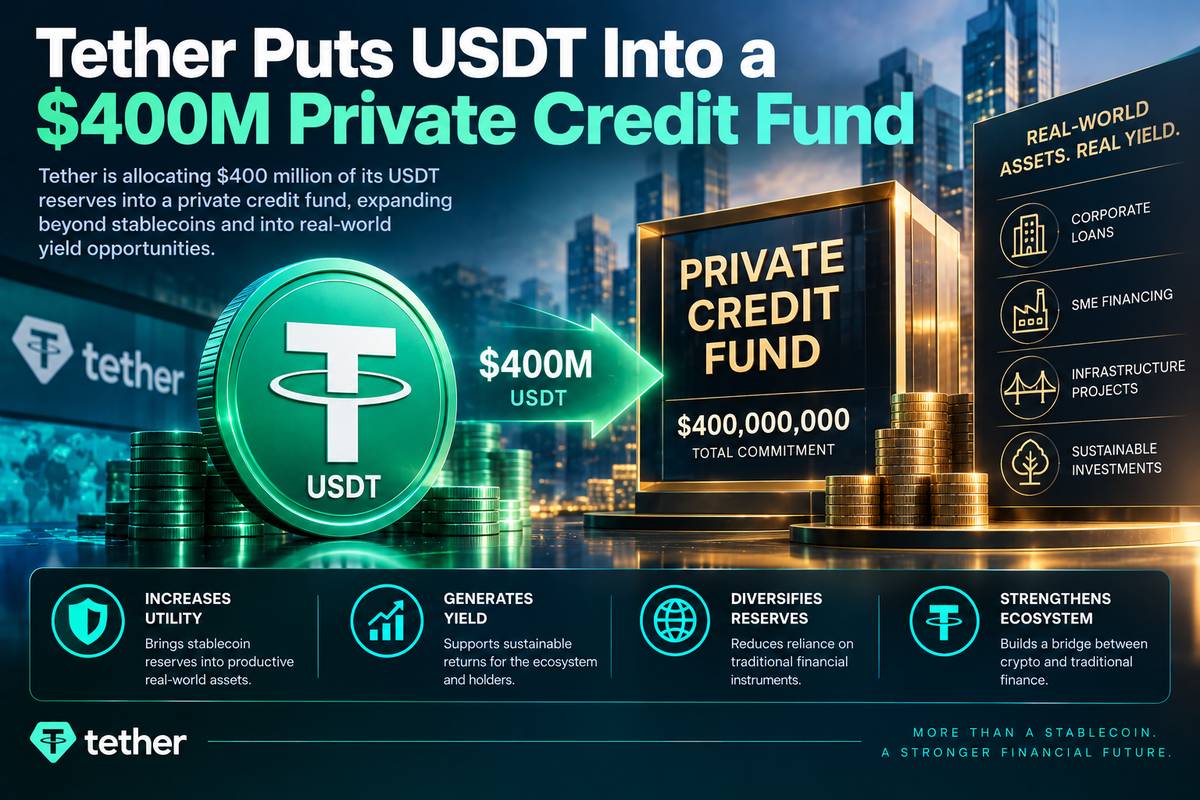
Tether is moving USDT into a part of financial infrastructure that has little to do with crypto trading.
On September 9, Tether and Fasanara Capital announced StableFund, an evergreen private-credit vehicle anchored by $400 million of co-investment from the two firms. The fund plans to seek up to $3 billion from external institutional investors.
Fasanara will manage the investments, deploying capital through fintech lending platforms operating in more than 60 countries. Tether will source USDT-linked financing opportunities and provide stablecoin infrastructure for moving capital across borders.
That makes the announcement more interesting than a conventional crypto-finance fund launch.
The key question is not whether USDT can move money quickly.
It is what happens when that faster settlement layer is attached to traditional private credit.
The $400 million is fund capital, not $400 million of new USDT
The first distinction matters.
StableFund is anchored by $400 million of co-investment from Tether and Fasanara. The companies are targeting as much as $3 billion of additional third-party institutional capital.
That does not mean $400 million of USDT has already been issued or that $400 million of stablecoins has been deployed into loans.
The fund's capital and the stablecoin infrastructure used to move money are separate layers.
Fasanara is responsible for investment management and credit deployment. Tether's role includes sourcing USDT-linked opportunities and providing infrastructure for on- and off-ramp connectivity and treasury movement.
That distinction will matter when future reports start publishing fund size, loan originations and stablecoin transaction volumes.
They are not interchangeable metrics.
What does USDT actually add?
Private credit already has mechanisms for moving dollars internationally.
The potential advantage of a stablecoin rail is different: settlement can become programmable, available around the clock and less dependent on the operating windows of traditional correspondent banking.
StableFund is designed to finance short-duration, asset-backed loans through fintech lenders.
Those lenders can operate in different jurisdictions and currencies, while the capital movement between participants can use digital-dollar infrastructure.
The result is not necessarily an on-chain loan.
It is better understood as an off-chain credit business with a stablecoin-enabled movement of capital.
That difference is crucial.
The underlying borrower can still be a small business or consumer.
The loan can still be originated, underwritten, serviced and collected through conventional fintech infrastructure.
USDT can simply become the settlement layer between parts of that system.
Faster settlement does not remove credit risk
This is where the announcement should not be oversold.
Stablecoins can potentially reduce settlement friction.
They do not automatically improve underwriting.
A short-duration, asset-backed loan can still default.
Collateral can still lose value.
A fintech originator can still fail.
A borrower can still become delinquent.
Cross-border compliance can still create operational friction.
In other words, StableFund may change the plumbing of private credit without changing the fundamental economics of credit risk.
That distinction is particularly important because the fund is targeting small and medium-sized businesses and consumers through fintech platforms in more than 60 countries.
The geographic reach creates an opportunity for capital efficiency, but it also creates multiple regulatory, operational and underwriting environments.
The interesting part is the connection between crypto and private credit
Tether has historically been best known as the issuer of USDT.
StableFund extends that role.
Instead of USDT simply functioning as a digital dollar for trading and payments, the token becomes part of a capital-allocation workflow.
That is a different use case.
The broader private-credit market is already enormous. Tether says the market is approximately $3 trillion globally, while the fund's strategy focuses on short-duration, asset-backed financing.
The potential advantage for Tether is therefore not just another source of USDT transaction volume.
It is deeper integration between the stablecoin ecosystem and real-world financial activity.
But the announcement does not prove that this integration will scale.
The fund still needs external institutional capital, loan demand, viable underwriting and repeatable settlement flows.
On-chain money does not mean on-chain credit
This may be the most important distinction for users trying to understand the announcement.
A stablecoin can move on a blockchain.
That does not mean the loan itself exists on-chain.
StableFund is described as using USDT infrastructure to support lending through fintech platforms.
That means the blockchain layer can handle part of the movement of capital while the economically important credit records remain in conventional systems.
This creates a hybrid architecture:
capital → stablecoin rail → fintech lender → borrower
rather than:
tokenized loan → blockchain → borrower
The difference affects transparency, risk management and what investors can actually verify on-chain.
A blockchain transaction can show that USDT moved.
It cannot by itself prove that the underlying borrower is solvent, that collateral is adequate or that a loan will be repaid.
Why the $3 billion target matters more than the headline
The $400 million anchor is tangible.
The $3 billion target is a test.
If third-party institutional investors commit significant capital, StableFund could become more than a strategic experiment between Tether and Fasanara.
If external fundraising remains limited, the announcement may prove more important as an infrastructure demonstration than as a major new credit channel.
This is why future capital raised is a more useful adoption metric than the initial headline.
The same applies to actual loan deployment.
A $3 billion target is not $3 billion of loans.
It is an objective that still has to be achieved.
What could go wrong?
There are several layers of risk.
First is credit risk: borrowers can default.
Second is originator risk: fintech lending platforms can have different underwriting and servicing standards.
Third is operational risk: cross-border systems still require compliance, reconciliation and controls.
Fourth is stablecoin infrastructure risk: the settlement rail introduces its own dependencies.
Fifth is liquidity risk: moving money faster does not guarantee that capital can always be converted efficiently between digital dollars and local currencies.
Finally, there is a transparency question.
StableFund may create blockchain-visible movement of capital without creating blockchain-visible information about every underlying loan.
That means investors should not confuse transaction transparency with credit transparency.
What to watch next
- Third-party capital raised: progress toward the $3 billion target will show whether institutional investors accept the structure beyond the two sponsors.
- Loan originations: actual deployed credit is more meaningful than announced fund size.
- USDT settlement volume connected to the fund: rising activity would indicate that the stablecoin rail is being used rather than merely marketed.
- Geographic and borrower diversification: concentration across countries, originators or borrower types would reveal how diversified the credit book actually is.
- Delinquencies and losses: these are essential for determining whether faster settlement translates into a viable credit model rather than simply faster money movement.
Conclusion
StableFund is an important test of a broader idea: stablecoins may become financial infrastructure even when the underlying financial asset is not itself tokenized.
Tether and Fasanara are starting with $400 million of sponsor capital and targeting up to $3 billion from outside institutions.
But the real experiment is the connection between private credit and digital-dollar settlement.
USDT can potentially make cross-border movement of capital faster and more flexible.
It cannot eliminate borrower defaults, underwriting mistakes, collateral losses or operational risk.
The next meaningful evidence will therefore not be another announcement.
It will be external capital raised, actual loans originated, stablecoin settlement activity and the performance of the underlying credit book.
Sources
Tether — StableFund announcement
Financial Times — Tether launches private-credit fund with Fasanara
CoinDesk — Tether pushes into private credit with $400 million fund
Disclaimer
This material is for informational and analytical purposes only and does not constitute financial, investment, legal or tax advice.