Bitwise Is Closing Its Dogecoin ETF: What Happens to BWOW?
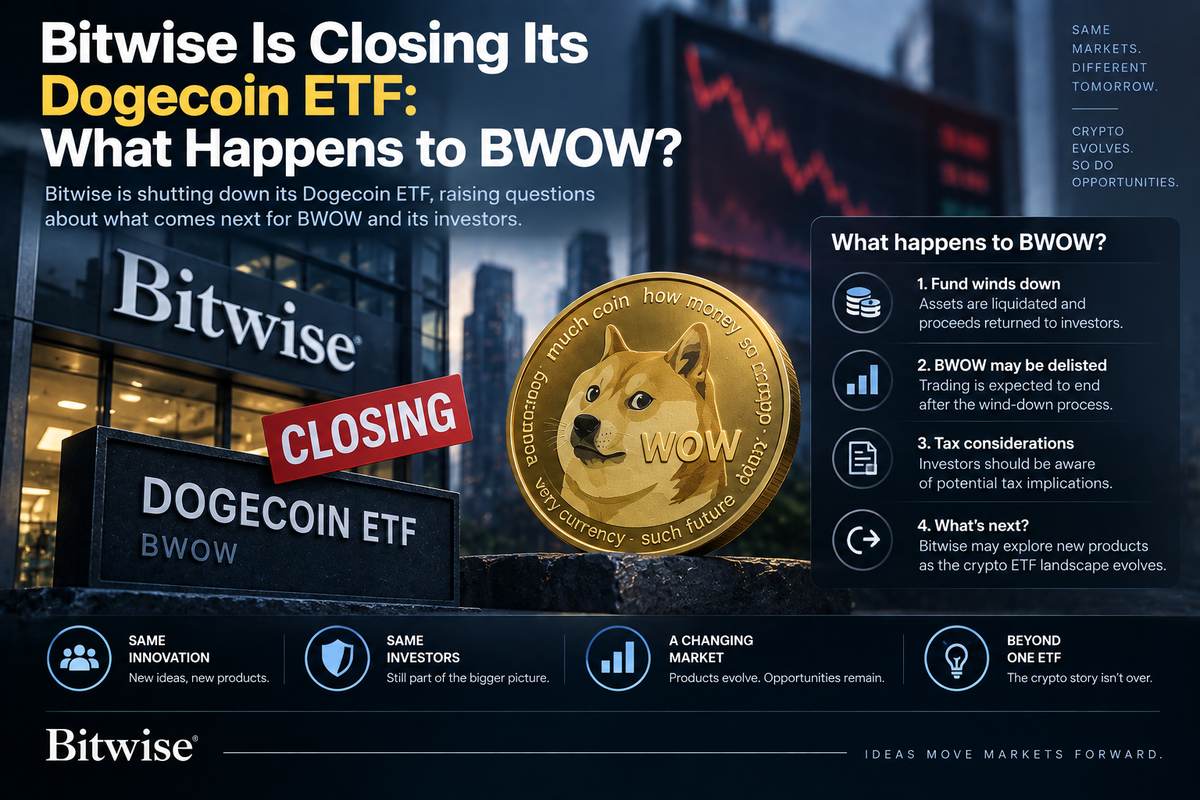
Bitwise is closing its Dogecoin ETF less than a year after the fund began trading, creating a practical question that ETF launch headlines rarely address: what actually happens when a spot crypto fund shuts down?
On September 10, Bitwise Investment Advisers notified NYSE Arca that it had voluntarily decided to close, delist and liquidate the Bitwise Dogecoin ETF, ticker BWOW. The SEC filing sets out a defined wind-down rather than an immediate shutdown.
The expected last trading day is October 14. Creation of new shares will cease before the market opens on October 15, secondary-market trading will stop, and the fund's holdings are scheduled to be liquidated by October 22 or shortly thereafter. Investors still holding BWOW through the process are expected to receive cash based on the fund's net asset value.
The event matters beyond Dogecoin because it demonstrates how the exit mechanics of a single-asset crypto ETF work — and why “ETF liquidation” should not be confused with an instantaneous market sale on announcement day.
What Bitwise actually announced
Bitwise described the decision as part of an effort to optimize its product range for evolving investor needs. It did not state in the filing that Dogecoin itself had failed, nor did it identify a particular DOGE price level as the reason for closing the fund.
The timetable is more useful than trying to infer an unstated motivation.
Bitwise expects October 14 to be BWOW's final day of normal NYSE Arca trading.
Before the market opens on October 15, the fund will stop accepting new share creations and secondary-market trading will be halted.
Its portfolio will then enter liquidation.
The SEC filing says the holdings should be liquidated by October 22 or shortly thereafter. Bitwise's accompanying release says remaining investors are expected to receive cash on October 22 based on NAV calculated as of October 21.
That sequence means September 10 was the announcement date, not the date on which the entire DOGE position necessarily disappeared from the fund.
What can a BWOW shareholder do?
There are effectively two paths.
A shareholder can sell BWOW on the exchange while normal trading remains available through October 14.
In that case, execution depends on the secondary market: the prevailing share price, bid-ask spread and available liquidity.
Alternatively, an investor can continue holding BWOW into the liquidation.
Bitwise says shareholders remaining at the end of the process do not need to take action. Their shares will be automatically redeemed and cash distributed through their brokerage accounts.
Those two outcomes are economically related but not identical.
A secondary-market sale gives the investor a market price at the time of execution.
Holding through liquidation means waiting for the fund's assets to be disposed of and receiving the resulting NAV-based cash distribution.
The SEC also warns that such cash distributions can constitute taxable events. The tax consequences depend on the investor's circumstances and jurisdiction.
Does Bitwise now have to sell DOGE?
BWOW's primary asset is Dogecoin. Its June 30 filing describes DOGE as the trust's sole asset.
Closing the product therefore ultimately requires the fund to turn its remaining portfolio into cash before distributing proceeds to shareholders.
But timing matters.
The September 10 announcement should not be described as evidence that Bitwise immediately dumped its entire DOGE position into the spot market that day.
The filing says portfolio liquidation occurs as part of the later wind-down process.
It also does not specify the exact execution schedule, venues, individual trade sizes or prices at which the remaining holdings will be sold.
Without those facts, claiming a precise DOGE sell-pressure impact would go beyond the evidence.
Could liquidation affect DOGE liquidity?
Potentially, but scale and execution determine the effect.
A spot crypto fund undergoing liquidation converts underlying assets into cash. Other things equal, selling DOGE creates sell-side flow.
That statement alone does not tell us whether the flow will materially move Dogecoin's global market.
The relevant variables include the quantity of DOGE remaining in BWOW when liquidation begins, overall spot liquidity, trading volume at the time of execution and how the liquidator breaks up the orders.
Bitwise's June 30 report showed the trust holding approximately 6.56 million DOGE valued at roughly $474,000 at that reporting date.
That is useful historical context, but it should not be treated as the fund's current September holdings. Creations, redemptions, expenses and DOGE's market value can all change the position over time.
A current holdings figure would therefore be preferable before estimating any potential market impact.
Does the closure prove institutions do not want Dogecoin?
No.
It does provide evidence that this particular investment product did not remain sufficiently compelling for its sponsor to keep it in the lineup.
That is narrower than saying institutional demand for DOGE has disappeared.
ETF survival depends on several factors: assets under management, trading volume, spreads, operating costs, competitive products, distribution agreements and the sponsor's broader product strategy.
Bitwise manages dozens of investment products. Closing an individual fund is a product-management decision as well as a market-demand signal.
The closure becomes more informative when compared with other Dogecoin products and with crypto ETFs targeting different assets.
If multiple DOGE vehicles consistently fail to attract assets while comparable products succeed, the evidence for a broader demand problem becomes stronger.
One fund closure by itself is insufficient to establish that conclusion.
Why ETF liquidity matters before the final day
Investors who intend to sell before October 14 should distinguish the ETF share market from the DOGE market itself.
BWOW shares trade on NYSE Arca.
DOGE trades across crypto venues globally.
Normally, ETF creation/redemption mechanisms and market makers help connect the value of fund shares to their underlying assets.
During a wind-down, however, creations eventually stop and the product approaches its final trading date.
That makes share-level liquidity, spreads and the relationship between market price and NAV especially relevant.
A thinly traded ETF can have a wider bid-ask spread even when its underlying cryptoasset remains highly liquid elsewhere.
The fund closing therefore creates two separate liquidity questions:
How easily can investors exit BWOW?
And how efficiently can the fund itself dispose of its underlying DOGE?
They should not be treated as the same metric.
What the closure does not prove
The announcement does not prove that Bitwise sold all DOGE on September 10.
It does not establish that a subsequent DOGE price movement was caused by the ETF closure.
It does not show that all Dogecoin investment products are economically unviable.
And it does not mean BWOW shareholders who take no action simply lose their investment.
According to the disclosed liquidation process, remaining shareholders are due to receive cash following the wind-down.
What to watch next
- BWOW assets and DOGE holdings: an updated holdings figure will indicate how much underlying DOGE remains to be liquidated. A smaller position would reduce the potential direct market footprint.
- BWOW trading volume and bid-ask spread: deteriorating share liquidity before October 14 could increase execution costs for shareholders choosing to exit on exchange.
- Market price versus NAV: a widening discount would show that the secondary market is becoming less efficient as the fund approaches closure.
- DOGE spot volume around the liquidation window: unusually large volume during the fund's disposal period would provide context for assessing whether the liquidation is significant relative to the broader market.
- Other Dogecoin ETF assets and flows: persistent weakness across multiple products would provide stronger evidence about regulated-investment demand than BWOW's closure alone.
Conclusion
BWOW's closure is more useful as a lesson in ETF mechanics than as a verdict on Dogecoin.
Bitwise announced the decision on September 10, but shareholders still have a trading window through October 14. Those who remain through liquidation are expected to receive a cash distribution after the fund converts its remaining portfolio.
The important distinction is between the closure announcement, the end of exchange trading and the actual disposal of the underlying DOGE.
Only the last of those directly creates fund-driven DOGE selling.
For market analysis, the useful next data are therefore current holdings, BWOW liquidity, NAV deviations and the scale of any eventual liquidation relative to the wider DOGE spot market — not an assumed price reaction to the headline.
Sources
SEC — Bitwise Dogecoin ETF Form 8-K
SEC — Bitwise liquidation press release