Zcash ETF Tops $500M — But That Is Not $500M of New Money
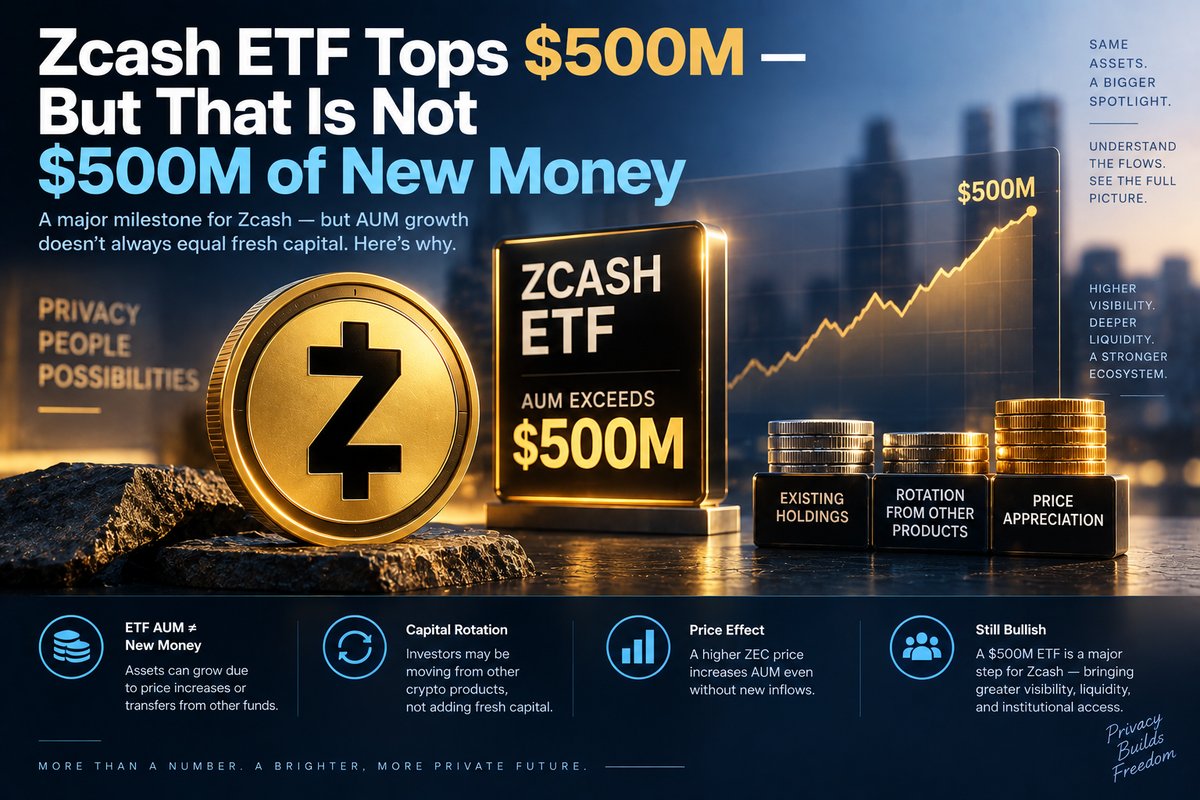
The Zcash ETF has crossed $500 million in assets under management less than three weeks after beginning trading on NYSE Arca.
That sounds like a simple institutional-demand story.
It is not.
On September 8, Grayscale disclosed that The Zcash ETF, ticker ZCSH, had grown beyond $500 million in AUM. The same day, DCG International Investments acquired roughly $100 million of fund shares by contributing 85,705.32563297 ZEC through an Authorized Participant or its designee. Grayscale also said the fund had recorded more than $70 million of cumulative inflows since its August 25 NYSE Arca debut.
Options on ZCSH also began trading on NYSE Arca.
Those are meaningful developments. But they represent three different things: the size of the fund, new capital entering the product and an exchange of already-owned ZEC for ETF shares.
Understanding the distinction matters much more than the $500 million headline.
$500 million AUM is not $500 million of fresh inflows
The biggest potential misunderstanding is the fund's age.
ZCSH did not appear from nothing on August 25.
SEC filings show that the vehicle was previously called Grayscale Zcash Trust (ZEC). It was formed in 2017 and its shares had traded on OTCQX before the trust was renamed The Zcash ETF and moved to NYSE Arca.
That means some ZEC and shareholder capital were already inside the vehicle before the exchange-traded launch.
So when Grayscale says AUM has exceeded $500 million, that figure describes the total value of assets currently held by the product.
It does not mean investors supplied more than $500 million of new cash after August 25.
Grayscale provided a more relevant figure for that question: more than $70 million in cumulative inflows since the NYSE Arca launch, excluding the separately described $100 million DCG investment.
This is a much better way to interpret the early adoption of the new exchange-traded structure.
The DCG transaction was not a $100 million spot purchase
The second important distinction concerns DCG.
The SEC filing states that on September 8 DCG acquired approximately $100 million of ZCSH shares in exchange for 85,705.32563297 ZEC.
This was an in-kind transaction.
DCG contributed ZEC and received fund shares with approximately the same economic value.
That is very different from an investor sending $100 million of dollars into the market and instructing a fund manager to buy ZEC.
The transaction increased the amount of ZEC held by the fund, but the filing does not establish that 85,705 ZEC were purchased on the open market on September 8.
They were contributed to the ETF.
This distinction is critical when interpreting ETF headlines as crypto-market flows.
A cash creation can require an intermediary to acquire the underlying asset.
An in-kind creation can instead move already-owned tokens from one holder into the fund structure.
Both increase ETF assets. Their immediate effect on spot-market demand can be very different.
Why ETF AUM can rise without equivalent net inflows
There is another component behind AUM: the price of ZEC itself.
AUM is broadly the value of the assets held by a fund.
If the fund owns the same number of ZEC tomorrow but ZEC rises 10%, the dollar value of the fund's assets also rises by approximately 10%, before considering other changes.
No new investor money is required for that increase.
That makes three separate forces behind ZCSH's AUM:
existing assets that were already inside the former trust;
new creations and inflows;
changes in the market value of the ZEC held by the product.
Analysts therefore should not use a change in AUM as a substitute for net flow data.
What does the ETF actually hold?
Grayscale's product page reported approximately $532.9 million in AUM as of September 8 and about 464,515 ZEC held by the fund.
It also showed roughly 0.0801 ZEC per share and a market price close to NAV at the September 8 close.
The fund's prospectus makes another important point: owning ZCSH shares is not the same as directly owning ZEC.
The trust owns the underlying tokens. Investors own shares representing an interest in the trust.
They do not receive ZEC private keys and ordinary shareholders cannot individually redeem a single share directly for the underlying cryptocurrency. Creation and redemption mechanisms operate through Authorized Participants and specified basket structures.
That distinction is standard for many crypto exchange-traded products, but it matters particularly for an asset whose investment narrative includes privacy and self-custody.
ETF exposure removes the operational burden of holding ZEC directly.
It also removes some of the properties of direct ownership.
What the launch of options changes
September 8 also brought options trading on ZCSH.
That adds another layer of market infrastructure.
Options allow investors to express views on volatility and direction, hedge existing positions and build strategies that do not require simply buying or selling the ETF.
For institutional markets, this can make the product more usable.
A market maker holding ZCSH shares may use options for risk management. An investor can buy downside protection. Other traders can take volatility positions.
But options activity should not automatically be interpreted as bullish demand for ZEC.
An options market contains both bullish and bearish positions.
Its more important contribution may be improved hedging and price discovery.
Does the ETF create demand for scarce ZEC?
Potentially — but the mechanism matters.
When genuinely new ETF shares are created and the fund receives additional ZEC, more tokens become held inside the trust structure.
Grayscale's September 8 disclosure confirms that post-listing inflows and the DCG contribution have increased the fund's scale.
That can matter in a market with a limited circulating supply.
But several conclusions would go beyond the available evidence.
We cannot assume every dollar increase in AUM required an equivalent spot purchase.
We cannot assume DCG bought its contributed ZEC immediately before the transaction.
And we cannot infer how long future ETF shareholders will hold their positions.
Creations can eventually be followed by redemptions.
Institutional access makes flows easier in both directions.
Why the old trust history matters
The conversion from an OTC product into an NYSE Arca-listed structure is arguably as important as the headline AUM.
Before the exchange listing, the trust had historically traded at premiums and discounts to the value of the ZEC backing its shares.
The current structure provides ongoing creation and redemption mechanisms through Authorized Participants.
Those mechanisms are designed to help market prices remain closer to underlying NAV because professional intermediaries can respond when meaningful gaps emerge.
As of September 8, Grayscale reported the market price only slightly below NAV.
One day does not establish a long-term pattern, but the premium/discount is now one of the most useful metrics for evaluating whether the market structure is functioning efficiently.
What the event does not prove
The $500 million milestone does not prove that $500 million of fresh institutional money entered ZEC.
It does not prove that ZEC's recent price movement was caused by the ETF.
Several factors can influence cryptocurrency prices simultaneously, including broader risk sentiment, liquidity, derivatives positioning, token-specific developments and existing holders changing their exposure.
The DCG contribution also should not be described as a $100 million spot-market inflow.
And the launch of options is not automatically bullish.
The strongest confirmed conclusion is narrower: ZCSH has quickly gained scale as an exchange-traded product, recorded meaningful new creations after listing, received a large in-kind contribution and now has a derivatives layer around its shares.
What to watch next
- Net creations and redemptions: these show whether ZEC is actually entering or leaving the fund rather than simply changing in dollar value.
- Total ZEC held: rising token holdings provide a cleaner measure of accumulation inside ZCSH than AUM alone.
- NAV premium or discount: persistent deviations would indicate friction between the ETF share market and the value of its underlying ZEC.
- Options volume and open interest: growing activity would show that ZCSH is developing a deeper derivatives ecosystem rather than remaining only a spot-exposure vehicle.
- Daily share trading liquidity: sustained volume and tighter bid-ask spreads would make the ETF more practical for larger investors.
Conclusion
ZCSH crossing $500 million is significant, but the number needs to be unpacked.
The fund existed before its NYSE Arca debut, so total AUM is not equivalent to new ETF inflows.
Grayscale separately reports more than $70 million of cumulative inflows after the listing, while DCG added another approximately $100 million through an in-kind contribution of 85,705 ZEC.
Those are much more informative numbers.
The next test is not whether ZCSH can produce another large AUM headline.
It is whether the fund continues to accumulate ZEC through net creations, maintains efficient pricing around NAV and develops enough spot and options liquidity to become a durable institutional market for Zcash exposure.
Sources
SEC — ZCSH Form 8-K, September 8, 2026
SEC — Grayscale ZCSH announcement
CoinDesk — Zcash ETF crosses $500 million
Disclaimer
This material is for informational and analytical purposes only and does not constitute financial, investment, legal or tax advice.