S&P Global Backs Kaiko as Tokenized Markets Need Better Data
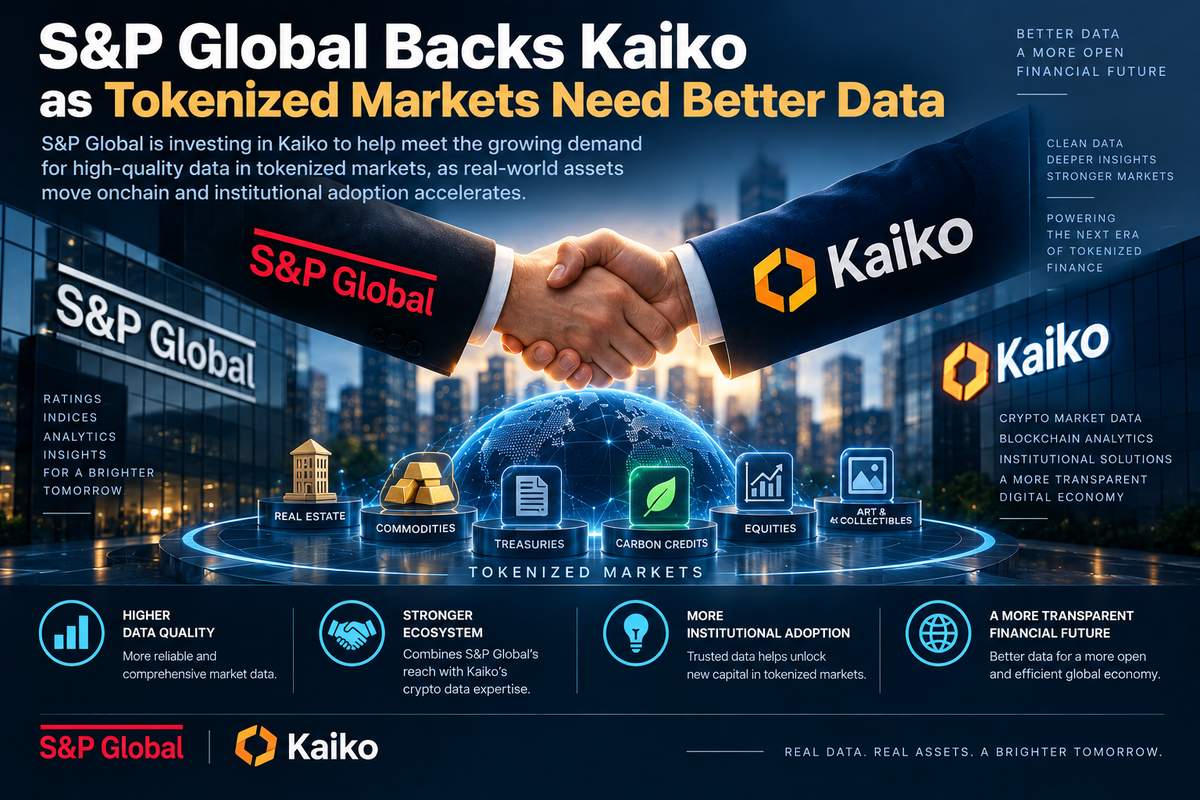
S&P Global is leading a strategic investment in crypto-data provider Kaiko, but the most useful part of the announcement is not the funding number.
Kaiko said on September 14 that the transaction extends its Series B to $110 million. Participants include BNP Paribas, Bpifrance, Broadridge, Canton Foundation, Coinbase Ventures, DRW Venture Capital, Nasdaq Ventures, Royal Bank of Canada, Stellar and Susquehanna Private Equity Investments, alongside existing shareholders.
At the same time, participating institutions are joining a Kaiko-chaired Strategic Industry Working Group focused on the data infrastructure needed for tokenized markets.
That combination matters. Banks, exchanges, index providers, trading firms and blockchain organizations are not only investing in a crypto-data vendor. They are positioning themselves around a less visible problem in onchain finance: how do institutions price, value, compare and reconcile assets when markets operate continuously across multiple venues and blockchains?
First, $110 million does not mean a new $110 million check
The headline requires an important clarification.
Kaiko says the latest transaction extends its Series B to $110 million. Reuters likewise describes the financing as bringing the round to that level.
That is not the same as saying investors supplied $110 million of fresh capital on September 14.
Kaiko had already raised a $53 million Series B in 2022, according to reporting cited by The Block. The company has not publicly broken out the exact amount contributed by each investor in the latest extension or disclosed its new valuation.
For users assessing financing headlines, this distinction is useful:
round size describes the total financing associated with that round after extensions;
new capital in the latest transaction describes only the additional money being added now.
The available announcements establish the first number, not a complete investor-by-investor breakdown of the second.
Why market data becomes harder when assets move onchain
Traditional capital markets already depend heavily on pricing data.
A fund needs a valuation. An index needs reference prices. A risk system needs consistent inputs. A trader needs to know whether prices on different venues are actually comparable.
Tokenization does not remove those requirements.
It can make them more complicated.
Crypto markets operate 24 hours a day, seven days a week. The same asset can trade on centralized exchanges, decentralized protocols or multiple blockchain networks. Liquidity can be fragmented, and different venues can show different prices or depth at the same moment.
Kaiko says its current infrastructure covers more than 150 exchanges and protocols and provides market data, analytics, indices and related services for institutional users.
As Treasury instruments, money-market funds, equities or bonds gain tokenized representations, institutions need to answer questions that are familiar in finance but technically different on blockchain rails:
Which price should determine NAV?
How should an asset be valued outside traditional market hours?
What happens if one venue diverges sharply from the rest?
How should onchain transactions be reconciled with conventional books and records?
And how can data be delivered reliably to a smart contract rather than only to a human terminal?
Those are infrastructure problems, not token-price problems.
Why 24/7 markets need 24/7 reference data
A tokenized asset can theoretically trade while its traditional counterpart is closed.
That creates an unusual pricing problem.
Suppose a tokenized equity changes hands on Sunday. The underlying conventional stock does not have a normal Sunday closing price.
The market therefore needs a framework for deciding what available data represents a meaningful valuation.
The same problem already exists in crypto. Bitcoin can trade at different prices across exchanges, while available liquidity near those quotes can differ substantially.
A single last-traded price is therefore not always enough.
Institutions may need consolidated prices, venue-quality filters, liquidity information and rules for rejecting anomalous observations.
This is where data infrastructure becomes part of market infrastructure.
The investment does not prove that any particular model has become the standard. But the composition of the investor group shows why established financial companies increasingly care about the layer between blockchain transactions and institutional valuation systems.
The working group may matter as much as the funding
Kaiko’s announcement says the strategic investors have also joined an industry working group chaired by the company.
That is potentially more consequential than a passive equity investment.
The participants span different parts of financial infrastructure. S&P Global operates benchmarks and analytics; Nasdaq runs exchange infrastructure; BNP Paribas and RBC are major banks; DRW and Susquehanna are trading firms; Coinbase and Stellar represent crypto-native infrastructure.
Their requirements are not identical.
A bank may care about valuation, controls and regulatory records.
A trading firm may prioritize latency and executable liquidity.
An index provider needs robust methodologies and reliable reference data.
A blockchain application may need data that can be delivered directly onchain.
If tokenized finance scales, those different systems have to agree on enough common data conventions to interact.
The existence of a working group does not mean an industry standard has already been created. Kaiko has not announced one.
It does show that the investors are participating in the infrastructure discussion rather than simply providing capital.
This is not direct institutional buying of crypto
The transaction should also be separated from asset-demand headlines.
S&P Global, BNP Paribas or Nasdaq investing in Kaiko does not mean those institutions bought Bitcoin or Ether through the financing round.
They bought exposure to a data-infrastructure company.
That distinction matters because “institutional crypto adoption” can describe several very different activities:
holding cryptoassets;
offering custody or trading;
issuing tokenized products;
building indices;
or supplying the data and technology required for those markets.
Kaiko sits primarily in the last category.
The investment therefore provides stronger evidence of institutional demand for crypto-market infrastructure than it does for directional demand for any token.
What would prove the thesis is working?
Funding gives Kaiko resources. It does not demonstrate that tokenized markets will necessarily achieve large-scale adoption.
The stronger evidence will appear in usage.
Kaiko says it already supports more than 250 financial firms, institutions and regulators globally, and recently acquired Amberdata and MiCA-regulated DeFi infrastructure provider Cometh. It also launched the S&P Kaiko Digital Asset Indices with S&P Dow Jones Indices.
Those are concrete infrastructure developments.
But the bigger claim — that onchain capital markets require a new institutional data layer — will need to be tested by actual tokenized assets, trading activity and institutional workflows.
The question is not simply how many datasets exist.
It is whether institutions rely on those datasets to price, trade, settle and manage risk in production.
What to watch next
- Institutional adoption of Kaiko data: new integrations with banks, exchanges, custodians or asset managers would show that the financing is translating into production use.
- Tokenized assets using institutional benchmarks: more funds, bonds or other instruments relying on digital-asset reference data would demonstrate actual demand for the infrastructure.
- Cross-venue price dispersion: narrower, more consistently measurable differences can indicate a more mature market; persistent fragmentation would make high-quality consolidated data even more important.
- 24/7 trading volume in tokenized products: sustained activity outside conventional trading sessions would strengthen the case for continuous valuation infrastructure.
- Outputs from the Strategic Industry Working Group: published methodologies, standards or technical integrations would be more meaningful than the group’s existence alone.
For MyCoinWay, the broader lesson is familiar: a price is most useful when its source, market and liquidity context are clear. Cross-venue differences can contain information, but they are not automatically executable opportunities.
Conclusion
S&P Global’s investment in Kaiko is not primarily a bet that one cryptocurrency will appreciate.
It is a bet on the infrastructure required if more financial assets trade on blockchain rails.
The $110 million figure needs to be read correctly: it is the size to which Kaiko’s Series B has been extended, not a confirmed $110 million of entirely new capital arriving in one transaction.
The more important development is the group behind the investment.
Banks, exchanges, trading firms, index providers and blockchain organizations are increasingly confronting the same problem: tokenized markets still need trusted prices, valuation methods and data that works continuously.
If onchain finance becomes a significant part of capital markets, reliable data may turn out to be less visible than the tokens themselves — but no less essential.
Sources
Kaiko — S&P Global Leads Strategic Investment in Kaiko
S&P Global — Strategic Investment in Kaiko
Reuters — Crypto data firm Kaiko secures funding led by S&P Global
The Block — S&P Global leads Kaiko Series B extension
Disclaimer
This material is for informational and analytical purposes only and does not constitute financial, investment, legal or tax advice.