SoFi and Kraken Link 24/7 Dollars With Crypto Markets
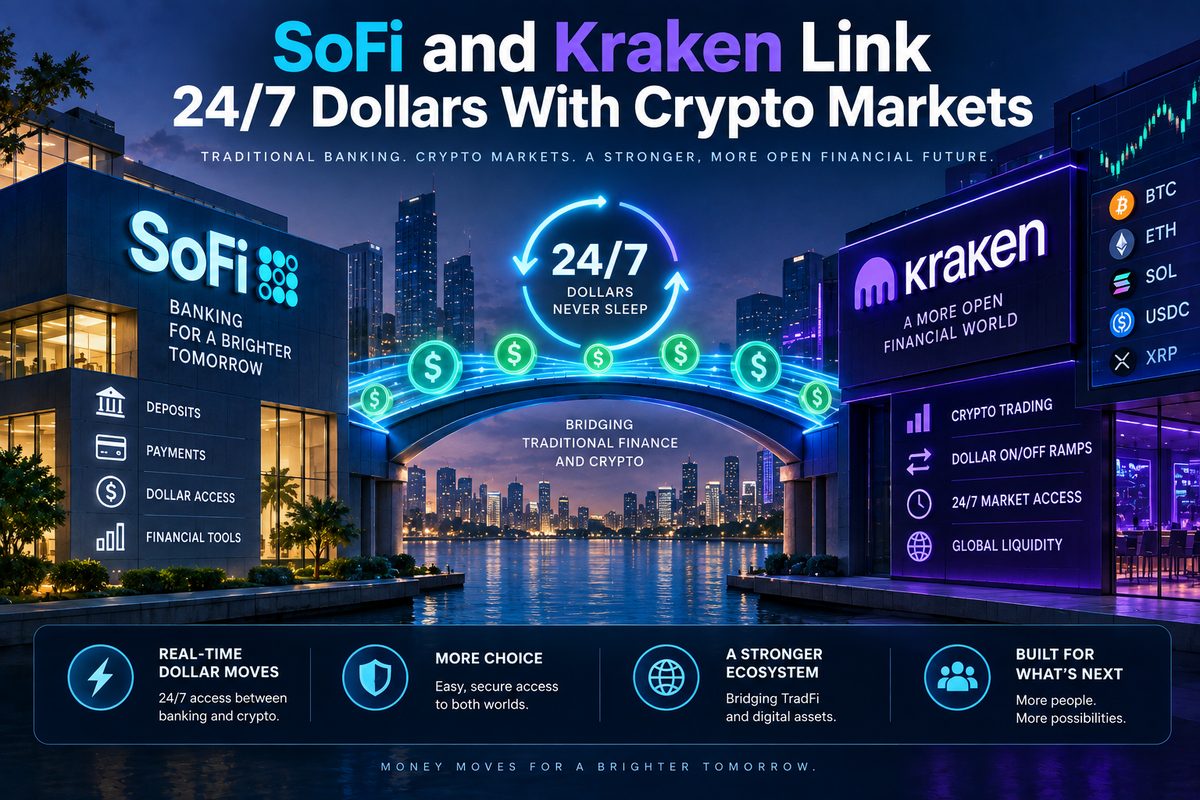
SoFi and Payward, the company behind Kraken, are connecting three pieces of financial infrastructure that usually operate separately: bank-dollar settlement, cryptocurrency trading liquidity and an on-chain stablecoin.
The partnership announced on September 3 brings Payward into the SoFi Exchange Network (SEN), SoFi’s real-time settlement system. Kraken is also listing SoFiUSD, the dollar stablecoin issued by SoFi Bank, while SoFi will use Kraken Prime as an additional source of liquidity for cryptocurrency trades made through its app.
SOFID trading on Kraken went live on September 4.
The interesting part is not simply that another stablecoin received an exchange listing. The arrangement illustrates how traditional dollars and blockchain dollars can coexist inside the same market infrastructure — and why they are not interchangeable.
What actually changed
Payward will gain access to SEN, which SoFi describes as a real-time settlement network allowing institutional clients to clear and settle US dollar transactions 24 hours a day, seven days a week.
This addresses a longstanding mismatch in crypto-market infrastructure.
Bitcoin, Ether and stablecoins trade continuously. Traditional banking systems do not always provide the same around-the-clock access to cash settlement. A crypto institution can therefore have an active trading venue while the fiat leg required to rebalance accounts or move dollars between counterparties operates on a different schedule.
SEN is intended to narrow that gap.
But SEN is not a blockchain stablecoin.
It is a banking settlement network for US dollars. SoFiUSD, also identified by the ticker SOFID, is a separate payment stablecoin operating on supported blockchain networks. SoFi says it is intended to be redeemable one-for-one for dollars and that its reserves consist primarily of cash.
The partnership therefore provides two different routes for moving dollar value: bank-based settlement through SEN and token-based transfer through SoFiUSD.
Why have both SEN and SoFiUSD?
At first glance, a 24/7 bank settlement network could appear to make a stablecoin unnecessary.
In practice, they address different environments.
SEN can let participating institutional counterparties move conventional dollars within a regulated banking relationship. That may be useful for treasury management, exchange settlement and moving cash without waiting for normal banking windows.
SoFiUSD can move across supported blockchain networks and interact with crypto-market infrastructure directly.
The distinction matters because access conditions are different. Participation in a banking network depends on institutional relationships and account infrastructure. A blockchain token can potentially move between supported wallets and platforms, but introduces blockchain, custody and smart-contract-related operational considerations.
One does not automatically replace the other.
The more meaningful long-term question is whether institutions use them together: conventional dollars for bank settlement when appropriate and stablecoins when on-chain transfer is more efficient.
A bank-issued stablecoin is still not a bank deposit
The name behind SoFiUSD could create another misunderstanding.
SoFi Bank, N.A. is a US national bank regulated by the Office of the Comptroller of the Currency, and SoFiUSD is issued through that institution. But SoFi’s own disclosure states that SOFID is not a deposit, is not FDIC- or SIPC-insured, is not legal tender and is not bank-guaranteed.
That distinction should not be treated as fine print.
Bank supervision can affect how an issuer operates and manages reserves. It does not convert every product issued by a bank into an insured deposit.
Likewise, a 1:1 redemption design does not guarantee that the token will trade at exactly $1 every second on every venue.
Secondary-market prices depend on available buyers and sellers, market-maker inventory, transfer availability and the efficiency of redemption and arbitrage.
A bank-issued stablecoin can therefore still experience a market premium or discount.
Why the Kraken listing matters
Kraken gives SoFiUSD a much larger open-market distribution channel.
The exchange announced that SOFID trading became available on September 4. Kraken describes the token as a US-dollar payment stablecoin whose reserve assets are intended to at least equal its outstanding supply.
Distribution, however, should not be confused with adoption.
A listing creates access. It does not tell us how much liquidity exists close to $1, how much volume users will generate or whether institutions will use the asset for settlement rather than simply hold or trade it.
Those questions now become measurable.
If order-book depth grows, spreads remain narrow and meaningful volumes appear without persistent peg deviations, the listing would be translating into market liquidity.
If the token remains technically available but lightly traded, the infrastructure change would be more significant than its immediate market impact.
Kraken Prime completes the other side of the deal
Liquidity also flows in the opposite direction.
SoFi plans to use Kraken Prime as an additional source for crypto execution inside its own application. Kraken says its prime infrastructure can evaluate pricing and depth across supported venues and route orders for execution.
This means the partnership is not only about sending SoFiUSD onto Kraken.
Kraken’s trading infrastructure also feeds back into SoFi’s crypto product.
That creates a useful separation between three functions:
SEN moves traditional dollars between eligible institutional participants.
SoFiUSD moves tokenized dollar value on supported blockchains.
Kraken Prime provides crypto execution liquidity.
Connecting all three can reduce friction, but the announcement itself does not prove that spreads have narrowed or settlement costs have fallen.
What the announcement does not prove
There are several conclusions the available evidence does not support.
It does not prove that SoFiUSD will take market share from USDT or USDC.
It does not prove that Kraken clients will move substantial settlement volume through SEN.
It does not prove that SoFi customers are already receiving materially better execution.
And it does not prove that SoFiUSD cannot depeg because its issuer is a regulated bank.
Those outcomes require market data rather than partnership announcements.
There is also no defensible basis for attributing current Bitcoin or broader crypto price movement directly to the agreement. The event changes infrastructure; it does not disclose a large asset purchase or identifiable net flow into crypto markets.
What to watch next
- SOFID trading volume: sustained growth would show that the Kraken listing is producing actual usage rather than nominal availability.
- SOFID deviation from $1: persistent discounts or premiums would reveal friction in liquidity, arbitrage or redemption. A stable quote alone does not prove reserve quality.
- Bid-ask spread and market depth: tighter spreads with meaningful depth would indicate improving executable liquidity.
- SEN settlement adoption: any future disclosure of transaction activity or institutional usage would show whether 24/7 bank-dollar settlement is becoming part of crypto treasury operations.
- Additional integrations: more exchanges, wallets, chains or institutional counterparties would demonstrate whether SoFiUSD is developing network effects beyond the SoFi–Kraken relationship.
Conclusion
The SoFi–Payward partnership matters because it connects rather than replaces financial rails.
SEN provides round-the-clock conventional dollar settlement. SoFiUSD provides an on-chain representation of dollar value. Kraken contributes exchange distribution and crypto execution infrastructure.
The test begins after the announcement.
If these systems attract meaningful flows while maintaining tight spreads and reliable settlement, the partnership can become evidence that banking and blockchain infrastructure are converging operationally. If usage remains limited, it will remain an important integration without necessarily becoming an important source of market liquidity.
Sources
SoFi — SoFi and Payward Partner to Connect Banking and Digital Asset Markets
Payward — official partnership announcement
Kraken — SOFID is available for trading
SoFi — SoFiUSD product and risk disclosure
CoinDesk — SoFi and Kraken tie up across banking and crypto infrastructure
The Block — independent coverage of the partnership
Disclaimer
This material is for informational and analytical purposes only and does not constitute financial, investment, legal or tax advice.