21 Financial Giants Plan a Dollar Stablecoin for 2027
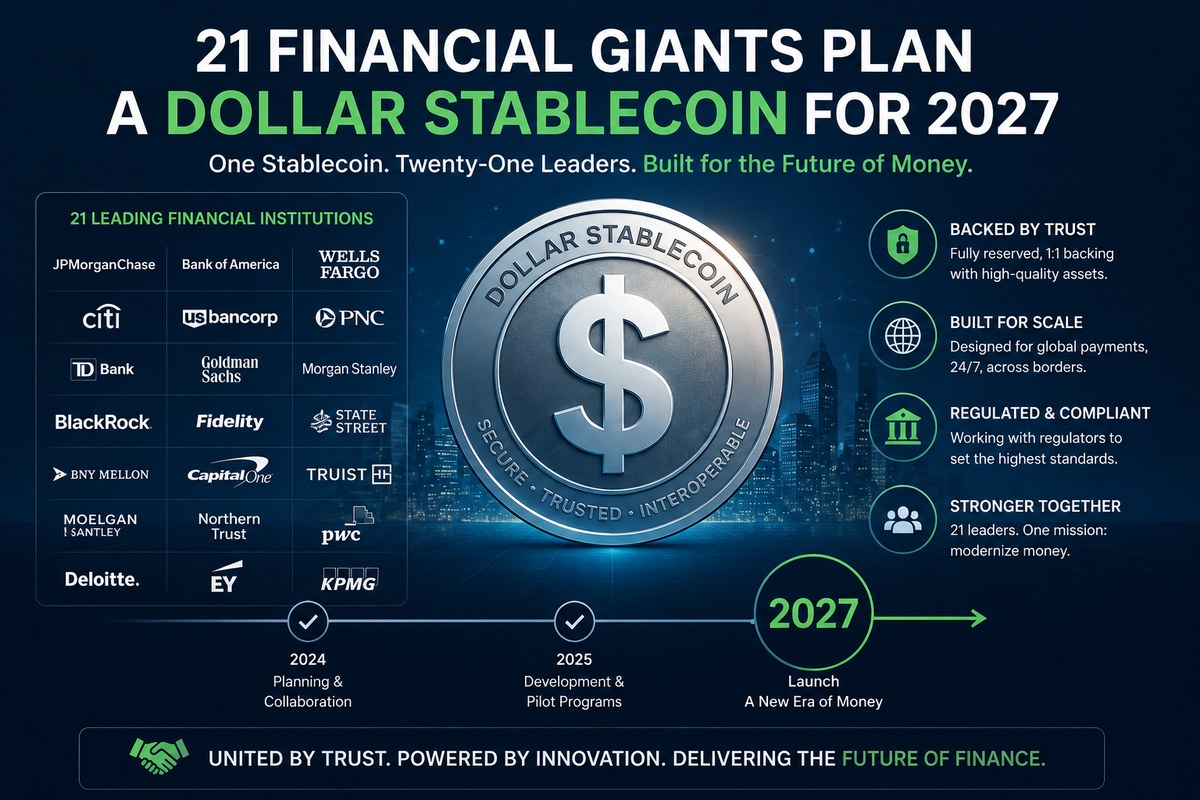
Twenty-one major financial institutions have committed to create a new company that plans to launch a US dollar-denominated stablecoin in the first half of 2027. The group spans North America, Europe, East Asia, the Middle East and Africa and includes Bank of America, Citi, Goldman Sachs, Deutsche Bank, Wells Fargo, Santander, UBS, MUFG Bank and other large financial firms.
The headline is significant because this is not another single-bank blockchain experiment. The participating institutions are trying to build a shared payment asset with global distribution, targeting cross-border payments, digital-asset settlement and potentially wholesale, institutional and retail users.
But the announcement should not yet be interpreted as evidence that the stablecoin will compete successfully with USDT or USDC.
Stablecoin markets are driven by more than issuer credibility. The harder challenge is creating usable liquidity across exchanges, wallets, payment networks and blockchains. For MyCoinWay users, that makes future supply, peg deviations, exchange spreads and transfer availability much more informative than the number of banks backing the project.
What happened
The consortium announced on September 1 that it intends to establish a new company during the second half of 2026, subject to closing conditions. The company has not yet been named.
Its first planned product is a US dollar stablecoin targeted for launch in the first half of 2027. The longer-term roadmap includes stablecoins denominated in other G7 currencies, with a euro token identified as the next priority.
The 21 participants include Bank of America, Capital One, Citi, Fidelity Investments, Goldman Sachs, PNC Financial Services, Scotiabank, TD Bank Group, Wells Fargo and WisdomTree in North America; Santander, BBVA, Commerzbank, Crédit Agricole, Deutsche Bank, Lloyds Banking Group, Rabobank and UBS in Europe; MUFG Bank in East Asia; Sirius International Holding in the Middle East; and Standard Bank in Africa.
The group says the stablecoin is intended for cross-border payments and digital-asset settlement and could serve wholesale, institutional and retail use cases. It also intends to comply with the US GENIUS Act and the EU's MiCA framework where applicable.
The initiative began on a smaller scale. In October 2025, an initial group of ten banks said it was exploring a 1:1 reserve-backed digital payment asset available on public blockchains. The expansion from ten participants to 21 shows that the project has moved beyond an exploratory discussion, although product design, blockchain deployment and final operational details have not yet been disclosed.
Why distribution matters more than the banking names
A consortium containing several globally important banks has an obvious advantage: existing customers, compliance infrastructure and payment relationships.
That does not automatically produce a liquid stablecoin.
Stablecoins benefit from network effects. A token becomes more useful when exchanges list it, market makers quote it, wallets support it, payment companies accept it and counterparties are willing to settle obligations in it.
USDT's position illustrates this dynamic. Reuters reported that Tether has issued more than $180 billion of its dollar-pegged token. By contrast, Societe Generale's dollar stablecoin — despite being issued by a major regulated bank — had only around $12.5 million in circulation.
That comparison does not prove the new consortium will struggle. It shows why institutional reputation and market adoption are separate variables.
Twenty-one institutions can create strong initial distribution. But liquidity ultimately has to emerge in actual markets.
The real competition is settlement liquidity
The new token may not need to replace USDT or USDC everywhere to become economically relevant.
Its strongest early use case could be institutional settlement.
Banks already interact with corporate clients, custodians, asset managers and payment networks. A common stablecoin could theoretically reduce friction when moving tokenized assets or settling transactions outside traditional banking hours.
This is also where competition becomes more nuanced.
A crypto-native trader values deep order books, multiple blockchain integrations and immediate exchange transfers. A large institution may instead prioritize legal certainty, counterparty controls, compliance and integration with existing banking relationships.
The same token may therefore compete differently in institutional and retail markets.
For Market Pulse, the important question is not simply whether the token launches. It is where liquidity forms first.
If most supply remains inside closed institutional settlement channels, its impact on crypto exchange liquidity could initially be limited. If the token reaches public blockchains, exchanges and wallets with broad redemption access, competition with existing stablecoins becomes much more direct.
Peg stability will still need to be proven
The consortium originally described the proposed digital money as 1:1 reserve-backed. That is important, but reserve backing does not make secondary-market deviations impossible.
A stablecoin can temporarily trade above or below $1 because of fragmented liquidity, delayed redemptions, banking-hour constraints or imbalances between exchanges.
This means the eventual product should be judged using both issuer-level and market-level metrics.
Reserve composition and redemption rights tell users how the token is designed.
Peg deviation and exchange spreads tell users how that design performs in practice.
A banking consortium could have exceptionally strong reserve infrastructure and still experience wider spreads during the early phase if there are too few market makers or trading venues.
Likewise, a token with a perfect $1 quote on one venue may not yet have meaningful liquidity if the order book is shallow.
A multi-bank issuer introduces different risks
Shared issuance can reduce dependence on one banking brand, but it introduces governance complexity.
Twenty-one institutions will need to agree on reserve structure, custody, compliance rules, blockchain support, redemption procedures and operational responsibility.
The official announcement says the separate company is intended to combine bank-grade compliance, governance, distribution and institutional risk management. However, many concrete details remain unknown.
Users should therefore avoid assuming that every participating bank directly guarantees every token.
The legal issuer, reserve ownership, redemption obligation and bankruptcy treatment will matter more than the logo list once documentation becomes available.
There is also regulatory fragmentation. The project aims to comply with both the GENIUS Act and MiCA where relevant, while potentially serving customers across many additional jurisdictions. That could affect where the token can be issued, redeemed or marketed.
Market reaction: the announcement is not yet a flow event
There is currently no reason to treat the September 1 announcement as evidence of capital moving from USDT or USDC into the future bank stablecoin.
The product does not yet exist.
No circulating supply, blockchain contracts, exchange listings or live redemption mechanism have been announced.
Reuters notes that the stablecoin sector remains heavily dominated by existing crypto-native issuers and that previous bank-backed tokens have generally attracted limited adoption.
The next meaningful market signals will therefore appear much closer to launch.
Until then, announcements of new partners and regulatory approvals are infrastructure milestones rather than liquidity data.
What to watch next
- Blockchain and issuance model: whether the stablecoin launches on public chains, permissioned infrastructure or both will strongly influence accessibility.
- Reserve and redemption terms: identify the legal issuer, eligible reserve assets, redemption counterparties and whether users can redeem directly at par.
- Initial circulating supply and volume: growth in absolute supply will show actual adoption better than partnership announcements.
- Peg and inter-exchange spreads: after launch, persistent deviations from $1 will reveal the quality of liquidity and arbitrage.
- Exchange and wallet integrations: broad support will determine whether the token becomes open market infrastructure or remains primarily an institutional settlement asset.
For MyCoinWay, the most useful signals after launch will be stablecoin peg deviations, inter-exchange spreads and unusual volume spikes. Those metrics can show whether bank distribution is translating into real market liquidity.
Disclaimer
This article is for informational and analytical purposes only. It does not constitute investment, legal or tax advice, a recommendation to buy or sell any cryptoasset, or a promise of future returns. The proposed stablecoin has not yet launched, and its design, regulatory treatment and timeline may change before 2027.
Sources
Wells Fargo — official consortium announcement.
BBVA — participating institution confirmation and project details.
Reuters — independent reporting on the consortium and existing stablecoin competition.
The Wall Street Journal — independent reporting on the banking consortium and intended use cases.