Cronos Rollback After Tectonic Exploit Tests DeFi Risk
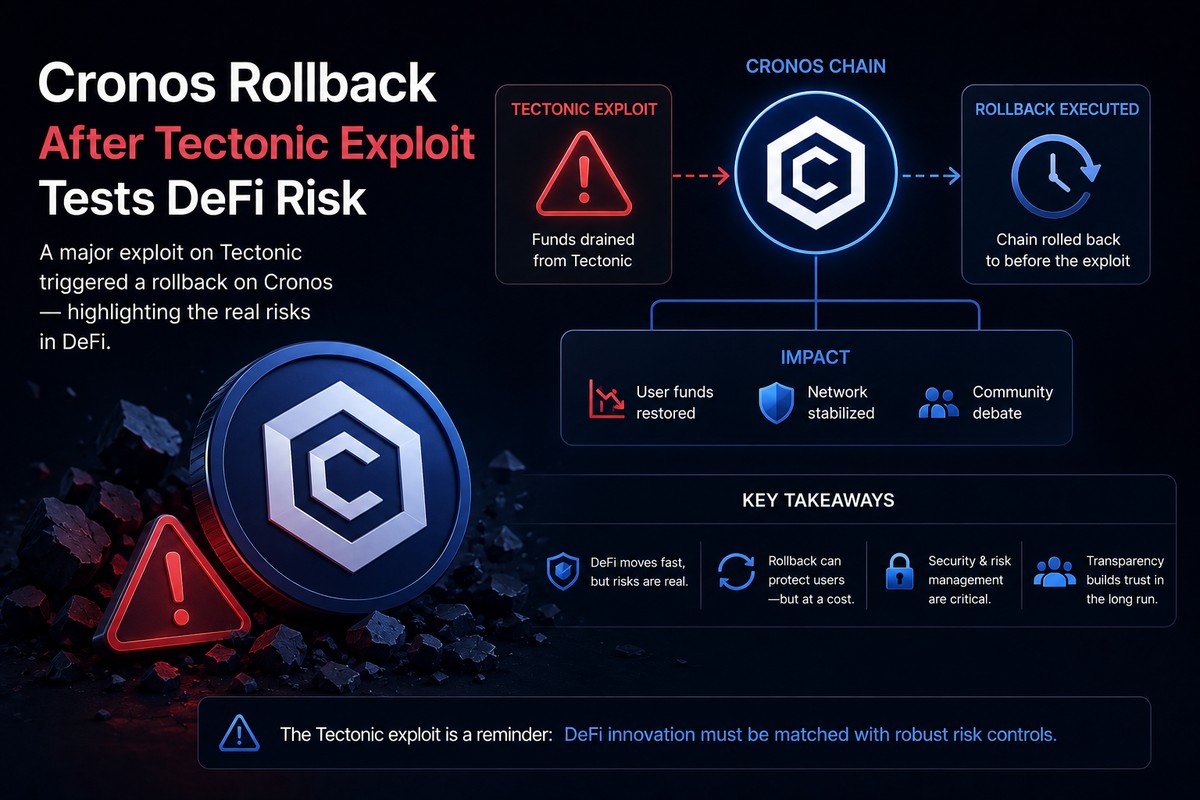
Cronos has resumed block production after an emergency halt triggered by an exploit of Tectonic, the network's largest lending protocol. The response went further than simply patching an application: validators restored the chain to a state before the exploit, reversing activity that had remained on Cronos while funds already bridged to Ethereum were outside the rollback's reach.
The incident is important beyond the estimated dollar value involved. It connects three separate risks that DeFi users often evaluate in isolation: thin collateral liquidity, oracle-driven lending and blockchain finality. A token can have an observable market price without having enough real liquidity to support large borrowing positions. And when an exploit becomes large enough, the containment decision can affect every user of the underlying network, not only the compromised protocol.
What happened
On August 30, Cronos halted block production after identifying an exploit affecting Tectonic. Independent reporting and blockchain-security analysis describe the incident as a price-manipulation attack involving TONIC, Tectonic's governance token.
According to TRM Labs, the attacker drove TONIC's price roughly 100 times higher in around 20 minutes and then used the inflated collateral value to borrow more liquid assets from Tectonic. TRM estimates that approximately $75 million was borrowed in the attack and says TONIC had recorded only about $305,000 of trading volume during the preceding week. That would make the amount borrowed roughly 245 times the token's previous weekly trading volume.
The approximately $75 million figure should be treated as an external estimate rather than a final loss figure confirmed by Tectonic. Early on-chain analyses have used different methodologies and produced materially different gross-outflow estimates. The Block, for example, reported the roughly $75 million estimate while explicitly noting that Tectonic had not yet confirmed either the amount or the root cause at the time of publication.
What is clearer is what happened next. Only a portion of the assets escaped to Ethereum before Cronos validators stopped the network. TRM estimates that roughly $6 million reached Ethereum and that approximately $68.7 million remaining on Cronos was subsequently reversed when validators restored the chain to its pre-exploit state.
Cronos later announced that block production had resumed from block 90,896,189 at 23:49:01 UTC on August 30. Node operators were instructed to restart using Cronos v1.7.8 and an updated mainnet snapshot. The network also warned that some protocols, RPC providers, explorers and cross-chain bridges could take longer to recover.
Crypto.com CEO Kris Marszalek said the company's app and exchange were not compromised. Tectonic is a separate DeFi protocol operating on Cronos.
Why thin collateral can become a systemic problem
The key analytical issue is not simply that TONIC's price moved sharply. It is the relationship between price, liquidity and borrowing capacity.
A lending protocol needs a way to value collateral. But a quoted market price is not equivalent to executable liquidity at scale.
If a token trades in a shallow market, relatively limited buying pressure can move its displayed price dramatically. If a lending system accepts that new price without sufficiently restrictive collateral parameters, liquidity checks or manipulation-resistant oracle design, the protocol may recognize collateral value that could never realistically be liquidated at the same level.
CoinDesk reported that TONIC had around $1.34 million of liquidity and approximately $11,000 in daily trading volume, while Tectonic allowed it to be used with a 20% collateral factor.
That gap is more informative than the price chart itself.
For risk monitoring, the relevant question is therefore not only whether collateral is volatile. It is whether the depth of the underlying market is remotely proportional to the credit that the protocol allows the asset to support.
The chain halt changed the transmission of the exploit
The second unusual feature was the network-level response.
Cronos validators halted block production, preventing the attacker from continuing to move assets on-chain. This contained much of the exploit but simultaneously stopped normal activity for every other network participant.
The subsequent rollback adds another dimension. Transactions that had remained inside the rollback boundary could be reversed, while assets already transferred to Ethereum were no longer subject to the restored Cronos state.
That creates a practical distinction between protocol risk and settlement risk.
A user may never interact with Tectonic yet still encounter unavailable transfers, delayed bridges, RPC disruptions or exchange deposit and withdrawal restrictions when the underlying chain stops.
It also raises a broader finality question. A blockchain may provide normal transaction finality under ordinary conditions while retaining a governance or validator mechanism capable of coordinating an emergency state rollback. Whether that trade-off is acceptable depends on the network's design and user expectations, but it should be treated as part of the risk model rather than ignored until an emergency occurs.
Market and liquidity implications
The immediate market signal after an exploit can be misleading.
A token price remaining relatively stable does not necessarily mean that operational risk has disappeared. When bridges or withdrawals are unavailable, arbitrage routes become constrained. Prices across exchanges can diverge because traders cannot freely move inventory between venues.
The same principle applies to stablecoins and wrapped assets inside the affected ecosystem. Their nominal value may remain unchanged while their transferability temporarily deteriorates.
Cronos explicitly cautioned after the restart that some bridges and infrastructure providers would require additional recovery time.
For MyCoinWay users, this makes inter-exchange spreads, unusual volume and transfer availability more useful than watching CRO or TONIC price alone. A widening spread while deposits or withdrawals are suspended can reflect fragmented liquidity rather than a clean directional market signal.
What to watch next
- Cronos infrastructure recovery: watch whether bridges, RPC providers, explorers and exchange deposit/withdrawal routes return to normal operation.
- Tectonic's final post-mortem: the protocol still needs to establish the definitive loss accounting, exact exploit mechanics and remediation measures.
- Collateral and oracle changes: watch for tighter TONIC parameters, liquidity-based limits or changes to price-feed design.
- Cross-venue spreads and volume: abnormal differences between venues can indicate that transfer routes or market-maker inventory remain impaired.
- Treatment of the Ethereum-side funds: assets that crossed the bridge before the halt are a separate recovery problem from transactions reversed on Cronos.
The useful Market Pulse lesson is broader than one exploit: collateral price without market depth is an incomplete risk signal, and network availability is part of liquidity.
Disclaimer
This article is for informational and analytical purposes only. It does not constitute investment, legal or tax advice, a recommendation to buy or sell any cryptoasset, or a prediction of future returns. Estimates concerning the Tectonic exploit remain subject to revision until the protocol and relevant investigators publish final accounting.
Sources
TRM Labs — analysis of the Tectonic price-manipulation exploit
The Block — initial independent reporting on the Cronos halt and Tectonic exploit
CoinDesk — analysis of TONIC liquidity and the lending mechanism
Decrypt — reporting on the Cronos halt and containment
Cronos Network update — restart and pre-exploit state restoration