The $89M Coldcard Exploit: How a Hardware Flaw is Distorting Bitcoin Metrics
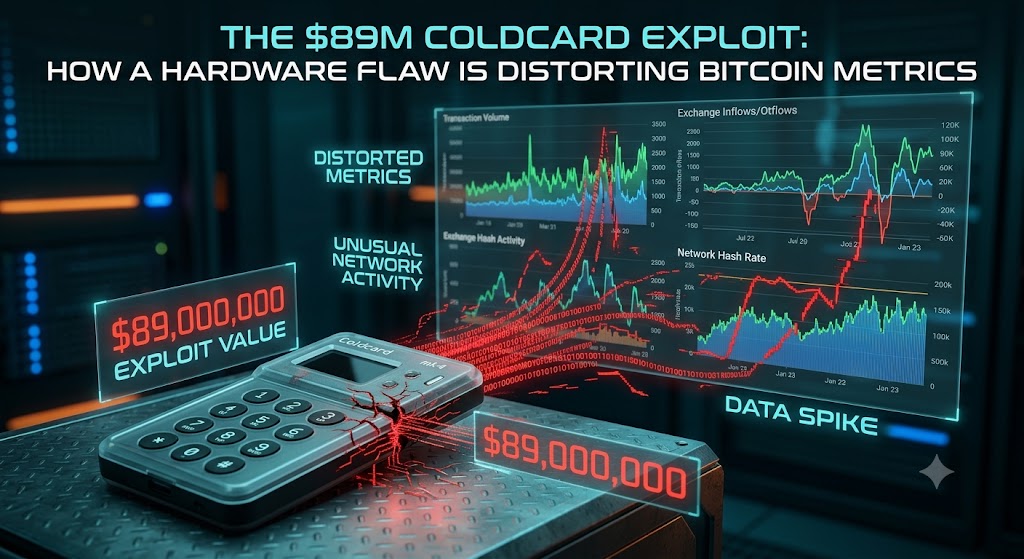
For years, the cryptocurrency industry has operated on a fundamental, almost dogmatic premise: offline cold storage is the ultimate sanctuary for digital assets. However, as August 2026 unfolds, that foundational belief is facing a brutal reality check. Over the past 72 hours, a catastrophic vulnerability in one of the industry's most trusted hardware wallets has triggered a massive security crisis, resulting in the theft of nearly $89 million in Bitcoin.
On August 2 and 3, security firms, including Galaxy Research, confirmed that a highly sophisticated attack drained approximately 1,367 BTC from over 4,500 addresses. The target was Coinkite’s Coldcard, a device widely favored by privacy-focused and security-conscious Bitcoin holders. As a Senior Editor and Analyst at MyCoinWay, I am closely monitoring the fallout. Beyond the immediate financial losses, this event is triggering a massive migration of on-chain capital. This sudden movement of funds is actively distorting exchange inflow metrics, congesting the mempool, and challenging the way institutional and retail investors approach digital asset custody.
The Anatomy of an Offline Hack
To understand how an offline device could be compromised without ever touching the internet, we must delve into the mechanics of cryptographic security. A hardware wallet does not store actual Bitcoin; it stores the private keys—derived from a seed phrase—needed to authorize transactions on the blockchain. The security of that seed phrase relies entirely on "entropy," or true mathematical randomness, generated during its creation.
According to researchers at Block’s Bitcoin Engineering team, the exploit traces back to a firmware integration error introduced in March 2021. Instead of utilizing the robust hardware random-number generator (RNG) built into the device’s microchip, a bug caused the seed generation process to fall back on a deterministic software pseudo-random number generator (PRNG).
This software fallback relied on predictable values, such as the device's unique identifier and internal timer states. Because these values lacked true randomness, attackers were able to use immense computational power to offline-generate millions of candidate output streams. By cross-referencing these mathematically predictable seeds with active addresses on the public blockchain, the hackers successfully reconstructed the private keys without ever gaining physical access to the victims' devices. The only users spared were those who manually injected extra entropy during setup—such as rolling physical dice at least 50 times.
Market Reaction: On-Chain Distortions and Exchange Inflows
While the technical mechanics of the hack are fascinating, the secondary market effects are where active traders must focus their attention. The realization that thousands of cold storage wallets are fundamentally compromised has sparked widespread panic among self-custody advocates.
The immediate reaction for affected—or merely frightened—users is to migrate their funds. We are currently witnessing the largest movement of sub-1 BTC balances since the collapse of FTX. However, unlike standard market cycles, these users are not necessarily moving their funds to sell; they are moving them to secure, tier-1 centralized exchanges to escape a compromised hardware environment.
This is where the market mechanics become treacherous. Many algorithmic trading bots and quantitative models heavily weight "exchange inflows" as a bearish signal, assuming that Bitcoin moving onto an exchange is preparing to be dumped on the spot market. Over the last 48 hours, these automated systems have been reading a massive spike in inflows, creating artificial, data-driven selling pressure that suppresses Bitcoin's price momentum in the $63,000 range. Human traders who fail to contextualize this on-chain data risk being caught on the wrong side of the market.
Reassessing Custody and Liquidity Dynamics
The Coldcard exploit highlights a painful truth: self-custody eliminates counterparty risk, but it exponentially increases operational and supply-chain risk. If the underlying math generating your keys is flawed, being completely air-gapped from the internet offers zero protection.
This realization is driving a rapid capital rotation. Users are temporarily abandoning hardware setups in favor of enterprise-grade custodial solutions. Centralized platforms utilize multi-signature institutional cold storage, distributed key generation, and dedicated security teams that are far more resilient to isolated hardware flaws.
Furthermore, this mass migration creates localized liquidity friction. As users scramble to sweep their vulnerable addresses, Bitcoin mempool congestion spikes, drastically inflating network transaction fees. Users who decide to exit their Bitcoin positions entirely out of frustration may seek refuge in stablecoins, potentially widening peer-to-peer (P2P) spreads as local merchants adjust to the sudden influx of BTC sell orders.
What to Track Next
Navigating a market distorted by a major security crisis requires looking past surface-level metrics. Misinterpreting the current on-chain data could lead to costly trading errors.
Active participants should monitor the following key indicators in the coming days:
- Exchange Inflow Context: Do not blindly short Bitcoin based on rising exchange inflows this week. Cross-reference inflow data with actual spot market sell volume. If inflows are high but spot volume remains average, the market is simply witnessing a security migration, not a massive sell-off.
- Perpetual Funding Rates: Monitor derivative funding rates closely. If algorithmic traders misinterpret the exchange inflows and heavily short the market, funding rates will flip negative. This heavy short positioning, unsupported by actual spot selling, creates the perfect setup for a sudden short squeeze.
- Mempool Congestion and Gas Fees: Track Bitcoin network fees. Sustained high fees indicate ongoing wallet migrations, which can slow down routine arbitrage operations and increase the cost of doing business on-chain.
- Stablecoin P2P Premiums: Keep an eye on local P2P desks for widening fiat-to-stablecoin spreads. A flight to safety often translates into increased retail demand for USDT or USDC.
To successfully filter out the noise and track accurate market mechanics, we highly recommend utilizing the MyCoinWay Market Pulse dashboard. By monitoring real-time funding rate divergences, contextualizing exchange inflows, and tracking P2P liquidity depth, traders can navigate these on-chain distortions and protect their portfolios from algorithmic misdirection.
Disclaimer: This article is for informational and analytical purposes only. It does not constitute financial, investment, or legal advice. Cryptocurrency markets are highly volatile, and security exploits can lead to unpredictable market behavior. Always conduct your own research before executing trades.
Sources:
- IG Market News: "Coldcard Hardware Wallet Hack Drains $89m: What It Means for Crypto Self-Custody" (August 3, 2026).
- ThaiCERT & Coinkite Official Security Advisories regarding the firmware RNG vulnerability.