Revolut Breach Exposed KYC and Bitcoin Transaction Data
Revolut has confirmed a security incident in which sensitive customer information was disclosed to an unauthorized third party after fraudulent requests appeared to come from a legitimate government agency email domain.
The distinction in that sentence matters.
According to Revolut, its own systems were not breached and customer funds were unaffected. The incident instead involved the company responding to requests it believed were legitimate. Reuters reported on September 12 that Revolut described the number of affected customers as “very limited” but did not provide an exact figure.
For crypto users, the important question is therefore not simply whether bitcoin was stolen. It was not, based on the information currently available.
The more useful question is what happens when identity records and crypto transaction histories are exposed together.
What happened
Revolut told Reuters and The Block that an unauthorized third party submitted fraudulent information requests using an email account on a legitimate government agency domain.
Revolut treated the requests as authentic and disclosed customer information. After identifying the problem, the company says it blocked the address and alerted the relevant government agency, law-enforcement bodies, data-protection authorities and financial regulators.
The name of the government agency has not been disclosed publicly.
Neither has the exact number of affected customers.
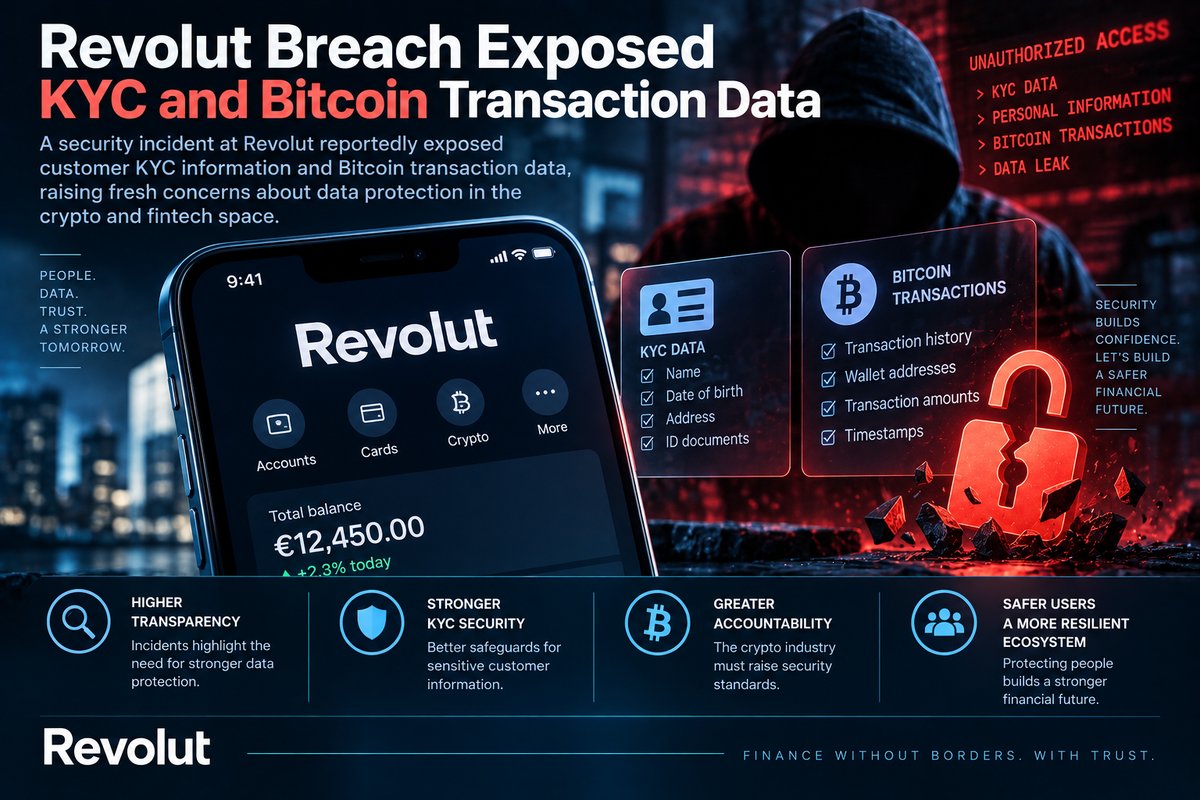
According to notices sent to affected customers and reviewed by media outlets, the information potentially disclosed included names, dates of birth, postal and email addresses, telephone numbers and copies of identity documents such as passports or driving licences. The Block also reports that verification selfies, account statements, IBANs, withdrawal records and transaction histories — including Bitcoin transactions — may have been included for affected customers.
Those categories should not be interpreted as meaning every listed data point was exposed for every affected user. The publicly available reporting describes information that may have been included in the disclosures.
This was not the same as an account hack
Crypto-security incidents are often discussed primarily in terms of stolen funds.
That framework is incomplete here.
There is currently no confirmed evidence that the unauthorized party gained access to customer accounts, obtained wallet private keys or withdrew cryptoassets from Revolut accounts as part of this incident. Revolut explicitly told Reuters that its systems and customer funds were unaffected.
The weakness was instead in the information-request process.
Financial institutions routinely receive legitimate requests for customer records from law-enforcement agencies, courts and regulators. The incident demonstrates that the security of this process depends not only on protecting internal databases, but also on authenticating the external party requesting access.
An email can be technically genuine for a domain and still be controlled by someone who is not authorized to make the request.
That is why ordinary email-authentication signals alone should not be confused with verification of legal authority.
Why Bitcoin transaction history creates a different privacy risk
A transaction history is not equivalent to a private key.
Knowing that a customer bought or withdrew bitcoin does not, by itself, allow someone to spend that bitcoin.
But combining financial history with identity information can reduce privacy substantially.
A dataset containing a person's name, address, identity document and crypto transaction history can potentially tell an attacker much more than any one piece of information alone.
It may help identify people who appear to hold significant crypto exposure. It may make highly targeted phishing more convincing because the attacker can reference real financial activity. And where withdrawal information can be associated with external blockchain addresses, it can potentially help link an identity to otherwise pseudonymous onchain activity.
Those are risk scenarios, not confirmed outcomes of the Revolut incident.
No reliable public evidence currently shows that the disclosed records have been used to steal crypto, extort customers or identify specific external wallets.
That distinction is important: exposure creates potential attack surface; it does not prove exploitation of that attack surface.
“Funds unaffected” does not mean “no user impact”
Revolut's statement that funds were unaffected is important and should not be minimized.
But it answers only one security question.
A user can suffer a serious privacy incident without losing money directly from an account.
Identity documents are difficult to replace in the same way a password can be changed. Transaction records cannot be made historically secret again once copied. Contact details can make later social-engineering attempts more personalized.
That makes this incident different from a password leak.
If a password is compromised, rotating the credential can remove much of the immediate access risk.
If a passport image and years of financial activity are disclosed, remediation is less straightforward.
At the same time, users should avoid assuming that every future suspicious message is necessarily connected to this breach. Without evidence connecting an attempted fraud to the leaked dataset, causality cannot be established.
The unanswered question is verification
The incident raises a broader infrastructure issue for financial institutions and crypto platforms.
KYC rules require companies to collect unusually sensitive datasets. Law-enforcement and regulatory obligations can require those companies to disclose some of that information when presented with valid legal requests.
The security boundary therefore extends beyond login systems and encryption.
It includes the process for deciding when data should leave the institution legitimately.
A strong verification process needs to establish more than whether an email belongs to a government domain. It needs to establish whether the sender is authorized, whether the request itself is genuine and whether its scope is valid.
Revolut has not publicly detailed the full verification workflow that failed or the changes it has made beyond blocking the relevant address and alerting authorities.
Without that information, it would be premature to claim that the root cause has been fully resolved.
What we still do not know
Several material facts remain undisclosed.
Revolut has not published the exact number of affected customers.
It has not identified the government agency whose domain was used.
The company has not publicly established whether customers in one jurisdiction or multiple markets were affected.
There is also no confirmed public evidence showing whether the unauthorized party has attempted to use the disclosed data.
These gaps matter because they determine the real scale of the incident.
A highly targeted disclosure affecting a small group creates a different risk profile from broad exfiltration across a customer database.
At present, the evidence supports the former description more strongly: Revolut calls the affected group “very limited,” while there is no evidence that its production systems or overall customer database were compromised.
What to watch next
- Affected-customer count: a precise disclosure would establish whether the incident was narrowly targeted or materially broader than currently described.
- Regulatory notifications or findings: statements from data-protection or financial regulators could clarify whether Revolut's verification controls met applicable obligations.
- Scope of exposed records: confirmation of which data categories were actually released for affected customers would materially improve risk assessment.
- Evidence of secondary abuse: verified phishing, account takeover, extortion or wallet-targeting linked to the leaked data would show whether the incident progressed from disclosure to exploitation.
- Revolut's remediation: details of stronger out-of-band verification for government requests would indicate whether the process failure has been addressed structurally.
Conclusion
The Revolut incident is not a story about hackers draining a crypto wallet.
It is a story about a different security boundary: the point at which a financial institution decides that an external party is legitimately entitled to sensitive customer data.
Customer funds and Revolut's systems were unaffected according to the company. That sharply limits what can responsibly be claimed about direct financial loss.
But KYC documents and transaction histories — especially when they include Bitcoin activity — have their own security value.
The most important next evidence will therefore not be crypto prices or exchange flows. It will be the scale of the disclosure, whether the data is subsequently abused and whether the request-verification process is changed to prevent a repeat.
Sources
Reuters — Revolut confirms sensitive customer data breach after fake government requests.
The Block — Revolut says customer KYC and Bitcoin transaction data were exposed.
Disclaimer
This material is for informational and analytical purposes only and does not constitute financial, investment, legal or tax advice.