BounceBit Sunsets Chain After $3M Exploit: The Flight to BNB Liquidity
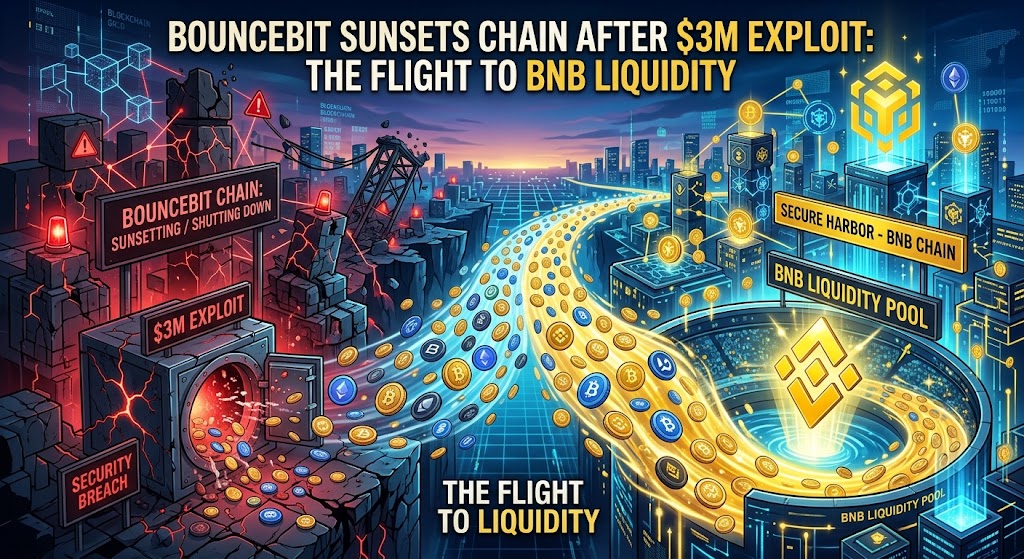
The aggressive expansion of application-specific blockchains—commonly known as appchains—has just collided with a brutal reality check. Over the last 48 hours, the digital asset ecosystem witnessed a stark reminder of the security trade-offs inherent in fragmented network architectures. On August 21, 2026, YZi Labs-backed Bitcoin restaking firm BounceBit officially announced the sunsetting of its proprietary blockchain.
The catalyst for this sudden closure was a highly targeted smart contract exploit that resulted in the theft of over $3.1 million worth of the protocol's native BB tokens. Instead of attempting a convoluted hard fork or deploying a temporary patch to a compromised infrastructure, the developers made a ruthless mechanical decision: they are abandoning the chain entirely and executing an emergency migration of the protocol and its remaining liquidity to the BNB Chain.
As a Senior Editor and Analyst at MyCoinWay, I view this event as a critical case study in emergency capital flight. The unwinding of a live blockchain is a chaotic, highly mechanical process. It actively distorts cross-chain bridge traffic, severely fractures spot market pricing, and creates extreme volatility in the derivatives sector. For active traders, understanding the plumbing of a network shutdown is essential for navigating the current liquidity gaps.
The Anatomy of an Emergency Chain Evacuation
To comprehend the market impact, we must first look at the mechanics of the BounceBit protocol. As a Bitcoin restaking firm, the platform was designed to take idle BTC liquidity and repurpose it to secure its own network and generate yield. When the $3.1 million exploit occurred, it did not just crash the price of the BB token; it immediately compromised the trust in the network's consensus and smart contract layers.
Sunsetting a blockchain is not as simple as flipping a switch. It requires a synchronized evacuation of capital. Users and Liquidity Providers (LPs) are now forced to withdraw their wrapped Bitcoin, stablecoins, and remaining BB tokens from the dying chain. They must then route these assets through cross-chain bridges to either return them to Ethereum or port them over to the new deployment on the BNB Chain.
This creates a massive, localized liquidity vacuum. As capital flees, the automated market maker (AMM) pools on the BounceBit chain are drained of their base assets (like USDT or USDC). Traders who are late to the evacuation will find that attempting to swap volatile altcoins into stablecoins on the dying chain incurs catastrophic slippage, as the liquidity required to facilitate those trades no longer exists.
Market Pulse: Funding Rates and Inter-Exchange Spreads
The immediate financial fallout of the hack is actively playing out across centralized and decentralized trading venues.
First, consider the derivatives market. The theft of $3.1 million in BB tokens provided the hackers with a massive stockpile of spot assets, which they immediately began dumping on the open market. Anticipating this relentless spot selling pressure, algorithmic traders and hedge funds aggressively shorted the BB token. This speculative pile-on has skewed perpetual futures funding rates deeply into negative territory. Traders holding short positions are currently paying exorbitant fees to keep those positions open. If the spot selling pressure from the hacker is exhausted faster than anticipated, this heavily skewed derivatives market becomes a prime setup for a violent short squeeze.
Second, the migration creates severe inter-exchange spreads. Centralized tier-1 exchanges typically respond to an exploited chain by immediately halting deposits and withdrawals to prevent tainted funds from mixing with clean liquidity. With centralized gateways closed, the BB token becomes effectively siloed on decentralized exchanges. This isolation creates significant price deviations. Arbitrageurs who hold BB tokens on a centralized exchange might see entirely different pricing compared to the decentralized pools on the BNB Chain or the sunsetting BounceBit network.
Furthermore, peer-to-peer (P2P) merchants must exercise extreme caution. During a chain evacuation, users desperately attempting to off-ramp their capital may turn to P2P markets if cross-chain bridges become congested or temporarily paused. Merchants operating in these corridors are widening their bid-ask spreads significantly to account for the heightened risk of dealing with assets originating from a compromised network.
The Flight to Tier-1 Networks
From a macroeconomic perspective, BounceBit's migration to the BNB Chain signals a broader trend of consolidation within the DeFi sector. The premise of launching independent appchains was driven by the desire for customizable block space and lower fees. However, the operational overhead and security vulnerabilities of maintaining a bespoke blockchain are proving too high for many mid-tier protocols.
By migrating to the BNB Chain, BounceBit is trading architectural independence for battle-tested security and access to deep, established liquidity pools. This rotation of capital reinforces the dominance of major Layer 1 and Layer 2 networks, concentrating global liquidity rather than fracturing it across hundreds of micro-chains.
What to Track Next
Navigating a market disrupted by a major protocol exploit requires abandoning emotional sentiment and focusing strictly on execution mechanics.
Here are the critical metrics you must track in the coming days as the migration unfolds:
- CEX Deposit and Withdrawal Status: Monitor the status pages of major centralized exchanges regarding the BB token. Once exchanges resume deposits on the new BNB Chain contract, expect a sudden influx of spot selling as users finally gain access to liquid order books.
- Perpetual Funding Rates: Keep a close eye on the funding rates for BB perpetual swaps. Deeply negative funding rates are unsustainable. If the rate does not normalize, be prepared for sharp, liquidation-driven upward price wicks.
- Bridge Liquidity Depth: Track the volume and processing times of cross-chain bridges facilitating the migration to BNB Chain. Congestion here will temporarily widen the inter-exchange spreads between the old chain and the new deployment.
- BNB Chain TVL Inflows: Observe the Total Value Locked (TVL) on the BNB Chain ecosystem. A rapid, successful redeployment of BounceBit's restaking contracts will reflect positively on BNB's on-chain metrics and validate the protocol's recovery strategy.
To successfully filter the noise and track accurate market mechanics during this migration, we highly recommend utilizing the MyCoinWay Market Pulse dashboard. By monitoring real-time funding rate divergences and tracking inter-exchange liquidity depth, traders can navigate these on-chain distortions and protect their portfolios from sudden volatility.
Disclaimer: This article is for informational and analytical purposes only. It does not constitute financial, investment, or legal advice. Cryptocurrency markets are highly volatile, and smart contract exploits can lead to unpredictable market behavior. Always conduct your own research before executing trades.
Sources:
- The Block: "BounceBit to sunset blockchain, migrate to BNB Chain after $3 million exploit" (August 21, 2026).
- Protos: "YZi Labs-backed BounceBit Chain shuts down after $3M exploit" (August 21, 2026).