Uniswap v4 Goes Live: How 'Hooks' are Rewiring DeFi Liquidity
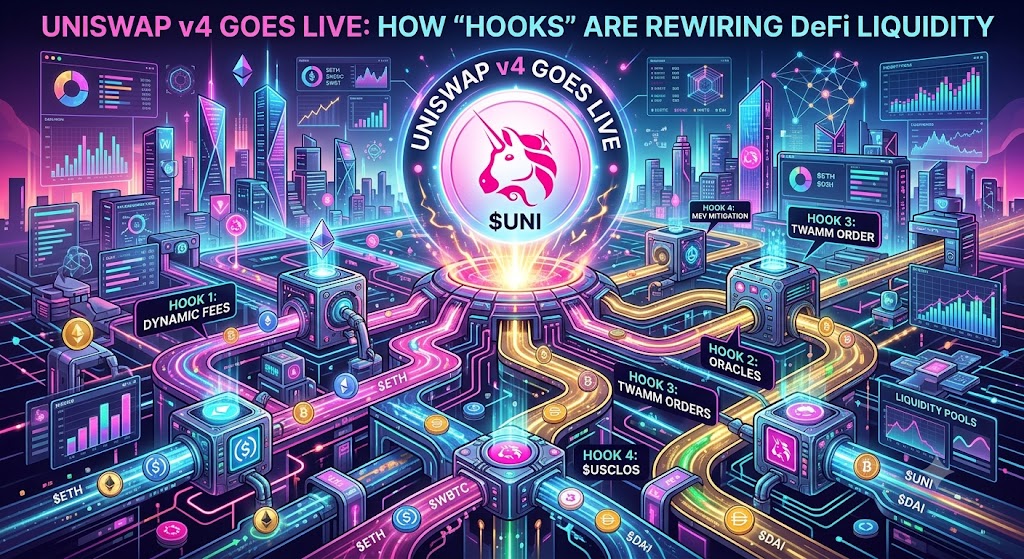
While the broader market has been fixated on central bank policies and regulatory delays, the decentralized finance (DeFi) sector just experienced a seismic architectural upgrade. On August 1, 2026, Uniswap v4 was officially deployed to the Ethereum mainnet. Within the first 24 hours of operation, over $450 million in Total Value Locked (TVL) migrated into the new protocol, signaling a rapid institutional and retail adoption of the new standard.
As a Senior Editor and Analyst at MyCoinWay, I view this launch not just as a software update, but as a fundamental rewiring of how on-chain liquidity operates. The transition from v3 to v4 introduces a new level of programmability that directly impacts active traders, arbitrageurs, and liquidity providers (LPs).
The Core Innovation: Introducing "Hooks"
To understand the market impact, we must look at the defining feature of Uniswap v4: Hooks. In previous iterations of the protocol, Automated Market Maker (AMM) pools operated on rigid, hardcoded rules. If you wanted to trade or provide liquidity, you played by a single set of universal parameters.
Hooks completely change this paradigm. They are customizable smart contracts that execute at specific points in a pool's lifecycle—such as before or after a swap, or when LP positions are modified. This allows developers to bolt custom logic onto any liquidity pool. For the first time natively, Uniswap now supports on-chain limit orders, dynamic fees that adjust based on market volatility, and Time-Weighted Average Market Maker (TWAMM) orders designed to execute large trades over time with minimal slippage.
Market Reaction: Spread Compression and Arbitrage
For active market participants, the introduction of dynamic fees is a game-changer. In Uniswap v3, LPs were frequently exploited by MEV (Maximal Extractable Value) bots and toxic arbitrage flow during high-volatility events because pool fees were static.
With v4 hooks, liquidity pools can now feature dynamic fees that automatically increase during periods of extreme price volatility. This protects LPs from impermanent loss and alters the calculus for cross-exchange arbitrage. Arbitrageurs accustomed to exploiting wide spreads between decentralized exchanges (DEXs) and centralized tier-1 platforms will find their margins compressed. As the dynamic fees eat into arbitrage profitability during volatile spikes, we expect inter-exchange prices to stabilize faster, creating a more efficient pricing environment across the board.
The Hidden Risk: Liquidity Fragmentation
However, this unprecedented flexibility introduces a significant structural risk: liquidity fragmentation. Because anyone can create a new pool with unique hooks, we are already seeing the creation of dozens of different pools for the exact same trading pair (e.g., ETH/USDC).
One pool might have a dynamic fee hook, another might have an on-chain limit order hook, and a third might feature a KYC-only hook for institutional compliance. This means the overall liquidity for a token pair is fractured across multiple custom pools. For standard retail traders executing market orders, this fragmentation can lead to routed trades experiencing higher slippage if the primary aggregator fails to source liquidity from the most efficient pool. Furthermore, every custom hook is a new smart contract, inherently increasing the risk of code exploits and hacks.
What to Track Next
The rollout of Uniswap v4 is in its infancy, and the market is actively adapting to these new mechanics. Traders should monitor the following key metrics in the coming days:
- TVL Migration Pace: Monitor the speed at which capital continues to drain from Uniswap v2 and v3 into v4 pools. A rapid transition confirms market confidence in the new smart contracts.
- Arbitrage Spreads: Track the price deviations between major pairs on Uniswap v4 and centralized exchanges. Dynamic fees should noticeably tighten these spreads during market volatility.
- Hook Exploit Vulnerabilities: Stay highly vigilant regarding security alerts. Custom hooks are the new attack vector for hackers; an exploit in a popular hook could trigger a localized liquidity flight.
- Gas Fee Fluctuations: Watch Ethereum network fees. While v4 introduces "flash accounting" to lower overall transaction costs for multi-hop trades, the initial rush to deploy custom pools and migrate LP positions may temporarily inflate gas prices.
To navigate this evolving DeFi landscape, we recommend utilizing the MyCoinWay Market Pulse dashboard. By monitoring real-time inter-exchange spreads and tracking liquidity depth across fragmented pools, you can adapt your trading strategies to the new efficiencies—and risks—introduced by Uniswap v4.
Disclaimer: This article is for informational and analytical purposes only. It does not constitute financial, investment, or legal advice. Cryptocurrency markets and experimental smart contracts are highly volatile and carry significant risk. Always conduct your own research before deploying capital or executing trades.
Sources:
- Uniswap Foundation: Official v4 Mainnet Deployment Announcement (August 1, 2026).
- Etherscan: Uniswap v4 Factory Contract analytics.