Standard Chartered Puts BTC and ETH on UAE FX Rails
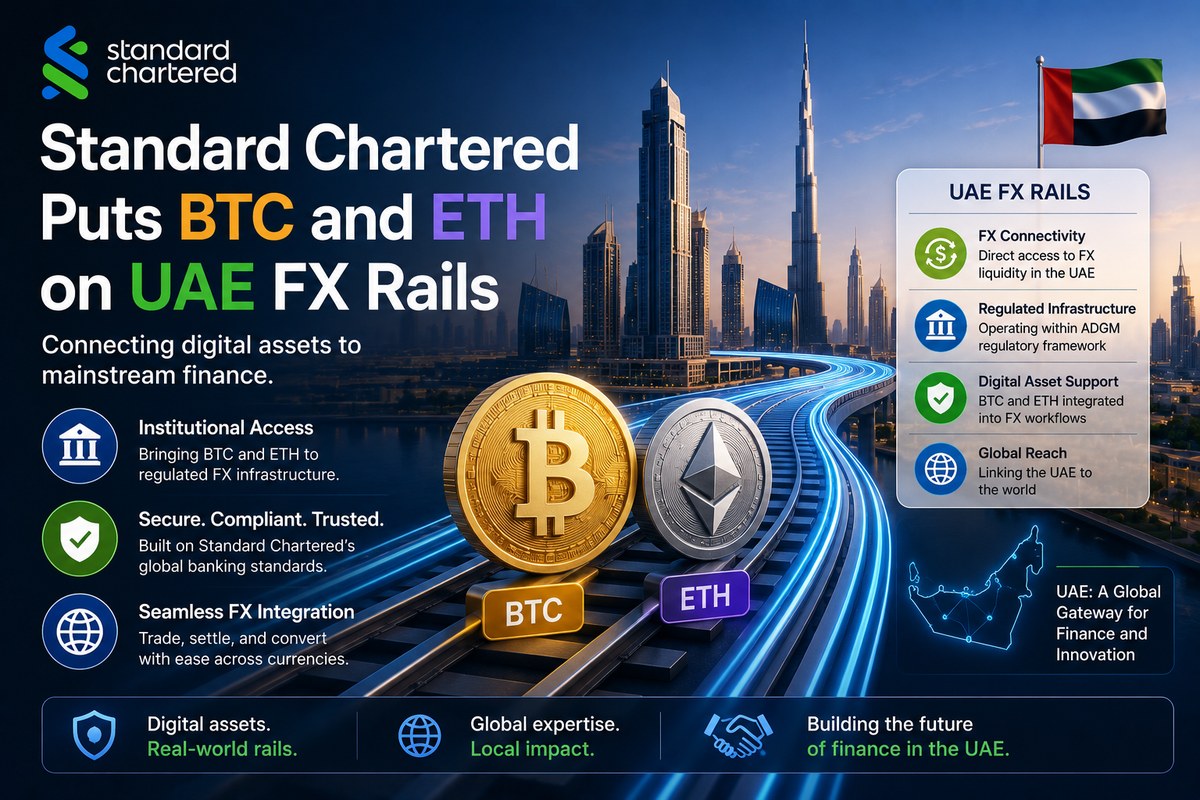
Standard Chartered has launched institutional spot trading in Bitcoin and Ether through its Dubai International Financial Centre operation, becoming the first Global Systemically Important Bank to offer the capability in the United Arab Emirates. Eligible clients can now trade BTC/USD and ETH/USD through the same type of electronic foreign-exchange infrastructure they already use for traditional currencies.
The important part is not simply that another bank has added crypto. Standard Chartered is moving crypto execution into an existing institutional workflow: familiar eFX interfaces, bank risk controls and a choice of custodians.
For Market Pulse, that makes this primarily a market-structure story. The question is whether putting Bitcoin and Ether on bank trading rails can improve institutional access without sacrificing the liquidity and continuous execution that crypto-native venues already provide.
What happened
Standard Chartered announced the UAE launch on September 3 through Standard Chartered DIFC, which is regulated by the Dubai Financial Services Authority.
The service supports deliverable spot transactions in Bitcoin and Ether. Institutional clients can execute through the bank's existing electronic channels and settle with a custodian of their choice, including Standard Chartered's own digital-asset custody service. The bank launched that custody capability in the UAE in 2024.
This is not Standard Chartered's first institutional crypto trading operation. The bank launched spot BTC and ETH trading through its UK branch in July 2025. The UAE expansion brings the same broader model into another regulated financial centre.
CoinDesk additionally reported, citing a bank spokesperson, that Standard Chartered operates the service as a principal trading desk: the bank can take the other side of client transactions rather than functioning only as an execution intermediary.
That distinction matters because the service is becoming part of the bank's balance-sheet and market-making relationship with institutional customers rather than merely a gateway to an external crypto exchange.
Why putting crypto on eFX rails matters
Institutional crypto adoption has often been discussed as a question of whether large investors are willing to own Bitcoin or Ether.
Execution infrastructure is a separate issue.
A fund that already trades dollars, euros and emerging-market currencies through bank platforms may need additional systems, counterparties and operational processes to execute crypto on a crypto-native venue. Standard Chartered is trying to reduce that gap by placing BTC and ETH inside a workflow institutional traders already understand.
That may lower operational friction.
But it does not automatically mean better execution.
Crypto markets trade continuously, while traditional institutional FX infrastructure evolved around a different market structure. Standard Chartered's existing digital-assets page says its UK crypto service is initially available during Asia and Europe hours, illustrating one of the fundamental questions for bank-based crypto execution: how closely can institutional banks match a market that trades 24/7?
The UAE launch announcement does not establish that bank liquidity will be equally deep at every hour.
That is why the next relevant metric is not the number of institutional clients signed up. It is execution quality.
Spreads become a useful adoption signal
Institutional traders care about much more than the quoted BTC or ETH price.
They care about how much price changes when they execute size.
A bank can display a tight BTC/USD quote, but the useful question is whether that spread remains competitive for larger transactions and during volatile periods.
This makes several metrics particularly important:
Bid-ask spreads indicate the immediate cost of crossing the market.
Market depth shows how much liquidity is available close to the quoted price.
Slippage reveals what price a client actually receives when executing meaningful size.
Cross-venue spreads show whether bank pricing stays aligned with major crypto exchanges.
If Standard Chartered's BTC or ETH pricing persistently diverged from major spot markets, arbitrage pressure would normally encourage convergence — but only if participants can efficiently move capital and assets between those venues.
For MyCoinWay, this is why inter-exchange spreads and unusual volume spikes are more informative than a headline announcing institutional access.
Custody choice is another structural change
The launch also separates execution from custody.
Clients are not required to leave assets with Standard Chartered after trading. The bank says customers can settle with a custodian of their choice, including its own custody service.
That structure can be attractive to institutions because trading counterparty and asset custodian do not necessarily need to be the same entity.
It also creates another operational variable: settlement.
Crypto-native exchanges often combine execution, custody and internal settlement inside one platform. Institutional financial infrastructure frequently separates these functions.
Separation can reduce concentration risk, but it also means users should pay attention to settlement timing, transfer availability and operational compatibility between execution and custody providers.
In volatile markets, the ability to move BTC or ETH quickly can matter almost as much as the quoted spread.
This is not yet evidence of new BTC or ETH demand
The launch should not be interpreted as proof that institutional capital has suddenly entered Bitcoin or Ether.
Standard Chartered has not disclosed trading volumes, client numbers or net purchases associated with the UAE service.
The event changes access infrastructure, not necessarily current asset demand.
That distinction is important because a bank trading desk can facilitate both buying and selling. Higher institutional volume does not automatically produce upward price pressure.
The market impact will depend on how much activity the service attracts and whether it brings genuinely new participants or simply relocates execution that was already taking place elsewhere.
CoinDesk notes that attracting substantial hedge-fund business may eventually depend on broader capabilities such as derivatives, financing, collateral and reliable around-the-clock liquidity. Standard Chartered has indicated ambitions beyond spot trading in several of those areas.
Why the UAE matters
The location is part of the story.
Standard Chartered operates the service through DIFC under DFSA regulation, allowing the bank to place crypto execution alongside other regulated institutional financial services.
That gives the UAE another piece of institutional digital-asset infrastructure: not merely exchanges or custodians, but a globally systemic bank directly providing spot execution.
The competitive question now shifts from regulatory permission to actual market quality.
If regulated banks can provide sufficiently deep liquidity, flexible custody and competitive pricing, more institutional crypto activity could migrate onto traditional financial rails.
If spreads are wider, hours more limited or product coverage too narrow, crypto-native venues may retain their execution advantage.
What to watch next
- BTC and ETH cross-venue spreads: compare institutional bank pricing with major spot exchanges, particularly during volatile sessions.
- Trading hours and liquidity depth: institutional adoption will be more meaningful if execution remains reliable outside normal banking hours.
- Volumes and client uptake: Standard Chartered has not yet disclosed them; future data would show whether this is meaningful new activity.
- Expansion into derivatives and financing: spot execution alone covers only part of institutional crypto trading.
- Settlement and custody flows: reliable transfers between trading and independent custody will be critical during periods of high volatility.
For MyCoinWay users, cross-exchange spreads, volume anomalies and derivatives funding rates can help distinguish a genuine change in institutional liquidity from an infrastructure announcement that has not yet translated into market flow.
Disclaimer
This article is for informational and analytical purposes only. It does not constitute investment, legal or tax advice, a recommendation to buy or sell Bitcoin, Ether or any other asset, or a prediction of future returns. Institutional crypto trading involves market, liquidity, custody, counterparty, settlement and regulatory risks.
Sources
Standard Chartered — official UAE institutional crypto trading announcement.
Standard Chartered announcement
Reuters — independent confirmation of the UAE launch.
CoinDesk — execution model, eFX integration and institutional-liquidity analysis.
Standard Chartered — digital-assets trading product information.