Singapore’s Stablecoin Plan Puts Reserves Before Yield
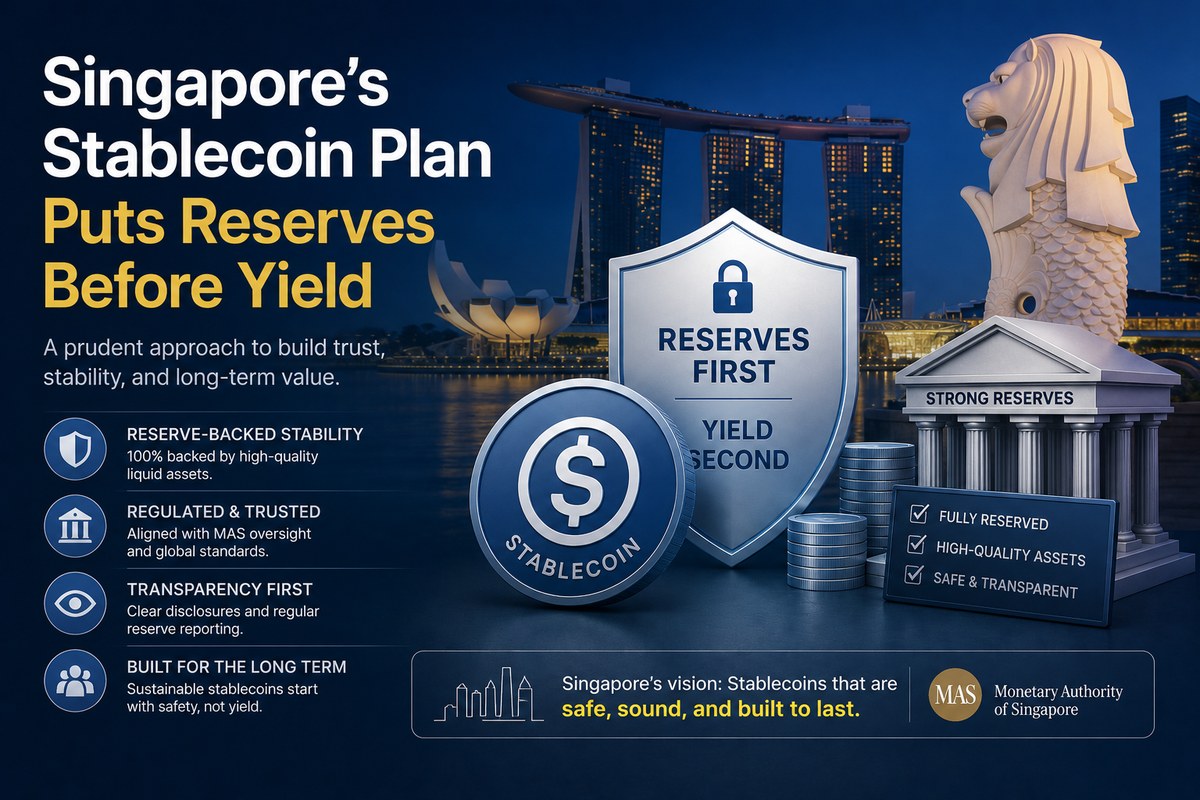
Singapore is moving closer to turning its stablecoin framework into enforceable legislation. On September 1, the Monetary Authority of Singapore (MAS) opened a consultation on amendments to the Payment Services Act covering reserve requirements, redemption, issuer safeguards and the treatment of foreign-issued stablecoins.
One proposal stands out for users evaluating stablecoins as both payment instruments and crypto-market infrastructure: MAS wants regulated issuers to maintain reserves equal to at least 100% of outstanding tokens while prohibiting interest or other benefits paid simply for holding the stablecoin.
The combination is important. Singapore is effectively separating two ideas that are often blurred in crypto markets: a stablecoin’s ability to preserve and redeem its nominal value, and the yield that users may earn elsewhere by deploying it.
For MyCoinWay users, that makes the most useful signals familiar ones: deviations from the peg, liquidity across venues, redemption conditions and unusually wide exchange spreads — not an advertised yield percentage alone.
What happened
MAS published its consultation on September 1 as the next legislative step for Singapore’s Single-Currency Stablecoin framework. The proposed amendments would determine which issuers may qualify as regulated stablecoin issuers and which safeguards they must maintain around value stability, capital, redemption at par and disclosure.
Only issuers licensed under the framework would be able to represent their tokens as “MAS-regulated stablecoins.” Stablecoins outside that framework would continue to be treated as Digital Payment Tokens under Singapore’s existing regulatory structure.
Among the most consequential proposals is a requirement for reserve assets worth at least 100% of stablecoins in circulation. CoinDesk reports that the reserves would need to remain segregated from the issuer’s own assets and be held with licensed financial institutions.
MAS is also proposing to prohibit regulated stablecoin issuers from paying interest or other benefits linked simply to a customer holding the token. The regulator’s stated position is that stablecoins may function as payment and settlement assets but should not be presented to the public as deposit-like investment products for generating yield.
The consultation goes further than domestic issuance. MAS is considering a pathway for a limited number of foreign stablecoins regulated under comparable overseas regimes, as well as arrangements for stablecoins jointly issued in Singapore and another jurisdiction.
Additional proposals include stress testing, recovery and orderly wind-down planning for regulated issuers. The consultation closes on October 16. No final implementation date has yet been announced.
Why 100% backing does not eliminate depeg risk
A requirement for full reserves is important, but it should not be interpreted as a guarantee that a stablecoin can never trade below $1 or its reference currency.
A market peg and reserve coverage measure different things.
Reserve coverage asks whether the issuer holds enough eligible assets to support the outstanding tokens.
The secondary-market price asks whether traders are currently willing and able to exchange those tokens near par.
Those two measurements normally reinforce each other, but they can temporarily diverge.
During market stress, a fully backed stablecoin can still trade at a discount if redemption channels become congested, banking rails are unavailable, exchanges suspend transfers or market makers reduce liquidity. Conversely, a token may trade very close to $1 for an extended period even when users have incomplete information about the quality or accessibility of its reserves.
That is why the MAS framework matters beyond the headline “100% backed.” Segregation of reserves, redemption rights, custody arrangements, disclosures and recovery planning all influence whether backing can actually translate into reliable convertibility.
For market monitoring, peg deviation remains a live signal even under strict regulation.
The yield ban changes where risk appears
The proposed prohibition on issuer-paid yield does not mean Singapore wants to prevent all economic use of stablecoins.
It means that the stablecoin itself should not be marketed as though holding it automatically generates a deposit-like return.
That distinction shifts the yield question downstream.
A user may still move a stablecoin into lending markets, liquidity pools or other DeFi strategies capable of generating returns. But in that situation the yield comes with a second layer of risk: smart contracts, borrowers, liquidity pools, token incentives or other counterparties.
This is an important analytical separation.
If Stablecoin A offers no native yield but is deposited into a protocol paying 6%, the 6% is not evidence that the stablecoin’s reserves themselves generate a risk-free return for the user.
Regulators in other major jurisdictions have moved in a similar direction. CoinDesk notes that Singapore’s proposed restriction is aligned with approaches in the United States and European Union that separate regulated stablecoin issuance from yield-bearing products.
For users, the practical question becomes: who is actually paying the yield, and which additional risks must be accepted to receive it?
Foreign stablecoins may be the more important market change
The proposed recognition of some foreign-issued stablecoins could ultimately matter more to crypto-market liquidity than the yield restriction.
Singapore is an important financial and trading hub, while the dominant stablecoins are global instruments. A framework that recognizes selected overseas tokens under comparable regulatory regimes could make cross-border settlement more interoperable without requiring every stablecoin to be independently issued inside Singapore.
MAS specifically links this discussion to cross-border wholesale use cases and tokenized financial markets.
But recognition would also create a new distinction between stablecoins that satisfy an accepted regulatory framework and tokens that remain ordinary Digital Payment Tokens in Singapore.
That could affect which assets institutions are willing to use for settlement, which stablecoins exchanges support in regulated products and where liquidity concentrates.
It should not, however, be assumed that recognition automatically produces deeper liquidity. The market will still determine whether users, exchanges and market makers actually adopt a token.
Market reaction: watch structure rather than price
There is little reason to expect a consultation document by itself to produce a directional move in major stablecoins. The proposals are not yet final rules, and no implementation date has been announced.
The useful signals will emerge over a longer horizon.
If Singapore-regulated stablecoins begin to scale, watch whether their secondary-market spreads remain tight during volatile periods. If foreign stablecoins gain recognition, monitor whether local exchange liquidity and trading pairs migrate toward the recognized assets.
The most revealing periods will not necessarily be quiet markets. Stablecoin quality becomes easiest to distinguish when redemption demand rises and market makers need to convert large positions close to par.
A token that stays at $1 only when liquidity is abundant has demonstrated less than one that maintains efficient redemption and narrow spreads during stress.
What to watch next
- Peg deviations: monitor persistent discounts or premiums rather than isolated ticks away from $1 or the reference currency.
- Redemption performance: once the regime is implemented, actual redemption speed and accessibility will matter as much as reserve ratios.
- Cross-exchange spreads: widening differences may reveal fragmented liquidity or stress in transfer and redemption routes.
- Foreign stablecoin recognition: watch which overseas frameworks and tokens MAS ultimately considers comparable.
- Reserve and issuer disclosures: changes in reserve composition, custody arrangements and stress-test reporting will help distinguish nominal backing from operational resilience.
For MyCoinWay, stablecoin depeg monitoring and cross-exchange spreads are directly relevant here: regulation can strengthen the framework around a token, but live market data still shows whether that framework is working under real trading conditions.
Disclaimer
This article is for informational and analytical purposes only. It does not constitute investment, legal or tax advice, a recommendation to buy, sell or hold a stablecoin, or a promise of future returns. The MAS proposals remain under consultation and may change before becoming law. Stablecoins carry issuer, reserve, liquidity, custody, regulatory and blockchain risks.
Sources
Monetary Authority of Singapore consultation, as reported from the MAS announcement — TNGlobal coverage of the MAS statement
CoinDesk — reserve requirements, yield restriction and foreign-stablecoin proposal — CoinDesk report
The Straits Times — independent Singapore coverage of the consultation — The Straits Times report
The Business Times — independent coverage of the proposed MAS-SCS framework — The Business Times report