21Shares Puts Staking at the Center of Five US Crypto ETFs
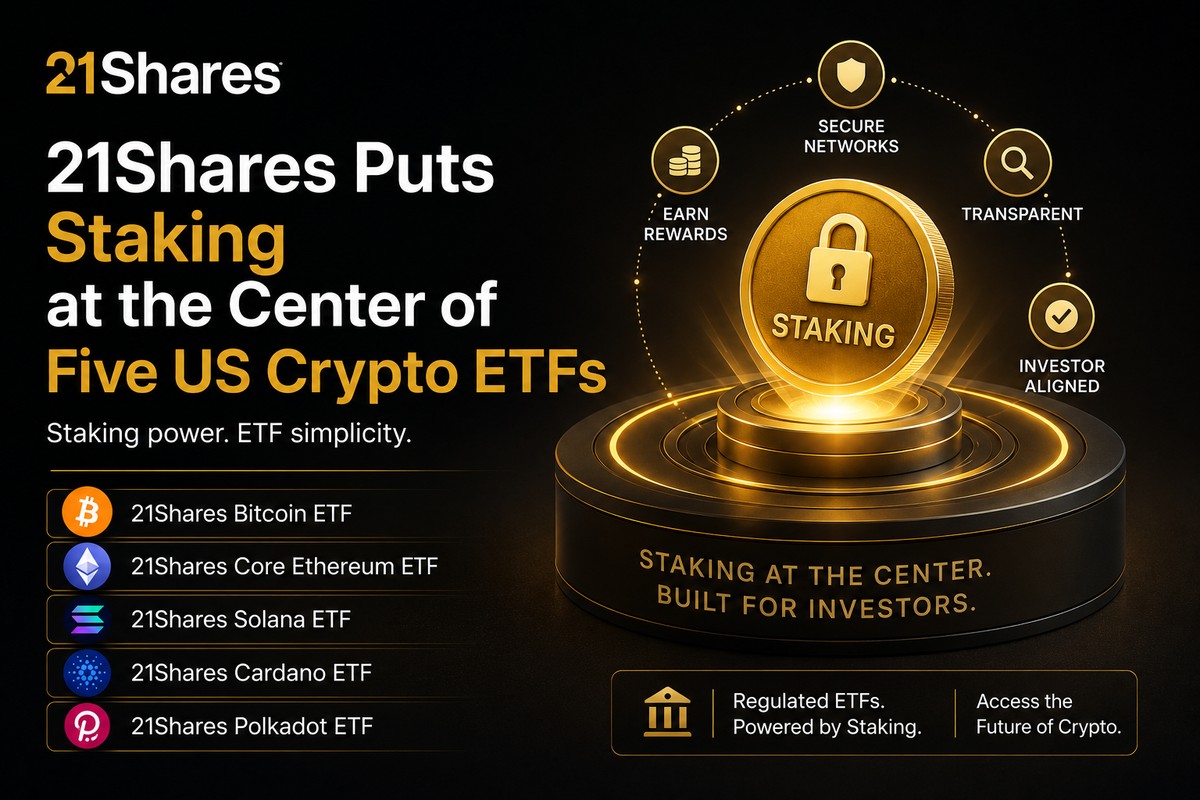
21Shares Puts Staking at the Center of Five US Crypto ETFs
A subtle but meaningful change has arrived in the US crypto ETF market: staking is moving from a technical feature in product documentation to a visible part of how regulated crypto products are presented to investors.
On August 27, 21Shares updated the names of five US-listed single-asset ETFs so their staking functionality is explicit. The change covers products tracking Ethereum, Solana, Polkadot, Sui and Hyperliquid.
This is not the same as suddenly adding staking to five previously passive funds. The more precise interpretation is that 21Shares has made an existing product feature much more prominent. That distinction matters. The market signal here is less about a one-day catalyst for token prices and more about the evolution of how proof-of-stake assets are packaged for traditional investment accounts.
What happened
Effective at the opening of trading on August 27, 21Shares renamed five products:
- TETH became the 21Shares Ethereum Staking ETF.
- TSOL became the 21Shares Solana Staking ETF.
- TDOT became the 21Shares Polkadot Staking ETF.
- TSUI became the 21Shares Sui Staking ETF.
- THYP became the 21Shares Hyperliquid Staking ETF.
In its announcement, 21Shares listed staking yields of 0.80% for TETH, 4.45% for TSOL, 2.04% for TDOT, 1.13% for TSUI and 1.33% for THYP. These figures should not be interpreted as fixed or guaranteed returns.
The change is also visible in regulatory documentation. SEC filings identify the Ethereum and Solana products under their new staking names.
For example, 21Shares describes TSOL as maintaining spot SOL exposure while reflecting rewards from staking a portion of the trust's SOL when the sponsor determines that doing so does not create undue legal or regulatory risk. The product page says staking rewards are distributed to shareholders in cash quarterly, net of fund expenses, and explicitly warns that reward rates are variable.
Separately, 21Shares also shifted selected US products to FTSE Russell digital-asset benchmarks on August 27, part of a broader effort to standardize its benchmark architecture across the US, Europe and Australia.
Why this matters
The interesting question is not whether staking exists. Native staking has been central to proof-of-stake networks for years. The question is whether regulated exchange-traded products can transmit some of that network economics to investors who never hold tokens directly.
A conventional spot crypto ETF mainly packages price exposure. A staking-enabled structure potentially adds another component: rewards generated by participating in network validation.
That can change how investors compare products tracking the same underlying asset. Expense ratios, liquidity and tracking error remain important, but investors may increasingly examine the proportion of assets staked, net staking rewards, validator arrangements, distribution policies and operational risks.
For networks such as Ethereum and Solana, that also creates a bridge between two previously distinct markets: on-chain staking and securities traded through brokerage accounts.
The development should not be interpreted as evidence that ETH, SOL or other affected tokens must appreciate. ETF naming changes do not alter the fundamental supply-demand balance by themselves. Their importance is structural: staking is becoming easier to identify as part of the regulated investment wrapper.
Market reaction and the risks behind staking yield
It would be misleading to attribute short-term moves in ETH, SOL or other tokens directly to the 21Shares announcement. Crypto prices respond simultaneously to macro conditions, ETF flows, derivatives positioning, liquidity and asset-specific developments.
A better way to evaluate the significance is to watch whether staking-focused products attract incremental capital over time.
There are also risks behind the headline yield.
Staking rewards fluctuate with network conditions. Validator performance can affect realized returns, while operational or protocol events can introduce additional uncertainty. An ETF investor also does not have the same control as a native token holder: the sponsor, custodian and staking arrangements sit between the investor and the underlying network.
Liquidity deserves particular attention. Assets committed to staking may have different withdrawal or activation mechanics depending on the blockchain. During periods of market stress, the interaction between ETF creations and redemptions, liquid token reserves and staked assets can become more important.
Investors should therefore distinguish between a network's headline staking rate and the actual net reward delivered by a fund.
What to watch next
- ETF flows and trading volume. Rising assets under management and sustained net creations would provide stronger evidence that investors value staking-enabled exposure than a one-day price move.
- Net staking rewards. Compare what shareholders actually receive with network-level staking rates. Fees, validator economics and the percentage of assets staked can create meaningful differences.
- ETH and SOL funding rates. If ETF interest coincides with sharply positive perpetual funding, part of the market move may be leverage-driven rather than purely spot demand.
- Spot and inter-exchange spreads. Wider spreads or sudden volume spikes around ETH, SOL and smaller proof-of-stake assets can reveal temporary liquidity stress. MyCoinWay users can combine these signals with funding and spread monitoring rather than treating ETF headlines in isolation.
- Regulatory and product updates. Watch whether other US issuers make staking a similarly explicit component of their products and whether distribution, custody or staking policies change.
The Market Pulse takeaway
The August 27 changes are notable because they make staking visible at the product-name level across five US-listed crypto ETFs. That is a stronger signal about product design than about immediate token prices.
If the model gains traction, competition among crypto ETFs may increasingly move beyond fees and brand recognition toward a more complex question: how efficiently can a regulated product capture the economics of the underlying blockchain?
For traders, the relevant evidence will come from flows, volumes, funding rates, spreads and realized staking distributions—not from the word “staking” appearing in an ETF name.
Sources
- 21Shares — Product Name Updates Across US Staking ETF Suite
- SEC — 21Shares Ethereum Staking ETF Form 8-K
- SEC — 21Shares Solana Staking ETF Form 8-K
- 21Shares — TSOL product information
- FTSE Russell/LSEG — Global Benchmark Partnership with 21Shares
Disclaimer: This material is for informational and analytical purposes only. It does not constitute investment, legal or tax advice, or a recommendation to buy, sell or hold any digital asset or financial product. Crypto assets and crypto-linked products involve substantial risk.