BSOL Hit $1B — Then Fell Below It: What the Gap Shows
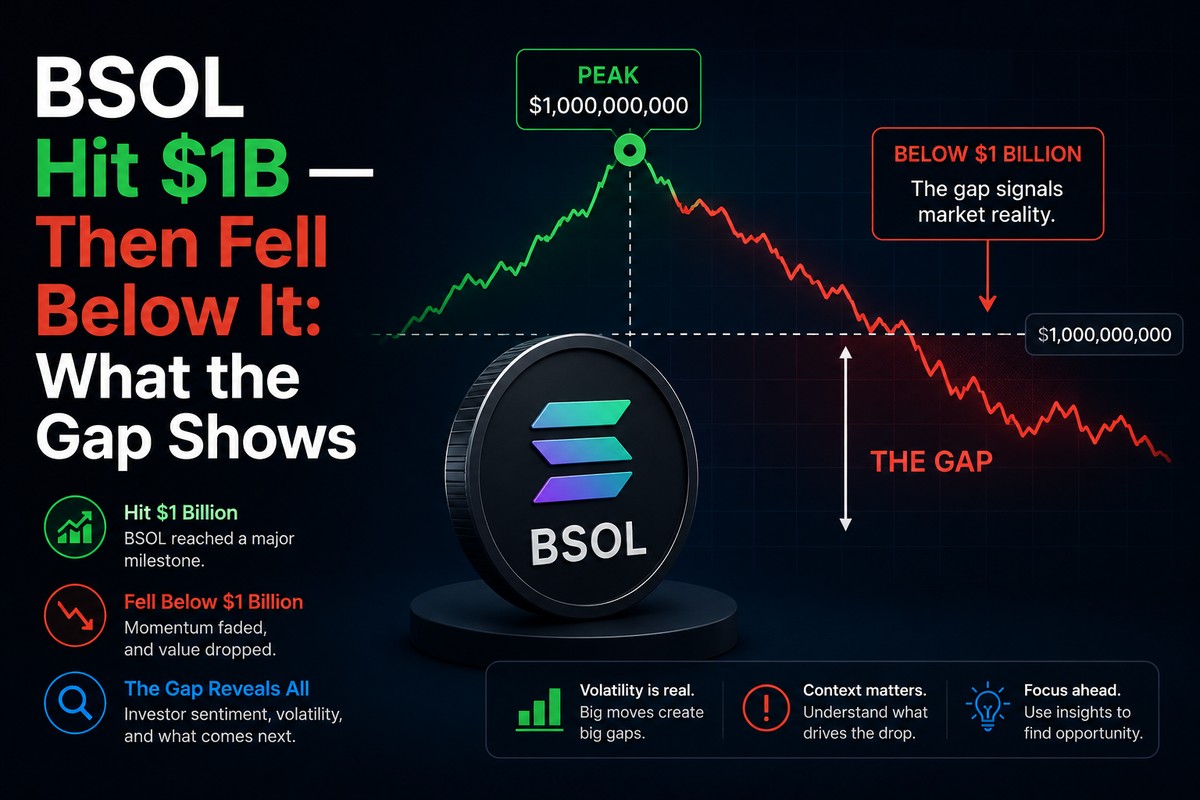
Bitwise’s Solana Staking ETF, BSOL, crossed the $1 billion assets-under-management threshold this week, becoming the first US Solana ETF to reach that level. But the more revealing data point came immediately afterward: Bitwise’s own fund page showed net assets falling back below $1 billion even as the amount of SOL held by the fund increased.
That apparent contradiction is the real Market Pulse signal.
ETF assets under management are not the same thing as cumulative investor inflows. For a single-asset crypto product, AUM can fall because the underlying token declines even while investors continue adding capital. Conversely, rising AUM can be driven partly by asset appreciation without equivalent new demand.
For traders watching institutional adoption of Solana, separating those variables is more useful than treating the $1 billion headline as a directional signal for SOL.
What happened
The Block reported on August 28 that BSOL had become the first Solana ETF to cross $1 billion in assets under management, roughly ten months after launch. The publication also reported that BSOL accounted for more than half of total Solana ETF assets.
Bitwise’s own data confirms that the threshold was reached. As of August 26, the fund reported approximately $1.018 billion in net assets and held about 9.33 million SOL.
One day later, however, the picture had changed. Bitwise’s updated page showed 9.44 million SOL in the trust — more tokens than before — but only about $976.3 million in AUM. In other words, the fund’s SOL holdings expanded while the dollar value of those holdings declined.
This is not evidence that investors suddenly withdrew enough money to reverse the milestone. It demonstrates how quickly the market value of a crypto ETF can change with its underlying asset.
FinanceFeeds, citing SoSoValue data, reported that BSOL took in $40.2 million on August 27, representing about 66% of the $60.91 million entering the group of US Solana ETFs that day. It placed BSOL’s cumulative inflows at roughly $1.01 billion.
That distinction — roughly $1 billion of accumulated net flows versus an AUM figure moving above and below $1 billion with SOL prices — is central to understanding the event.
Why the $1 billion milestone matters
BSOL launched in October 2025 as a product providing direct SOL exposure together with staking. Bitwise currently targets 100% of the fund’s SOL for staking and reported that 100% was staked as of August 27. Its disclosed 90-day average net staking reward rate was 5.80%, versus a gross rate of 6.17%. Bitwise explicitly warns that those rewards can change and are not guaranteed.
Reaching $1 billion is therefore meaningful in two ways.
First, it shows that regulated Solana exposure has attracted substantial capital despite the volatility of the underlying token. Second, it provides a live test of whether staking can differentiate one crypto ETP from competitors that offer similar spot exposure.
But neither conclusion means that $1 billion is a price signal for SOL.
An ETF can receive fresh capital while SOL falls. It can also gain AUM during a SOL rally even with modest inflows. To understand institutional demand, flows and holdings need to be evaluated alongside the token price.
The market signal is flows, not AUM alone
Consider the August 26–27 movement.
The number of SOL held by BSOL increased from roughly 9.33 million to 9.44 million, while reported AUM moved from just above $1 billion to about $976 million.
That is exactly why headline AUM can mislead during volatile sessions.
For Market Pulse readers, four layers should be separated:
Net flows show whether money is entering or leaving the fund.
SOL holdings show whether the fund is accumulating or reducing the underlying token.
SOL market price determines the dollar value of those holdings.
Staking rewards gradually increase the economic return generated by assets committed to validators, but they do not protect the product from large spot-price declines.
A 5.80% annualized net staking reward rate, for example, should not be interpreted as a 5.80% downside buffer. Crypto volatility can overwhelm an annual staking yield in a much shorter period.
Liquidity matters as much as demand
The ETF’s trading mechanics provide another useful signal.
Bitwise reported a 30-day median bid-ask spread of 0.10%. On August 26, BSOL’s NAV was $14.95 while its market price was $15.03, corresponding to a 0.56% premium.
Small premiums and discounts are normal in exchange-traded products, but persistent widening can indicate greater friction between secondary-market trading and the value of the underlying holdings.
That question is particularly relevant for a staking ETF. Bitwise says it seeks to stake 100% of the fund’s SOL. The product therefore has to reconcile staking participation with the liquidity needed for creations, redemptions and orderly share trading.
For MyCoinWay users, this makes several cross-market signals relevant: SOL spot liquidity, inter-exchange spreads, unusual volume spikes and perpetual-futures funding rates. If ETF demand strengthens while derivatives become heavily leveraged in one direction, the combination tells a different story than ETF inflows alone.
What the milestone does not prove
BSOL crossing $1 billion does not prove that SOL is undervalued, that institutional demand will continue at the same rate, or that Solana ETFs will necessarily produce positive returns.
Nor does staking eliminate market risk.
Bitwise itself notes that BSOL is not the same as directly holding SOL and that the product carries significant volatility and the possibility of substantial or complete loss. It is also structured as an ETP that is not registered under the Investment Company Act of 1940 and therefore does not receive all of the protections applicable to registered mutual funds and ETFs.
The milestone is better understood as evidence that a meaningful regulated distribution channel for Solana now exists.
Whether that channel continues expanding is a question for subsequent data.
What to watch next
- Daily and cumulative ETF flows: these are cleaner measures of investor demand than AUM alone.
- SOL held by BSOL: rising token holdings alongside falling AUM can reveal accumulation hidden by price weakness.
- Premium/discount and bid-ask spread: persistent widening may indicate liquidity stress or less efficient arbitrage.
- Staking reward rate: track the net rate, the share of assets staked and any changes in validator economics.
- SOL spot and derivatives: monitor volume spikes, inter-exchange spreads and funding rates to see whether ETF demand is being accompanied by broader leverage or spot accumulation.
The key takeaway is simple: the next important BSOL number is not whether its AUM prints $1 billion again. It is whether net inflows, token holdings and market liquidity continue to strengthen independently of short-term SOL price swings.
Disclaimer
This article is for informational and analytical purposes only. It does not constitute investment, legal or tax advice, a recommendation to buy or sell SOL, BSOL or any other financial instrument, or a promise of future returns. Cryptoassets, staking and exchange-traded products involve market, liquidity, custody, validator, operational and regulatory risks.
Sources
Bitwise — BSOL fund data, holdings, AUM, staking rates and liquidity metrics. Official BSOL fund page
The Block — reporting on BSOL becoming the first Solana ETF to cross $1 billion in AUM. The Block report
FinanceFeeds — Solana ETF flows and BSOL’s share of August 27 inflows. FinanceFeeds analysis
Bitwise — original BSOL launch documentation and staking structure. Bitwise launch announcement