Hashdex ETF Closure: How Liquidity Fragmentation is Forcing Bitcoin Consolidation
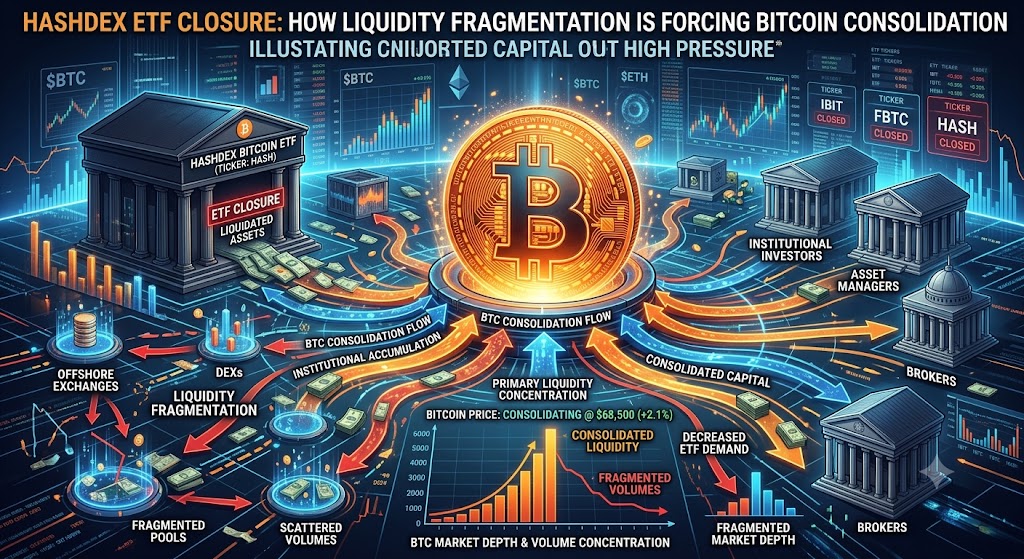
The cryptocurrency market is an ecosystem defined by relentless innovation and brutal efficiency. At the beginning of the year, the approval and launch of spot Bitcoin Exchange-Traded Funds (ETFs) in the United States was heralded as the ultimate victory for institutional adoption. A flood of issuers rushed to market, promising Wall Street seamless access to digital gold. However, as the initial euphoria settles in the dog days of August 2026, the harsh reality of market mechanics is taking hold. We are officially entering the consolidation phase of the spot Bitcoin ETF wars.
On August 3, 2026, Hashdex Asset Management filed an announcement with the SEC—subsequently reverberating through the market over the last 48 hours—detailing the closure and liquidation of the Hashdex Bitcoin ETF (ticker: DEFI). As of late July, the fund held approximately $14.7 million in Assets Under Management (AUM). Despite Hashdex successfully managing over $200 million across other products, the DEFI fund succumbed to the fatal trio of the ETF industry: low AUM, limited trading liquidity, and unsustainable operating costs.
As a Senior Editor and Analyst at MyCoinWay, I view the closure of the Hashdex Bitcoin ETF not as a failure of Bitcoin, but as a critical mechanical event that active traders must dissect. While $14.7 million is a drop in the ocean compared to Bitcoin’s $1.2 trillion market capitalization, the mechanics of how an ETF winds down physically held digital assets provide a masterclass in reading order book dynamics, volume spikes, and inter-exchange spreads.
The "Winner-Takes-All" Liquidity Paradox
To understand why an ETF backed by the world's most popular digital asset is shutting down, we must examine the "winner-takes-all" nature of institutional liquidity. Institutional capital allocators, registered investment advisors (RIAs), and high-frequency trading firms prioritize liquidity above all else. They require the ability to enter and exit massive positions without incurring significant slippage.
Consequently, liquidity begets liquidity. Giant funds from issuers like BlackRock and Fidelity absorbed the lion's share of early capital inflows, creating deep, highly liquid secondary markets for their ETF shares. Mid-tier and boutique issuers like Hashdex were left fighting for scraps. Without sufficient trading volume, the bid-ask spreads on the DEFI ETF shares widened, making the product even less attractive to new investors. This vicious cycle of low volume leading to wider spreads and higher operating overhead ultimately forced the sponsor's hand. This consolidation phase is a natural, albeit ruthless, maturation of the market.
The Mechanics of Scheduled Liquidation
The most actionable aspect of this event is the timeline and mechanics of the liquidation process. When a traditional equity ETF closes, it sells highly liquid stocks on the NASDAQ or NYSE. When a spot Bitcoin ETF closes, it must physically liquidate its on-chain or custodied Bitcoin holdings.
According to the official filing, shareholders have until August 17, 2026, to sell their DEFI shares on the open market. Following this Last Trading Day, the fund will stop accepting creation orders from Authorized Participants (APs) and will be delisted. The critical window for crypto traders opens immediately after: the fund will then liquidate its remaining Bitcoin holdings to distribute cash to remaining shareholders on or about August 28, 2026.
This creates a scheduled, mechanical selling event. The fund's custodian will be tasked with offloading millions of dollars worth of spot Bitcoin within a specific timeframe. Because the fund must ensure fair execution for its shareholders, this liquidation is not speculative—it is a forced, price-agnostic sell-off.
Market Pulse: Arbitrage and Inter-Exchange Spreads
For active market participants utilizing platforms like MyCoinWay, scheduled liquidations are highly anticipated events. While the total volume of the Hashdex liquidation is relatively small, it perfectly illustrates the trading strategies deployed during ETF unwinds.
First, consider the impact on inter-exchange spreads. When a custodian liquidates physical Bitcoin, they typically execute these trades through institutional OTC desks or directly on specific tier-1 centralized exchanges (such as Coinbase or Gemini, which serve as custodians for many US ETFs). This concentrated, localized selling pressure can create momentary volume spikes and thin out the bid-side order book depth on that specific exchange. Arbitrageurs who actively monitor cross-exchange pricing can capitalize on these fleeting price deviations, buying the temporarily discounted Bitcoin on the liquidating exchange and simultaneously selling it at a premium on other global venues.
Second, the derivatives market often overreacts to the psychological optics of an ETF closing. Retail traders, mistaking routine fund consolidation for a fundamental bearish signal, may aggressively short the market. This speculative behavior compresses perpetual futures funding rates. If funding rates turn deeply negative during the August 17-28 liquidation window, it indicates an overcrowded short trade. Smart money will recognize that the spot selling pressure is capped at $14.7 million and will look for opportunities to trigger a short squeeze, trapping over-leveraged bears.
What to Track Next
The closure of the Hashdex Bitcoin ETF is the first domino in what will likely be a broader consolidation of the crypto ETF space. Active traders must stop relying on broad market sentiment and focus strictly on execution mechanics.
Here are the critical metrics to track in the coming weeks:
- Spot Order Book Depth: During the August 17 to August 28 liquidation window, meticulously monitor the bid-side liquidity on major US-based spot exchanges. Look for abnormal volume spikes that indicate the fund's custodian is actively executing sell orders.
- Inter-Exchange Spreads: Utilize the MyCoinWay Market Pulse tools to track price deviations between US-based custodians and global offshore exchanges. Widening spreads offer low-risk, delta-neutral arbitrage opportunities.
- Perpetual Funding Rates: Watch the funding rates for BTC perpetual swaps. If the broader market misinterprets the ETF closure and heavily shorts the asset, deeply negative funding rates will provide a contrarian long signal.
- AUM of Competing Mid-Tier ETFs: The Hashdex closure puts a spotlight on other underperforming spot ETFs. Track the daily net flows and AUM of funds managing less than $50 million. Further closures will create similar, predictable liquidation events.
The maturation of the cryptocurrency market demands a highly mechanical approach to trading. By understanding the structural plumbing behind ETF creations, redemptions, and liquidations, traders can transform seemingly negative news into actionable, risk-adjusted strategies.
Disclaimer: This article is for informational and analytical purposes only. It does not constitute financial, investment, or legal advice. Cryptocurrency markets are highly volatile, and mechanical liquidations can lead to unpredictable price action. Always conduct your own research before executing trades.
Sources:
- Hashdex Asset Management SEC Form 8-K / Press Release: "Hashdex Announces Closure of Hashdex Bitcoin ETF" (August 3, 2026).
- Mitrade Market Insights on the DEFI ETF Liquidation (August 5, 2026).